Quick summary: Animal thermoregulation involves the mechanisms by which organisms keep body temperature within a functional range. To understand this topic clearly, it is essential to separate concepts that are often mistakenly treated as equivalents. Ectothermy and endothermy refer to the main source of body heat, whereas homeothermy, poikilothermy, and heterothermy refer to the pattern of body temperature variation. In this article, you will see how heat enters and leaves the body, how ectotherms also thermoregulate, and why body temperature directly affects metabolism, behavior, and biological performance.
Contents
- What thermoregulation is
- The difference between ectothermy and endothermy
- What homeothermy, poikilothermy, and heterothermy are
- Why ectothermy should not be confused with poikilothermy
- How ectotherms also thermoregulate
- How the microenvironment influences thermal regulation
- How animals exchange heat with the environment
- Endothermy and energetic cost
- Physiological integration of thermal regulation
- The thermoneutral zone
- Heterothermy and biological flexibility
- Why body temperature matters so much
- Reviewing the essentials
- Frequently asked questions
Thermal regulation in animals is a topic that often causes confusion because it brings together terms that seem similar but do not mean the same thing. To understand this subject with confidence, it helps to begin with a simple distinction. One question asks where most of the heat influencing body temperature comes from. Another asks whether that temperature tends to remain relatively stable or whether it varies more widely. Once these two questions are kept separate, the concepts begin to fit together much more clearly.
The body temperature of any animal results from a balance between heat gain and heat loss. The body may receive heat from the environment, it may produce heat through metabolism, and it may continuously lose heat to the surrounding medium. Body temperature, therefore, is neither an isolated value nor a fixed and immutable trait. It reflects the outcome of constant energy exchanges between the organism and the environment in which it lives. That is why thermal physiology must be understood as an integrative topic: it involves metabolism, behavior, environmental conditions, circulation, gas exchange, and biological performance.
Before moving further, it is worth organizing the fundamental concepts. Some terms describe the predominant source of body heat. Others describe the pattern of body temperature variation. Still others refer to the degree of control the organism exerts over this system. When all these ideas are mixed together, the topic seems far more difficult than it actually is.
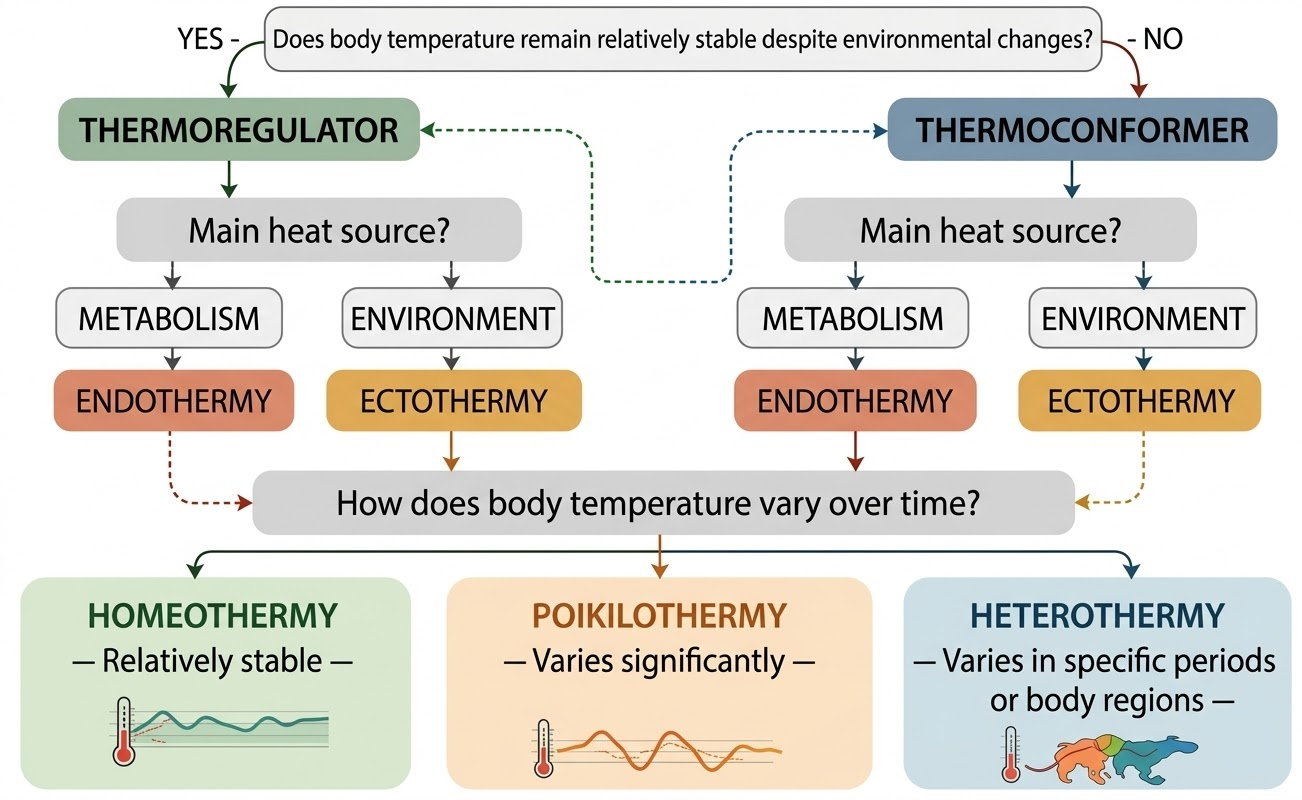
The figure above helps visualize this organization. In it, a thermoregulator appears as an organism that keeps body temperature within a relatively narrow functional range, whereas a thermoconformer tends to track environmental conditions more closely. At another level, the figure separates endothermy and ectothermy according to the main source of heat. Finally, it distinguishes homeothermy, poikilothermy, and heterothermy according to the pattern of body temperature variation. At this stage, the most important point is to recognize that these terms do not compete with one another as if they all described the same kind of phenomenon. They answer different questions about the same biological process.
What thermoregulation is
Thermoregulation is the set of mechanisms by which an organism maintains body temperature, or the temperature of certain tissues, within a range compatible with proper function. This does not mean an absolutely fixed temperature. Rather, it means maintenance around functional limits. Life depends on this relative stability because the body’s molecules, cell membranes, proteins, enzymes, and physiological systems as a whole respond to temperature.
Why body temperature must remain within a functional range
When temperature shifts too far away from the appropriate range, bodily function begins to deteriorate. Chemical reactions may become too slow or too fast, proteins may lose their proper conformation, muscle activity may change, nerve conduction may be impaired, and the organism’s overall performance may decline. For this reason, keeping temperature within levels compatible with life is not a secondary detail. It is a central requirement for the maintenance of biological activity.
How thermoregulation takes place
Thermoregulation may occur through physiological mechanisms, behavioral mechanisms, or a combination of both. In some animals, it depends heavily on internal heat production and on finely tuned internal adjustments. In others, it depends mainly on how the organism uses the surrounding environment. In both cases, the goal is the same: to prevent body temperature from moving too far outside the range in which the organism functions properly.
The difference between ectothermy and endothermy
Ectothermy and endothermy are concepts related to the predominant source of body heat.
What ectothermy is
Ectotherms are animals in which external heat sources play the predominant role in determining body temperature. In these organisms, the environment strongly influences body temperature. Solar radiation, air temperature, soil temperature, water temperature, and the temperature of surrounding surfaces can all substantially affect the temperature of the body. This does not mean that these animals do not produce metabolic heat. Every living organism produces heat as a result of metabolism. The decisive point is that, in ectotherms, this internal heat production is generally not sufficient to become the principal determinant of body temperature.
What endothermy is
Endotherms, in contrast, are animals in which metabolic heat production plays the predominant role in determining body temperature. In them, metabolism generates enough heat to play a central role in maintaining body temperature. This is the typical condition found in birds and mammals. In these animals, heat production is not merely an unavoidable consequence of metabolic reactions. It directly participates in the body’s thermal balance.
The correct distinction between ectothermy and endothermy
The distinction between ectothermy and endothermy must be understood precisely. These terms do not, by themselves, indicate whether body temperature is stable or variable. Above all, they refer to the predominant source of the heat that influences that temperature. For that reason, an ectothermic animal is not defined by always having a low body temperature, nor is an endothermic animal defined simply by having a high one. The central point is the dominant source of body heat.
What homeothermy, poikilothermy, and heterothermy are
Homeothermy, poikilothermy, and heterothermy refer to the pattern of body temperature variation.
What homeothermy is
A homeothermic animal maintains a relatively stable body temperature. The expression “relatively stable” matters because no real body temperature is perfectly invariable. Even in humans, temperature fluctuates throughout the day and changes with sleep, physical exercise, fever, and other conditions. Thus, homeothermy does not mean absolute rigidity, but maintenance within a relatively narrow range.
What poikilothermy is
A poikilothermic animal has a more variable body temperature. In these cases, body temperature tends to track environmental changes or external conditions more closely. This does not mean the absence of physiological organization. It simply means that thermal stability is lower and that body temperature may fluctuate more widely.
What heterothermy is
Heterothermy refers to situations in which body temperature varies significantly over time or among different regions of the body. Some animals may maintain relative thermal stability under certain circumstances and show major variation under others, as during torpor or hibernation. In other cases, certain parts of the body may remain warmer or cooler than others. Heterothermy shows that real biology does not always fit neatly into rigid and absolute categories.
The following figure helps bring these ideas together into a single overview, showing that the source of body heat and the degree of temperature constancy are different dimensions.
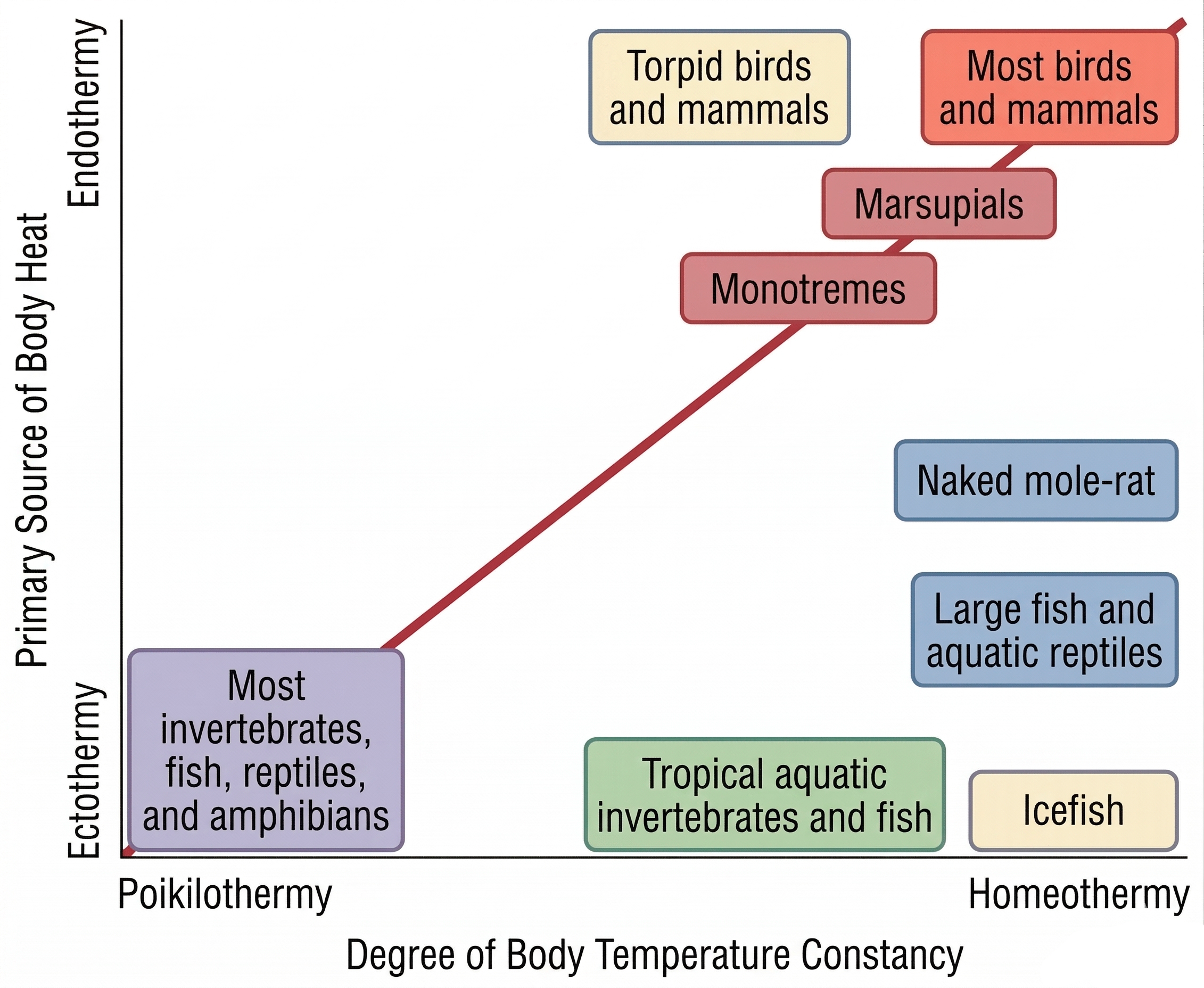
When looking at this figure, it becomes clear that animals can be distributed across a plane defined by two axes. On the vertical axis appears the predominant source of thermal energy, ranging from ectothermy to endothermy. On the horizontal axis appears the degree of constancy of body temperature, ranging from poikilothermy to homeothermy. This arrangement reveals something very important: the concepts are not synonyms. Different combinations occur in nature, including intermediate cases. For that reason, thermal physiology should not be reduced to simplified pairings such as “ectothermic equals poikilothermic” or “endothermic equals homeothermic.”
The figure also helps show that real organisms occupy different positions within this conceptual space. Most birds and mammals cluster toward endothermy and homeothermy, whereas most invertebrates, fish, amphibians, and reptiles lie closer to ectothermy and poikilothermy. Intermediate and unusual cases, however, remind us that these are biological tendencies rather than perfectly rigid categories.
Why ectothermy should not be confused with poikilothermy
The problem with oversimplified equivalences
A very common mistake is to treat ectothermy as though it were the same thing as poikilothermy, and endothermy as though it were the same thing as homeothermy. This association may seem to work in many familiar examples, but it is not conceptually correct.
An ectotherm may maintain relatively stable body temperature under certain conditions, especially when it can efficiently exploit thermal differences in the environment. Likewise, an endotherm may show substantial drops in body temperature under specific circumstances, as in torpor. This shows that the predominant source of heat and the pattern of body temperature variation are distinct dimensions. Mixing them leads to mistaken interpretations of how animals function thermally.
How ectotherms also thermoregulate
Thermoregulation in ectotherms
Another frequent mistake is to imagine that an ectotherm is a thermally passive organism that simply follows the environment without exerting any form of control. That view is incorrect. Many ectotherms do thermoregulate, but they do so mainly through behavior.
Instead of controlling temperature through intense internal heat production, these animals control their exposure to the environment. A lizard may warm itself in the sun, move into the shade when it begins to overheat, alter its body posture, reduce or increase contact with the substrate, enter burrows, or change its period of activity. In all these cases, the animal does not produce heat in amounts comparable to those of a typical endotherm, but neither does it behave like a thermally inert body. It uses the environment selectively and strategically.
This means that behavioral thermoregulation is a genuine form of regulation. In this case, control is not centered on large-scale internal heat production, but on the ability to exploit the thermal landscape available in the environment. This point matters because it avoids the oversimplified view that ectotherms are organisms devoid of thermal control.
How the microenvironment influences thermal regulation
The microenvironment and the diversity of thermal conditions
Behavioral thermoregulation only makes sense because the environment is not thermally uniform. In a single location, there may be sun-heated surfaces, shaded areas, moist soil, exposed rocks, vegetation, burrows, water at different temperatures, and varying wind intensities. Each of these conditions alters the exchanges of heat between the animal’s body and the environment.
When an ectotherm changes position, therefore, it is not merely moving through space. It is changing the set of physical conditions that determines its thermal balance. Moving from a sun-warmed rock into the shade is not simply a change of place. It is a change in the rates of heat gain and heat loss.
When the thermal options available in the environment are limited, the capacity for regulation is also reduced. If there is no sunlight available, if the substrate is entirely cold, or if the water is uniformly warmer than the organism’s most favorable range, body temperature will tend to track the environment more directly. This shows that behavioral thermoregulation depends not only on the animal, but also on the thermal structure of the environment in which it lives.
How animals exchange heat with the environment
To understand thermal regulation more deeply, it is necessary to examine the main pathways of heat exchange between the body and the environment.
Radiation
Radiation corresponds to heat gain or heat loss through the emission or absorption of radiant energy. Exposure to sunlight is the most obvious example of heat gain by radiation. At the same time, the animal also receives radiation emitted by other environmental surfaces, such as the ground, vegetation, and the atmosphere. In addition, the body itself emits thermal radiation.
Conduction
Conduction is the direct transfer of heat between surfaces in contact. An animal on a heated rock may gain heat by conduction. Likewise, it may lose heat when it comes into contact with a cooler surface.
Convection
Convection involves heat transfer mediated by the movement of air or water around the body. Wind may intensify heat loss, and in aquatic environments convection is often even more important.
Evaporation
Evaporation is a very efficient way of dissipating heat because the change of water from liquid to vapor consumes thermal energy. In animals that use sweating, panting, or other forms of evaporative heat loss, this mechanism can play a major role in body cooling.
The following figure shows these exchanges in an integrated way.
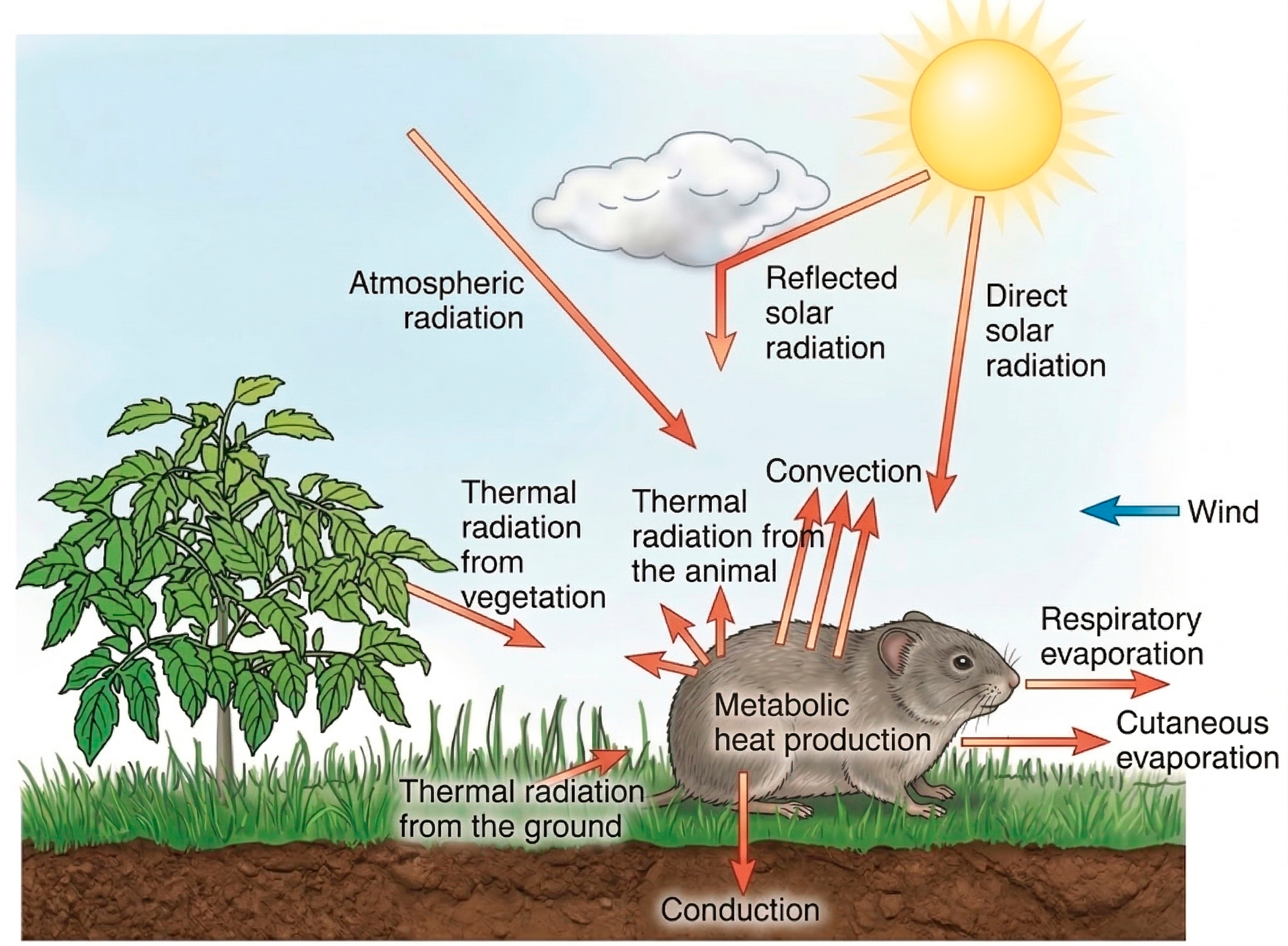
In this figure, the animal appears at the center of several simultaneous flows of energy. The body receives direct solar radiation, reflected solar radiation, atmospheric radiation, and thermal radiation emitted by surrounding surfaces such as vegetation and the ground. At the same time, it loses heat through convection, the emission of thermal radiation, and both respiratory and cutaneous evaporation. In addition, there is conductive heat transfer with the ground and metabolic heat production inside the body. The image makes it clear that body temperature does not depend on a single factor, but on the sum of several exchanges occurring at the same time. For that reason, thermal physiology cannot be understood as a simple response to “cold” or “heat.” The organism is embedded in a continuous network of energetic flows.
Endothermy and energetic cost
In endotherms, internal heat production plays a central role in regulation. This allows greater independence from the environment and favors the maintenance of high and relatively stable body temperatures, even when external temperature drops. However, this advantage comes with an energetic cost.
Producing heat metabolically requires energy expenditure. This means greater food consumption and a higher demand for oxygen. In other words, endothermy-based maintenance of a relatively stable body temperature depends on continuous physiological investment. In some contexts, this heat production may be associated with mechanisms such as thermogenin and, more broadly, with cellular respiration.
This point matters because it prevents the simplistic idea that endothermy is simply a “better” or “more advanced” condition. It is a biological strategy with benefits and costs. In cold environments, the ability to maintain a high body temperature may favor activity, locomotion, feeding, and the functioning of many physiological systems. But that requires energy. In very warm environments, the challenge is no longer only to produce heat, but also to dissipate it, which may also demand substantial physiological effort.
The graph below clearly shows how metabolic cost varies with environmental temperature in ectotherms and endotherms.
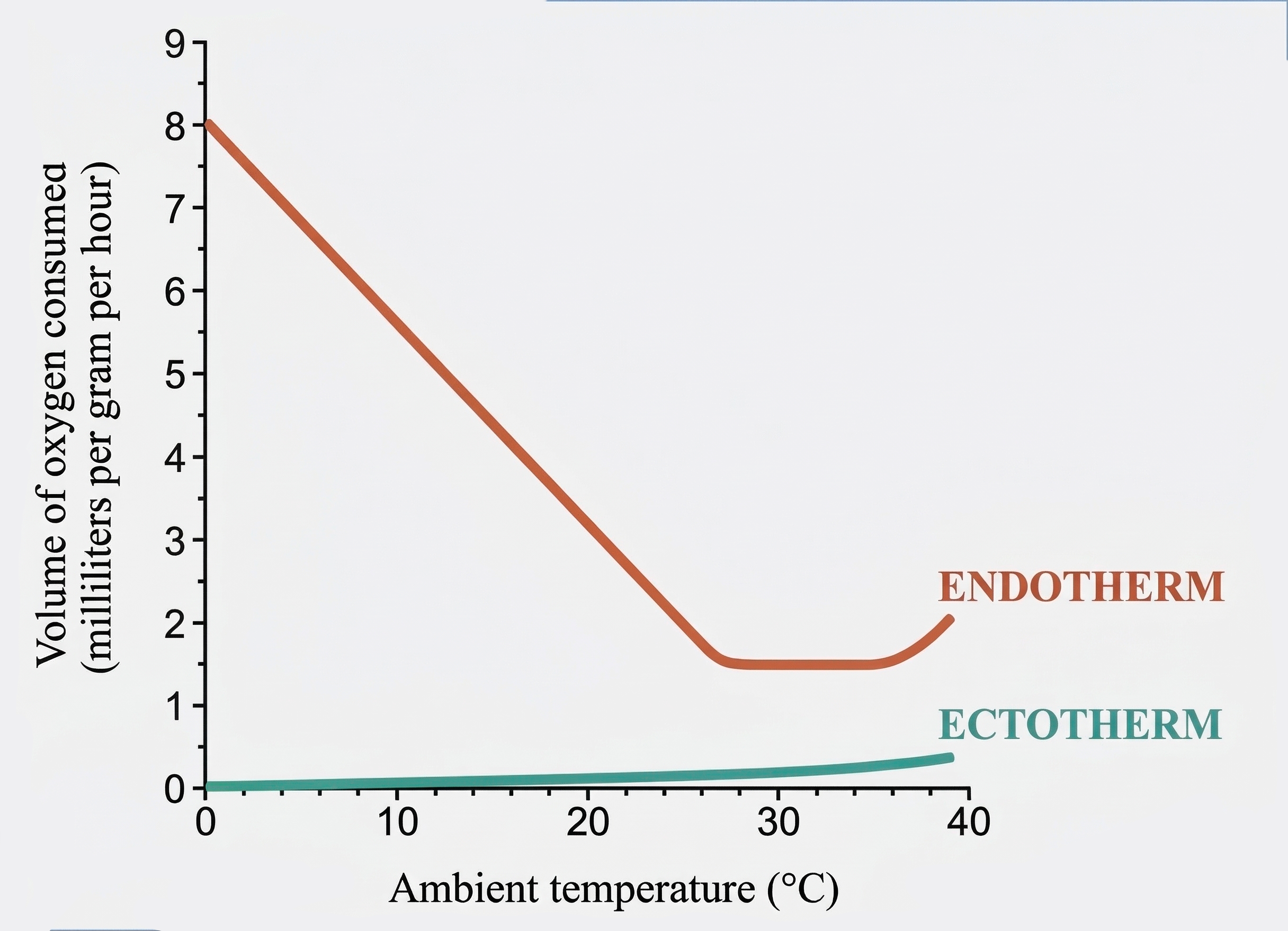
The endotherm curve shows very high oxygen consumption at low environmental temperatures. This occurs because, under these conditions, the organism must increase metabolism in order to produce heat and maintain body temperature. As environmental temperature rises, this cost falls until it reaches a lower-expenditure range. At higher temperatures, oxygen consumption rises again because heat dissipation also requires physiological responses. In the ectotherm, by contrast, oxygen consumption remains much lower throughout the entire range, but tends to increase as environmental temperature rises, following the increase in metabolism associated with body warming. The graph therefore shows that the difference between ectotherms and endotherms is not limited to the source of heat: it also appears in the way metabolic cost responds to changes in the environment.
Physiological integration of thermal regulation
In endothermic vertebrates, thermal regulation involves refined physiological integration. Information about body temperature is detected and processed by regulatory centers that coordinate appropriate responses. When body temperature drops, mechanisms may be activated that increase heat production or reduce heat loss. When temperature rises too far, mechanisms that promote heat dissipation come into action.
These responses include changes in peripheral circulation, muscular shivering, postural adjustments, shelter-seeking behavior, changes in activity level, and evaporative mechanisms. The most important point here is that thermal regulation does not depend on a single organ or on one isolated response. It results from integration among the nervous system, metabolism, circulation, muscles, the integument, behavior, and the environment.
The thermoneutral zone
In endotherms, there is a range of environmental temperature within which the organism can maintain body temperature at minimal metabolic cost. This interval is commonly referred to as the thermoneutral zone: the range of environmental temperatures within which body temperature can be maintained without the need for major increases in heat production or strong activation of heat-dissipation mechanisms.
When environmental temperature falls below this range, metabolism tends to rise in order to compensate for greater heat loss. When it rises above this range, the organism faces a greater risk of overheating and must activate cooling mechanisms, which also come with physiological costs.
This idea helps explain that thermal regulation is closely linked to energy economy. Maintaining body temperature does not simply mean preserving a “correct” value. It means doing so at a cost compatible with survival and with the organism’s other physiological demands.
Heterothermy and biological flexibility
Heterothermy shows that biological reality is more flexible than simplified divisions suggest. An animal may be endothermic and still substantially lower its body temperature under certain circumstances. It may also display different temperatures in different regions of the body. In some cases, this variation appears over time, as during torpor or hibernation. In others, it appears in the spatial distribution of heat within the body.
This shows that the thermal physiology of animals should not be treated as a set of rigid and perfectly separate boxes. What is most faithful to biological reality is to think in terms of predominant tendencies, functional combinations, and a great capacity for modulation. The earlier figure on thermal strategies already illustrated this diversity by bringing together cases that occupy intermediate positions between the best-known extremes.
Why body temperature matters so much
Body temperature matters because it directly affects how the organism functions. Chemical reactions, enzymatic activity, muscle contraction, nerve conduction velocity, digestion, locomotion, growth, reproduction, and behavior can all be altered by temperature.
This means that thermal regulation is not a peripheral topic. It runs through almost every aspect of bodily function. In many animals, maintaining an appropriate temperature is not only a way to avoid injury. It is a way to preserve physiological performance.
That is why an ectotherm may spend long periods adjusting its position relative to sun, wind, shade, or substrate. It is also why an endotherm must invest so much energy to keep its internal temperature within certain limits. In both cases, what is at stake is not merely heating or cooling the body, but preserving the conditions necessary for life to function efficiently, including the activity of enzymes and proteins.
Reviewing the essentials
A secure understanding of thermal regulation in animals depends on keeping the concepts in order. Ectothermy and endothermy concern the predominant source of body heat. Homeothermy, poikilothermy, and heterothermy concern the pattern of body temperature variation. Thermoregulation refers to the set of mechanisms that allows an organism to adjust its thermal balance so as to remain within a functional range.
When these concepts are confused, the topic seems unnecessarily complicated. When they are organized correctly, everything becomes clearer. Many ectotherms also thermoregulate, mainly through behavior. Many endotherms maintain relatively stable temperature, but this does not mean absolute stability. There are intermediate cases, temporary variations, regional differences, and highly diverse physiological solutions.
In the end, the central idea is simple. Every animal must deal with the thermal challenge in a way that is compatible with its structure, its metabolism, its environment, and its mode of life. It is from this interaction between body and environment that the great diversity of thermal strategies observed in the animal kingdom emerges.
Frequently asked questions about thermoregulation in animals
What is the difference between ectothermy and endothermy?
Ectothermy and endothermy concern the main source of body heat. In ectotherms, the environment is the principal source of heat influencing body temperature. In endotherms, heat generated by metabolism plays the predominant role.
Are ectothermy and poikilothermy the same thing?
No. Ectothermy refers to the predominant source of body heat. Poikilothermy refers to a more variable pattern of body temperature. They are different concepts.
Are homeothermy and endothermy synonyms?
No. Homeothermy means relatively stable maintenance of body temperature. Endothermy means predominance of internal heat production. These concepts often appear associated, but they are not equivalent.
Do ectothermic animals thermoregulate?
Yes. Many ectotherms thermoregulate mainly through behavior, by choosing warmer or cooler locations, adjusting body posture, and changing their periods of activity.
What is heterothermy?
Heterothermy is the condition in which body temperature varies substantially over time or among different regions of the body.
How do animals exchange heat with the environment?
Animals exchange heat with the environment mainly through radiation, conduction, convection, and evaporation, in addition to internal metabolic heat production.
Why is thermoregulation important?
Because temperature directly influences metabolism, enzymatic activity, muscle contraction, nerve conduction, behavior, locomotion, digestion, growth, and reproduction.
Explore more in GlobalBioverse
Visit the GlobalBioverse hub to explore more English-language Biology content.
Go to GlobalBioverseSupport this project
If this article helped you understand Biology more clearly, you can support the project through Buy Me a Coffee. Every contribution helps sustain independent educational content built on clarity, depth, and respect for knowledge.
Support GlobalBioverse Aprendendo Biologia