Quick summary: Astrobiology studies life as a planetary and cosmic phenomenon, connecting cells, chemistry, habitable environments, biospheres and the history of the universe. The article explains how life depends on matter, energy, planetary context and evolution, and why possible signs of life beyond Earth must be interpreted as evidence-based arguments rather than simple labels.
Contents
- Life as a Planetary and Cosmic Question
- What Astrobiology Studies
- From Stardust to the Chemistry of Life
- A Habitable Planet Is a System
- How a Habitable World May Become Inhabited
- Life Changes Planets
- Extremophiles Expanded the Map of Possible Habitats
- Worlds of Interest in Astrobiology
- Biosignatures: Evidence in Context
- Why Discovery Would Matter
- Frequently asked questions
Quick summary: Astrobiology studies life as a planetary and cosmic phenomenon, connecting cells, chemistry, habitable environments, biospheres and the history of the universe. The article explains how life depends on matter, energy, planetary context and evolution, and why possible signs of life beyond Earth must be interpreted as evidence-based arguments rather than simple labels.
Contents
- Life as a Planetary and Cosmic Question
- What Astrobiology Studies
- From Stardust to the Chemistry of Life
- A Habitable Planet Is a System
- How a Habitable World May Become Inhabited
- Life Changes Planets
- Extremophiles Expanded the Map of Possible Habitats
- Worlds of Interest in Astrobiology
- Biosignatures: Evidence in Context
- Why Discovery Would Matter
- Frequently asked questions
Life as a Planetary and Cosmic Question
Life is often introduced through cells, genes, proteins, membranes and metabolism. That starting point makes sense. Every known organism is cellular. Every cell depends on chemical reactions. Every living system must store, use and transmit biological information in some form.
Yet life is not only a cellular phenomenon. A cell is also a physical system. It is made of atoms, sustained by energy, bounded by an environment and shaped by a history that began long before the first organism existed.
The carbon in biological molecules, the oxygen in water, the nitrogen in amino acids, the phosphorus in nucleic acids and the sulfur in some proteins were not produced by life. They became available through cosmic history. Stars formed, evolved and dispersed chemical elements into space. Interstellar clouds carried atoms and molecules. Planetary systems emerged from disks of gas and dust. Rocky worlds formed, cooled and developed surfaces, atmospheres and internal activity. Only within that wider history could biological chemistry become possible.
Astrobiology begins from that wider view. A living organism is never separate from its conditions of existence. A microbe depends on a local chemical environment. A plant depends on light, water, minerals, atmosphere and climate. An animal depends on ecological relationships built over evolutionary time. A biosphere depends on a planet.
Seen across connected scales, life becomes more than a property of organisms. It becomes a process rooted in matter, energy, chemistry, planetary environments and evolution. Cosmic elements, organic molecules, rocky worlds, cells and biospheres are not isolated topics. They form a sequence of conditions through which life can be studied as part of the history of the universe.
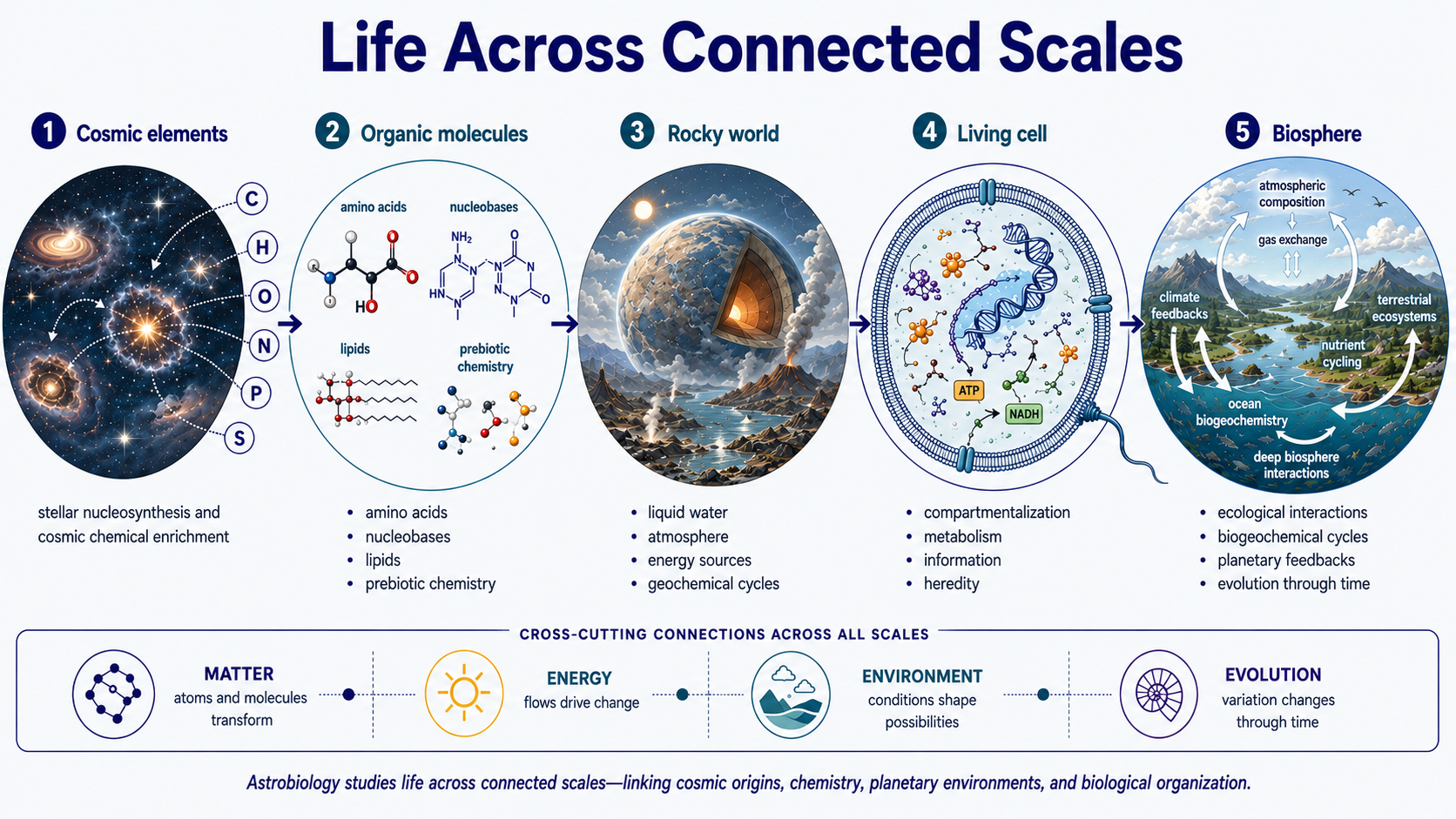
The sequence shown in Figure 1 is not meant to suggest a simple ladder in which life appears automatically. Its value is conceptual: it places biological organization inside a wider chain of conditions. Elements and molecules provide matter, planetary environments provide context, cells organize chemistry into living systems, and biospheres connect life to global ecological and geochemical processes. Astrobiology works precisely across those levels.
From this perspective, astrobiology asks a wider question than biology usually asks on its own. It asks how a universe governed by physical laws can produce chemical complexity, how some planets can maintain environments compatible with life, how non-living chemistry may cross into biological organization, and how life, once present, can alter the planet that supports it.
The field depends on several sciences working together. Chemistry explains molecules and reactions. Geology explains planetary surfaces, rocks, cycles and deep time. Astronomy explains stars, planetary systems and the wider cosmic setting. Evolutionary biology explains how populations change and diversify. Ecology explains how organisms interact with environments. Planetary science helps connect local habitats to whole worlds.
Astrobiology does not replace biology with astronomy. It expands the frame in which biological questions are asked. A gene still matters. A membrane still matters. A metabolic pathway still matters. Each one becomes part of a larger story: life as a planetary process rooted in cosmic history.
That broader view is what makes astrobiology scientifically distinctive. It studies life not only as something that happens inside organisms, but also as something that depends on planets, leaves traces in environments and may, under the right conditions, occur beyond Earth.
What Astrobiology Studies
Astrobiology studies life as a phenomenon of the universe. Its usual definition is broad for a reason: it investigates the origin, evolution, distribution and future of life. Each word opens a different scientific problem.
Origin refers to the transition from non-living chemistry to the first systems capable of persistence, heredity, variation and evolution. Evolution refers to the long history of living systems after life began, from early microbial communities to the complex biosphere on Earth today. Distribution asks where life may exist beyond Earth, whether in ancient environments on Mars, subsurface oceans inside icy moons, or planets orbiting distant stars. Future asks how life may persist, change or disappear as planets, stars and environments evolve.
The definition is wide, but not loose. Astrobiology is not a collection of disconnected curiosities about space and life. It is a scientific framework built around a sequence of connected questions. How did the universe produce the chemical elements required by living systems? How do planets become habitable? How can chemistry become organized enough to support biological evolution? How does life change a planet after it appears? How could another biosphere be detected from rocks, molecules, gases or light?
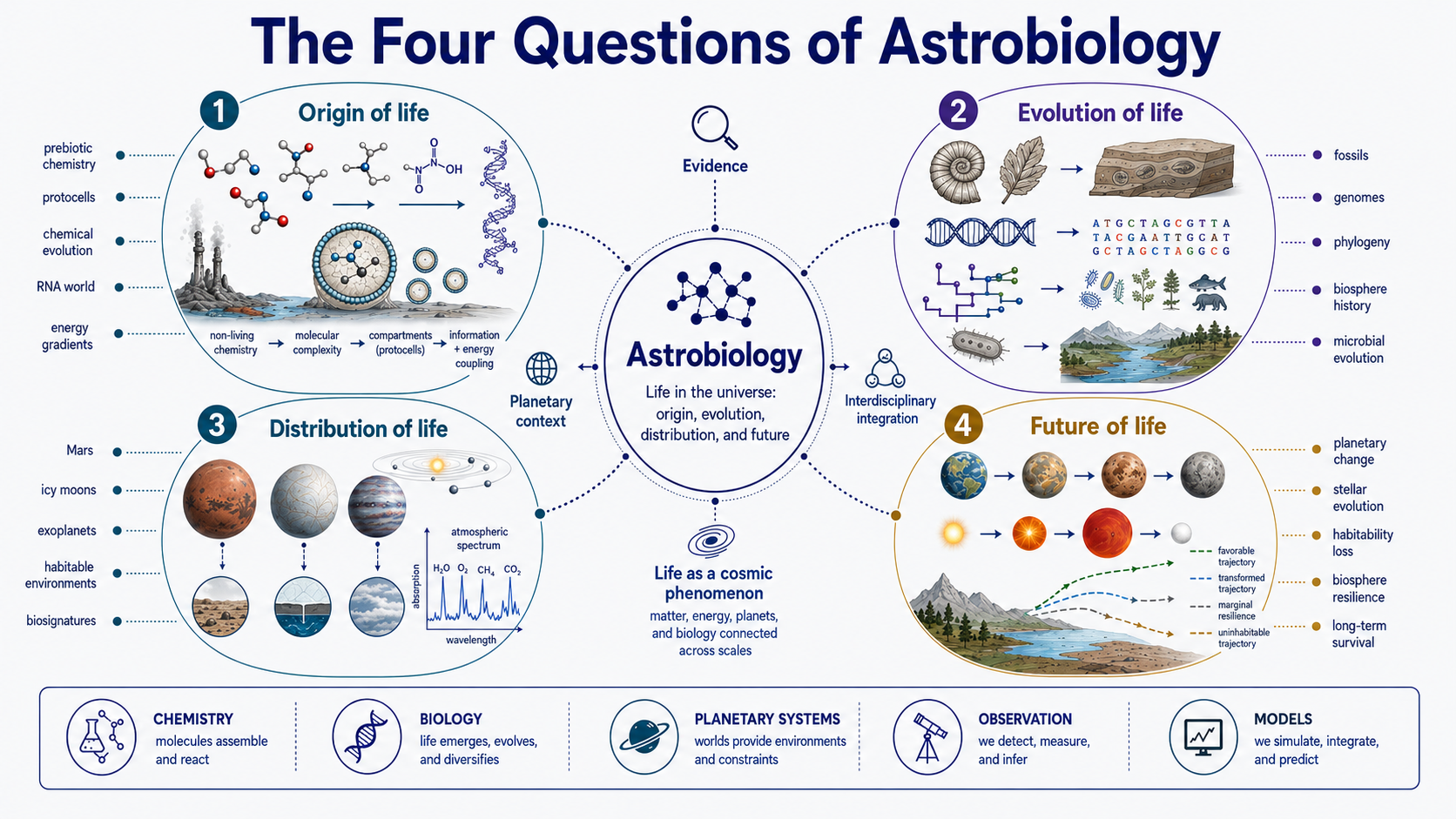
Figure 2 turns the broad definition of astrobiology into a map of scientific problems. The origin of life points toward prebiotic chemistry and protocells. The evolution of life points toward fossils, genomes, phylogeny and biosphere history. The distribution of life directs attention to Mars, icy moons, exoplanets, habitable environments and possible biosignatures. The future of life brings in planetary change, stellar evolution, habitability loss and biosphere resilience. The diagram also shows why evidence, planetary context, observation and models are not optional additions. They are part of how the field reasons.
Those questions also force astrobiology to examine a more basic problem: what counts as life?
On Earth, the distinction often seems easy. A bacterium, a tree and a whale are alive. A crystal, a rock and a drop of pure water are not. Familiar examples, however, are not enough for a science that may one day face unfamiliar biology. A definition built only from known organisms may miss forms of life that do not look like terrestrial cells. A definition that is too broad may include systems that are complex but not alive.
For that reason, many scientific definitions focus on features shared by known life. Living systems are organized. They use energy. They maintain internal conditions. They store and transmit information. They reproduce, at least through lineages. They vary. They evolve. One influential operational definition describes life as a self-sustaining chemical system capable of Darwinian evolution. The strength of that formulation is clear: it links life to chemistry, persistence and evolutionary change.
Still, no definition solves every problem. A spacecraft, telescope or rover may not be able to watch evolution happen. Scientists may have to infer biological activity from indirect evidence, such as organic molecules, isotopic patterns, mineral structures, atmospheric gases or microscopic traces preserved in rock. In practice, astrobiology works not with a single magic sentence, but with a disciplined set of criteria.
The interdisciplinary nature of astrobiology follows from the scale of the problem. Astronomy explains stars, planetary systems and exoplanets. Planetary science explains worlds as physical bodies with surfaces, interiors and atmospheres. Geology explains rocks, minerals, deep time and planetary change. Chemistry explains reactions, organic molecules and prebiotic pathways. Biology explains cells, metabolism, heredity and evolution. Ecology explains how organisms interact with environments. Paleontology and geochemistry help interpret traces of ancient life. Philosophy becomes relevant when scientists ask how life should be defined and what kind of evidence would justify a biological interpretation.
No single discipline can answer all those questions alone. Biology can explain living systems, but not the origin of the elements from which they are made. Astronomy can locate planets, but not decide by itself whether a chemical pattern is biological. Chemistry can describe molecular pathways, but not replace evolutionary history. Geology can preserve ancient traces, but those traces need biological interpretation.
Astrobiology exists because life is both local and cosmic. A cell is microscopic, but its possibility depends on planetary conditions and cosmic history. A biosphere may cover only one world, but its evidence may be read in rocks, atmospheres and radiation reaching a telescope. To study life at that scale, science needs a field able to move from molecules to planets without losing precision.
That is what astrobiology does. It organizes the study of life around the largest scientific context available: a universe where matter, energy, chemistry, planets and evolution may, under the right conditions, produce living worlds.
From Stardust to the Chemistry of Life
Before life can begin, the universe must make the right kinds of matter available. A living cell is built from molecules, but those molecules depend on elements with a cosmic history.
The earliest universe did not contain the full chemical diversity needed for life as we know it. Hydrogen and helium dominated the beginning. Heavier elements, including carbon, oxygen, nitrogen, phosphorus and sulfur, became abundant only after stars formed, evolved and returned newly made material to space. The chemistry of life therefore begins long before the first cell. It begins with the physical history that made chemically rich planets possible.
Carbon has a special role because it can form stable and diverse molecular structures. Oxygen and hydrogen are central to water. Nitrogen appears in amino acids and nucleic acids. Phosphorus is part of DNA, RNA and cellular energy transfer. Sulfur occurs in important amino acids and metabolic reactions. None of these elements is alive, but without them terrestrial life would not have the molecular architecture we recognize.
Astrobiology follows the story from elements to molecules. Organic compounds can form in interstellar clouds, in planetary atmospheres, near hydrothermal systems and in small bodies such as comets and meteorites. Some of those compounds may have reached young planets and contributed to prebiotic chemistry, the set of chemical processes that could prepare the ground for life before biology exists.
The word “organic” needs careful handling here. In everyday language, it often suggests something natural or biological. In chemistry, however, organic compounds are mainly carbon-based compounds. Many can form without organisms. Their presence does not prove life. It shows something different and scientifically more useful: some chemistry relevant to life can happen in non-living environments.
That distinction matters. Finding amino acids, nucleobases or other organic molecules in a meteorite would not mean that the meteorite was alive. It would mean that the universe can produce some of the molecular building blocks associated with biology. Astrobiology is interested in how far non-living chemistry can go, and what additional conditions are needed before chemistry becomes biological organization.
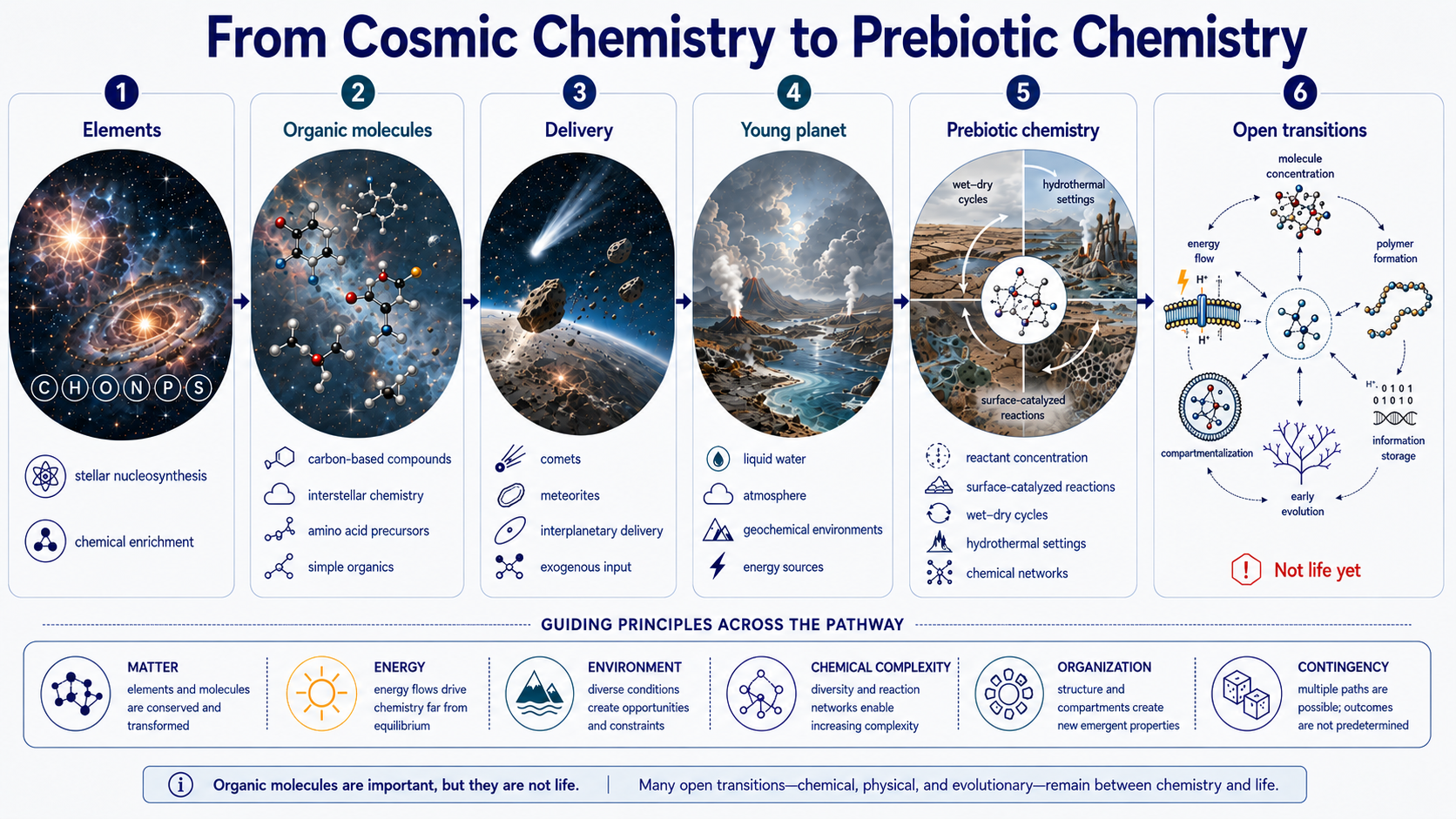
Figure 3 prevents a common misunderstanding. The presence of carbon-based molecules is not the same thing as life. The diagram separates element formation, organic molecules, delivery by comets and meteorites, young planetary environments, prebiotic chemistry and open transitions. The final stage does not show a modern cell because the scientific problem lies precisely between chemistry and life. Molecule concentration, polymer formation, energy flow, compartmentalization, information storage and early evolution are not decorative steps. They are the unresolved transitions that make the origin of life a scientific problem rather than a simple chemical recipe.
The transition from stellar element formation to prebiotic chemistry is not a simple ladder with a living cell waiting at the end. Elements must become molecules. Molecules must enter environments where reactions can continue. Some compounds may be delivered by comets, meteorites or interplanetary dust. Others may form on a young planet. Once present, they still need concentration, energy flow, selective reactions, compartments, information storage and continuity before evolution can begin.
The path from organic molecules to living systems is not a straight chemical assembly line. Molecules must be available in the right environments. Reactants must become concentrated rather than endlessly diluted. Some molecules must link into larger structures. Certain reactions must become more organized or more selective. Compartments must create an inside and an outside. Energy must drive processes away from simple chemical equilibrium. At some point, heredity and variation must appear, because evolution requires both continuity and change.
Astrobiology therefore avoids a simple formula such as “organic molecules plus water equals life.” Water is important. Organic chemistry is important. Energy is important. A suitable planetary setting is important. But life requires organization across several levels. Molecules must become part of systems that maintain themselves, interact with their surroundings and eventually evolve.
The phrase “from stardust to life” can sound almost poetic, but the scientific idea behind it is precise. Life depends on a chain of conditions. Elements must be produced. Molecules must form. Planets must provide environments where reactions can continue. Chemical systems must acquire structure, boundaries, energy flow and informational continuity. Astrobiology studies that chain with two attitudes at the same time: openness to possibility and discipline in the interpretation of evidence.
That balance gives the field its strength. The chemistry of life may begin in the wider universe, but biology begins only when matter becomes organized in a new way. Astrobiology studies the long passage between those two facts.
A Habitable Planet Is a System
A habitable planet is not defined by a single favorable ingredient. Liquid water matters deeply for life as we know it, but water alone does not make a world biologically promising. A planet may have water and still lack stable conditions, usable energy, accessible chemistry or enough time for life to emerge and persist. Another world may look hostile at the surface and still contain local environments where microbial life could, in principle, survive.
Habitability means the capacity of an environment to support life. The definition sounds simple, but it immediately raises a more careful question: habitable for what kind of life? A human body has narrow environmental limits. A desert plant, a deep-sea microbe and a radiation-tolerant bacterium do not require the same conditions. In astrobiology, the most relevant starting point is usually microbial life, because microorganisms dominate much of Earth’s biological history and can occupy environments that complex organisms cannot tolerate.
For that reason, habitability should not be imagined as a planet-wide label stamped onto a world from a distance. A planet may be broadly unsuitable at the surface and still contain habitable niches underground, under ice, inside rocks or near chemically active interfaces. The more precise question is not simply whether a planet is habitable, but where, for how long, under what conditions and for which kind of organism.
Earth shows why habitability must be understood as a system. The solid planet, atmosphere, oceans, climate and biosphere are not separate boxes. They interact. Earth’s interior contributes to volcanic gases, crustal recycling and long-term geochemical cycles. The atmosphere helps regulate temperature and protects the surface from some forms of radiation. Oceans provide a stable solvent-rich setting for chemical reactions and biological processes. Rocks and minerals store chemical information, supply nutrients and preserve traces of ancient environments. Life itself has altered the atmosphere, oceans, sediments and mineral diversity of the planet.
That integration matters. A planet may receive the right amount of energy from its star and still fail to remain habitable over geological time. Atmospheric loss, runaway greenhouse warming, global freezing, lack of chemical recycling or intense radiation can narrow or remove habitable conditions. Habitability is not only about being in the right place. It is also about maintaining the right kinds of planetary relationships.
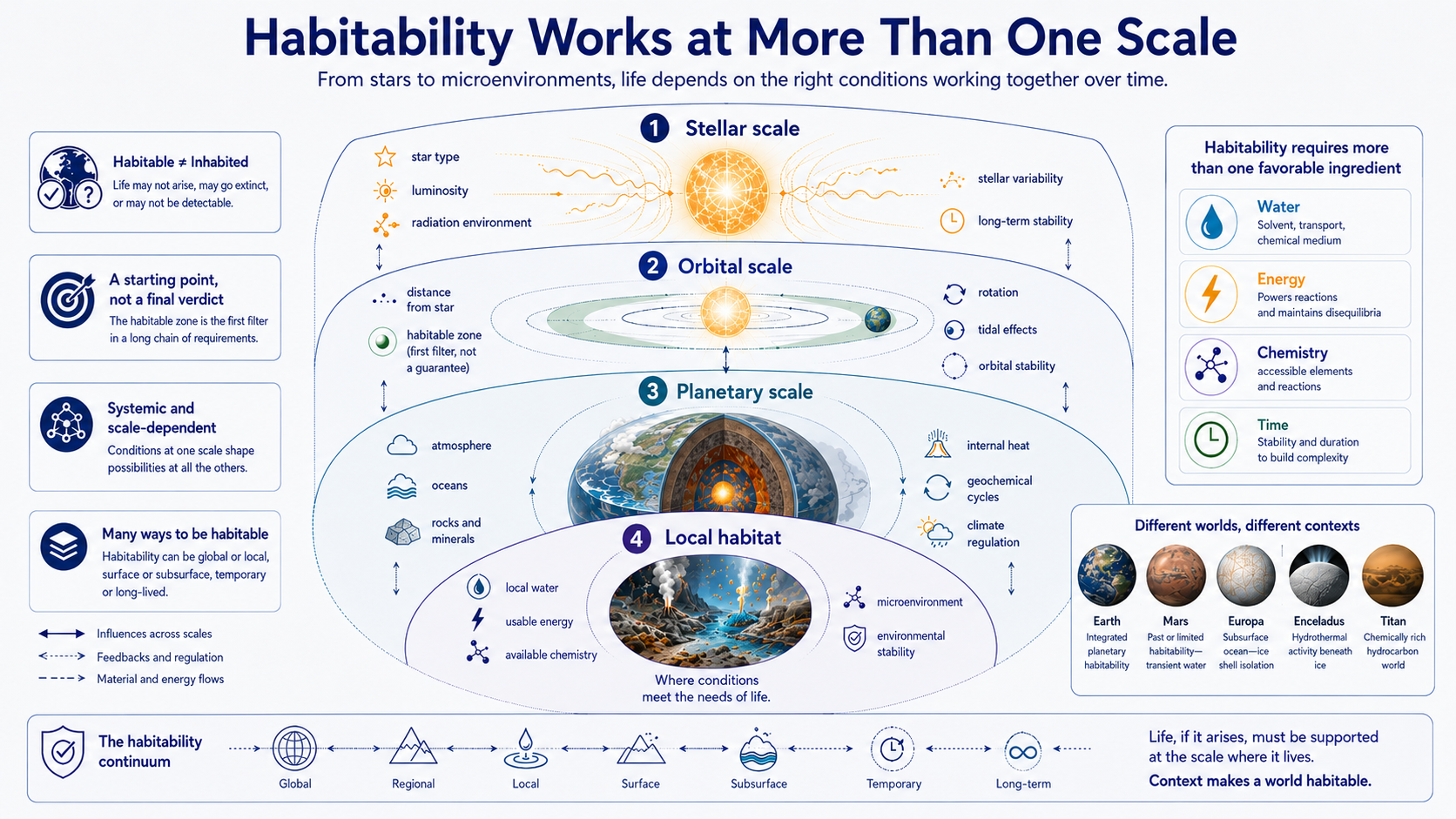
Figure 4 organizes habitability as a nested problem. The stellar scale controls energy input, radiation and long-term stability. The orbital scale includes distance from the star, the classical habitable zone, rotation, tidal effects and orbital stability. The planetary scale brings in atmosphere, oceans, rocks, internal heat, geochemical cycles and climate regulation. The local habitat scale asks where water, usable energy, available chemistry and environmental stability actually meet. That hierarchy clarifies why a planet in the habitable zone is not automatically inhabited, and why a world outside the classical surface habitable zone can still contain relevant environments.
The classical habitable zone is a useful first approximation. It describes the region around a star where a rocky planet with a suitable atmosphere could maintain liquid water on its surface. Around cooler stars, the zone lies closer to the star. Around hotter stars, it lies farther away. The concept helps astronomers compare exoplanets, especially when only orbital distance, stellar luminosity, planetary size or rough atmospheric clues are available.
Yet the habitable zone is not a life detector. A planet inside the classical zone may be sterile. Venus lies near the inner edge of habitability in our Solar System and shows how a planet can become far too hot for surface water to remain stable. Mars helps frame the opposite problem: a world may preserve evidence of past water, yet become cold, dry and atmospherically thin. Between those examples, Earth shows not merely the presence of water, but the long-term persistence of a coupled planetary system able to support a biosphere.
The habitable zone also misses some of the most interesting environments in astrobiology. Europa and Enceladus lie far outside the region where sunlight could maintain surface oceans. Their astrobiological interest comes from another source: internal energy. Tidal forces can heat the interiors of icy moons, helping maintain liquid water beneath frozen crusts. Enceladus is especially striking because its plumes release material from the moon into space, offering a rare opportunity to study water, salts, organic compounds and energy-related chemistry without drilling through kilometers of ice.
Titan expands the picture in a different direction. Its surface is extremely cold, but its atmosphere and surface chemistry are rich in organic compounds. Titan is not habitable in an Earth-like surface sense. Its value lies in showing that planetary environments can host complex organic chemistry under conditions very different from those on Earth. Astrobiology does not treat every chemically rich world as a living world. It asks how far chemistry can go before biology begins.
A stronger understanding of habitability requires several nested scales. At the stellar scale, the host star controls energy input, radiation environment and long-term luminosity. At the orbital scale, distance, rotation, tides and interactions with other bodies affect climate and internal heating. At the planetary scale, atmosphere, oceans, rocks, magnetic shielding, internal heat and chemical cycles shape the persistence of suitable environments. At the habitat scale, life would occupy specific settings where water, energy and usable chemistry meet.
Time adds another layer. A world may be briefly habitable, continuously habitable or formerly habitable. Early Mars may have had lakes, rivers or groundwater systems without necessarily having life. A young Venus-like planet may have lost water as warming intensified. An icy moon may maintain a subsurface ocean for long periods even though its surface remains frozen. For life to begin, short-lived conditions may not be enough. For life to evolve and leave detectable traces, stability, renewal and preservation become important.
Energy also needs careful treatment. Life does not merely sit in a favorable environment. It uses energy to maintain organization, repair damage, build structures and reproduce. Sunlight powers much of Earth’s surface biosphere, but light is not the only possible energy source. Chemical energy supports ecosystems in dark environments on Earth, including deep-sea hydrothermal systems and subsurface microbial habitats. That is why astrobiologists take seriously worlds where sunlight is weak but chemical gradients, water-rock reactions or tidal heating may provide usable energy.
Habitability and inhabitation must remain separate ideas. Habitability describes conditions that could support life. Inhabitation means life is actually present. A lakebed, a subsurface ocean, a hydrothermal environment or a planet in the habitable zone can be scientifically promising without being biological. Evidence must still be found, tested and interpreted.
The distinction protects astrobiology from two mistakes. One mistake is excessive skepticism, in which only Earth-like surfaces are considered worth studying. The other is premature certainty, in which water, organic molecules or a favorable orbit are treated as signs of life. The strongest approach lies between those extremes. A habitable world is not a conclusion. It is a setting where the search for evidence becomes scientifically meaningful.
Astrobiology works in that careful space. It asks whether an environment could support life, what kind of life might fit the conditions, how long the environment could remain stable, what traces living systems might leave and whether non-biological processes could produce similar signals. Habitability is not a simple checklist. It is a planetary question, an ecological question and, ultimately, a question about how matter, energy, environments and life can become connected over time.
How a Habitable World May Become Inhabited
A habitable world is not automatically an inhabited world. A planet may have liquid water, organic molecules, energy sources and chemically active environments without ever producing life. The origin of life begins in that gap between possibility and reality. It asks how a world with the right conditions could cross from non-living chemistry to biological organization.
Earth crossed that threshold very early in its history, but the detailed route remains unresolved. That uncertainty does not weaken astrobiology. It gives the field one of its most demanding scientific problems. The task is not to invent a single dramatic moment when life suddenly appeared. The task is to understand which chemical pathways, environmental settings and physical constraints could make the transition plausible.
Prebiotic chemistry is the starting point. It studies how molecules relevant to life could form before organisms existed. Amino acids, sugars, nucleobases, lipids and other organic compounds can be produced through different abiotic processes under certain conditions. Some may have formed on the early Earth. Others may have arrived through meteorites, comets or interplanetary dust. Their presence would not be life, but it could provide raw material for more complex chemical systems.
The difficulty lies in what happens next. A living system is not a loose mixture of useful molecules. It must maintain organization, use energy, preserve information and generate variation across generations. A pond, a hydrothermal vent or a mineral surface may contain organic compounds, but compounds alone do not make biology. The central problem is how chemistry becomes organized into systems with continuity.
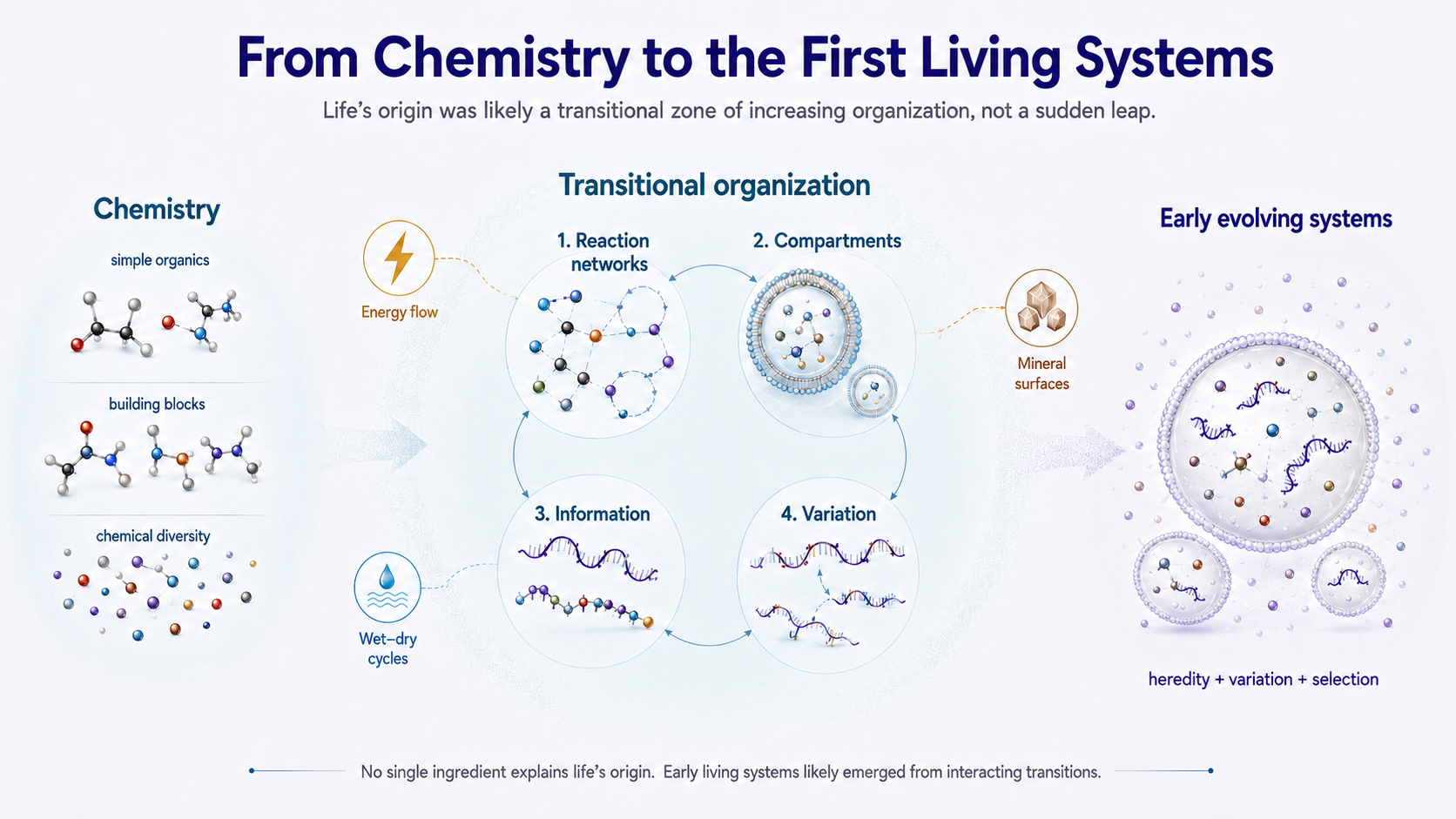
Figure 5 gives the origin-of-life problem its proper shape. The transition is not shown as a sudden jump from chemistry to a finished cell. On the left, chemistry provides simple organics, building blocks and chemical diversity. In the center, reaction networks, compartments, information and variation become linked inside a zone of transitional organization. On the right, early evolving systems appear only after heredity, variation and selection become coupled. The figure also places energy flow, wet-dry cycles and mineral surfaces around the central transition because environments do not merely contain chemistry; they shape which reactions can persist, concentrate and interact.
Several hypotheses address different parts of that transition. The RNA world hypothesis proposes that RNA or RNA-like molecules may have played an early role because RNA can store information and, in some forms, catalyze reactions. That dual capacity makes RNA attractive as a possible bridge between chemistry and biology. A molecule that can both carry information and influence reactions would help explain how heredity and chemical activity became linked.
The RNA world is not the only approach. Metabolism-first models emphasize self-organizing reaction networks that may have developed before genetic polymers became central. In that view, early life-like systems may have depended first on energy flow, catalytic cycles and chemical gradients. Hydrothermal vent environments are often discussed in this context because they provide minerals, water-rock reactions, temperature gradients and chemical disequilibria that could drive reactions away from simple equilibrium.
Wet-dry cycles offer another kind of setting. When water evaporates and returns, dissolved molecules can become concentrated, react and reorganize. Drying can favor the formation of larger molecules, while rehydration can allow those products to disperse, interact and enter new compartments. Shorelines, volcanic ponds, tidal flats or other changing environments may have created repeated cycles of concentration and reaction.
Mineral surfaces may also have mattered. Clays, iron-sulfur minerals and other surfaces can bind molecules, bring reactants together and influence chemical reactions. A surface can act as more than a passive background. It can concentrate compounds, orient molecules and create local chemical conditions that would not exist in open water.
Compartmentalization is another major step. Modern cells are bounded by membranes, and that boundary is not merely a container. It creates an inside and an outside. It allows molecules to remain together, reactions to become localized and chemical differences to be maintained across a boundary. Early compartments may have been much simpler than modern cells. They may have involved lipid vesicles, fatty acid membranes, coacervates or mineral pores. Their importance lies in organization. A chemical system that remains partly enclosed can persist and change in ways that a fully diluted mixture cannot.
Energy flow must also be included. Life is not only a structure. It is an active state maintained against disorder. Living systems build molecules, repair damage, move substances, regulate internal conditions and reproduce. All of that requires energy. Any plausible origin-of-life scenario must explain how early chemical systems captured energy and used it to sustain organization. Sunlight, geothermal heat, redox gradients, hydrothermal chemistry and wet-dry cycling have all been considered as possible energy sources or drivers.
Information marks another transition. Modern organisms store hereditary information mainly in DNA, express it through RNA and proteins, and pass it through lineages. The first evolving systems were almost certainly simpler. Still, some form of continuity had to emerge. Without heredity, there can be chemistry, but not biological evolution. Without variation, there can be repetition, but not adaptation. Without selection, there can be persistence, but not open-ended evolutionary change.
A protocell can be understood as a simplified model of this transition. It is not a modern cell. It is a proposed intermediate system in which a boundary, internal chemistry, energy flow and some form of information begin to operate together. A protocell does not need to contain everything found in bacteria today. Its scientific value is that it helps researchers ask how the core features of life could have become linked step by step.
The origin of life should not be reduced to a contest between single explanations. RNA, metabolism, membranes, minerals, hydrothermal systems and wet-dry cycles may represent different parts of a larger problem. The first living systems may have emerged from interactions among several processes rather than from one isolated breakthrough. Prebiotic chemistry needed environments. Environments created gradients and cycles. Gradients supplied energy. Boundaries organized reactions. Molecules stored information. Selection acted on systems that could persist and vary.
The threshold between chemistry and biology was probably not a sharp line visible from one instant to the next. It may have been a zone of increasing organization. Simple reactions became networks. Networks became partly enclosed systems. Enclosed systems gained stability and variation. Some systems began to influence their own persistence. At a certain point, chemical continuity became biological heredity, and a habitable world became inhabited.
Astrobiology studies that transition with care because the answer matters beyond Earth. If life began through highly specific conditions found only rarely, inhabited worlds may be uncommon. If the transition can occur through several pathways wherever water, energy, organic chemistry and stable environments coexist, life may be a more widespread planetary phenomenon. The only honest conclusion at present is that the problem remains open.
What makes the question scientifically powerful is not the lack of a final answer, but the growing ability to test pieces of the puzzle. Laboratory experiments can explore prebiotic reactions, self-assembly, protocell membranes and RNA-like chemistry. Geology can identify ancient environments that may have favored chemical evolution. Planetary science can search for worlds with water, energy and reactive chemistry. Biology can reveal which features of modern life may preserve clues about earlier stages.
The origin of life is therefore not a blank space in science. It is an active investigation into how matter can become organized enough to evolve. A habitable world provides the stage. Chemistry supplies the materials. Energy drives change. Compartments create local order. Information makes continuity possible. Evolution begins when some systems persist, vary and leave descendants. Somewhere in that sequence lies the passage from a planet that could host life to a planet that actually does.
Life Changes Planets
Habitability helps explain how life can exist, but the relationship also works in the other direction. Once life appears, it does not merely occupy a planet. It can become part of the planet’s chemistry, atmosphere, surface and long-term history.
Earth is the only example we know in detail, and its history is clear on one point: life has changed this world profoundly. Microorganisms altered sediments, minerals and chemical cycles long before animals or plants existed. Photosynthetic organisms transformed the atmosphere by releasing oxygen. Later, plants changed soils, weathering, landscapes and the exchange of gases between the surface and the air. Life on Earth is not just a collection of organisms living on a passive background. The biosphere is one of the forces that helped shape the planet.
The rise of oxygen is the best-known example. For much of Earth’s early history, the atmosphere contained very little free oxygen. Oxygenic photosynthesis changed that balance over time, allowing oxygen to accumulate in the atmosphere and oceans. That transformation affected minerals, metabolism, climate and the future evolution of complex life. A biological process became a planetary event.
Microbial life also leaves subtler marks. Microbes can influence mineral formation, drive redox reactions, fractionate isotopes, build layered structures and alter local chemistry. Some biological traces are physical, such as microfossils or stromatolite-like structures. Others are chemical, such as specific organic molecules, isotopic patterns or combinations of gases that would be hard to maintain without continual replenishment.
This matters for astrobiology because life beyond Earth, if it exists, may not be visible as forests, animals or anything large. Most of Earth’s biological history was microbial. Microbes were present for billions of years before complex animals appeared. A second biosphere may be small, ancient, hidden, chemically subtle or preserved only as a pattern in rocks, ice, minerals or atmosphere.
Early Earth also warns against using the modern planet as the only image of habitability. The early atmosphere, ocean chemistry, radiation environment and geological conditions differed from those of today. Life that seems extreme to humans may have been more ordinary in earlier planetary settings. A microbial biosphere does not need blue skies, forests or oxygen-rich air to be biologically real.
The search for life therefore depends on learning how biology becomes evidence. Ancient rocks, microbial fossils, stromatolites, isotopic patterns, organic residues and mineral textures are not just records of Earth’s past. They are training grounds for interpretation. If identifying early life on our own planet can be difficult, recognizing life on Mars or on an exoplanet will require even greater care.
This point is central to the logic of biosignatures. A biosignature is not simply something that life could produce. It is a feature whose biological origin becomes convincing only after the planetary context has been examined. Methane, oxygen, organic molecules, minerals or microscopic shapes may all have biological explanations in some settings. They may also have non-biological explanations in others.
Astrobiology therefore asks two questions at the same time. Could life produce this pattern? Could non-living processes produce it under the same conditions? The strongest evidence comes when several independent signs point toward biology and when abiotic explanations become less likely.
Life changes planets, but planets also preserve those changes unevenly. Some traces are destroyed by heat, radiation, erosion, oxidation or geological recycling. Others can persist in minerals, sediments, ice, atmospheres or remote spectra. The scientific task is not only to search for signs of life, but to understand how signs are made, altered, preserved and misread.
That is why Earth remains so important. It shows that a biosphere can become a planetary force. It also shows that life may leave evidence that is powerful, incomplete and difficult to interpret. For astrobiology, both lessons matter.
Extremophiles Expanded the Map of Possible Habitats
Human intuition is not a reliable guide to habitability. Environments that feel comfortable to humans represent only a narrow portion of the conditions life can tolerate. Modern microbiology changed the scale of the question by revealing organisms that live in places once considered too hot, too cold, too salty, too acidic, too alkaline, too dry, too deep or too exposed to radiation for life.
Extremophiles are organisms adapted to environmental conditions that are hostile to many other forms of life. Some grow near hydrothermal vents, where high temperatures, pressure and chemical gradients shape microbial ecosystems. Others live in hypersaline lakes, acidic waters, alkaline environments, polar ice, deserts, deep sediments, fractured rocks or radiation-exposed settings. Many are bacteria or archaea, although not all organisms in harsh environments belong to those groups.
Their importance is not that life can survive anything. That would be false. Every organism has limits. Proteins can lose structure. Membranes can fail. DNA can be damaged. Metabolism requires liquid chemistry, usable energy and molecular stability. Extremophiles do not erase biological constraints. They show that some constraints are broader than human-centered expectations once suggested.
The difference between survival and growth is especially important. A cell may survive a harsh condition in a dormant or protected state without actively growing there. Spores and resistant cells can endure stress for a time, but endurance alone does not define a living habitat. A true habitat must allow organisms to maintain themselves, obtain energy, carry out metabolism and reproduce across generations.
For astrobiology, this distinction protects the science from exaggeration. If a microbe can survive brief exposure to vacuum, radiation or freezing, that does not mean open space is a habitat. If cells can persist in dry rocks, that does not mean all deserts are biologically active everywhere. Survival expands what scientists should consider possible, but growth and reproduction define stronger biological relevance.
Extremophiles changed astrobiology because they widened the range of environments worth studying. Hydrothermal ecosystems on Earth make subsurface oceans more interesting, especially where water may interact with rock and produce chemical gradients. Deep subsurface microbes make the Martian underground more relevant than the hostile surface alone. Salt-tolerant organisms draw attention to brines, evaporites and minerals that can trap water or preserve biological traces. Radiation-resistant organisms help researchers ask how life could persist near surfaces exposed to harsh radiation, although resistance has limits.
The ecological lesson is just as important as the physiological one. Extremophiles do not live in abstract extremes. They live in habitats with structure. A hydrothermal vent has gradients of temperature and chemistry. A salt lake has zones, sediments and interfaces. A rock fracture may contain water films, minerals and redox reactions. Even harsh environments are spatially organized. Life uses the parts of those systems where energy, chemistry and physical conditions come together.
This is why extremophiles connect directly to the idea of habitable niches. A planet or moon may be globally severe but locally promising. Mars today has a surface shaped by cold, dryness and radiation, yet the subsurface may offer better protection and more stable chemistry. Europa and Enceladus have frozen surfaces, but their possible internal oceans raise questions about water-rock interactions and chemical energy. Titan is far too cold for Earth-like water-based surface life, yet its organic chemistry remains scientifically valuable for understanding chemical complexity under unfamiliar conditions.
Extremophiles also remind us that biology may be chemically conservative and ecologically flexible at the same time. Known life still depends on basic requirements such as chemical organization, energy flow and molecular stability. Yet the environments where those requirements can be met are more diverse than everyday experience suggests.
The result is a more disciplined imagination. Astrobiology can take hidden oceans, deep rocks, brines, ice-covered worlds and chemical gradients seriously without turning possibility into proof. Extremophiles help scientists ask better questions about where life could function. They do not answer whether life is present elsewhere.
Worlds of Interest in Astrobiology
Astrobiology studies Earth in depth, but its questions extend across the Solar System and beyond. The most interesting worlds are not always the most Earth-like. They are the worlds that preserve evidence of water, organic chemistry, energy sources, geological activity, atmospheric clues or possible biosignatures. Each one helps test a different part of the larger question: how can a planetary environment become biologically meaningful?
Mars remains one of the main targets because it records a complex environmental history. The modern Martian surface is cold, dry, thinly shielded by atmosphere and exposed to radiation. Ancient Mars, however, tells a different story. Valley networks, lake deposits, deltas, hydrated minerals and sedimentary environments point to past water activity. Those features do not prove that life existed. They show that some Martian environments may once have had conditions relevant to habitability.
The strongest Martian question is therefore historical. Did ancient Mars contain stable habitats long enough for prebiotic chemistry or microbial life? If life ever appeared there, could traces have survived in rocks, minerals or protected subsurface environments? The answer depends on geology as much as biology. A biosignature can be destroyed, altered or hidden. It can also be preserved if minerals, sediments and environmental conditions protect it over time.
The subsurface matters because the surface of Mars is harsh today. Below ground, radiation decreases, temperatures may be more stable and water-related minerals may preserve chemical information. That does not make the Martian subsurface inhabited. It makes it a more reasonable place to examine when thinking about past or possibly protected habitats.
Europa and Enceladus shift the discussion from ancient surface water to hidden oceans. Both are icy moons, and both are important because liquid water may exist beneath frozen crusts. Their astrobiological value comes not from sunlight at the surface, but from the possibility of internal energy, water-rock interaction and chemical gradients.
Europa is especially interesting because its ocean may lie above a rocky interior. If oxidants produced at the surface can reach the ocean, and if hydrothermal activity or water-rock reactions occur at depth, chemical gradients could provide energy for metabolism. The question is not merely whether Europa has water. The stronger question is whether its ocean has the right combination of chemistry, energy exchange and long-term stability.
Enceladus adds another remarkable feature: plumes. Material from its interior escapes into space, carrying water vapor, salts and organic compounds. That makes Enceladus scientifically valuable because a spacecraft can, in principle, sample material connected to the subsurface ocean without landing or drilling through the ice. Plume chemistry does not automatically indicate life, but it provides a direct way to examine habitability-related chemistry.
Titan, Saturn’s largest moon, is important for a different reason. Titan has a dense nitrogen-rich atmosphere, methane in its climate system and a wide range of organic compounds. Its surface is extremely cold, and liquid water is not stable at the surface under present conditions. Titan is not an early Earth twin. Its chemistry, temperature and volatile cycles are very different. Yet Titan offers a natural laboratory for studying how far organic chemistry can develop in a cold planetary environment.
That distinction matters. Titan is not compelling because it looks comfortably habitable. It is compelling because it separates organic complexity from ordinary Earth-like conditions. Methane clouds, hydrocarbon lakes and atmospheric photochemistry show that planetary chemistry can be rich even when surface water is frozen solid. For astrobiology, Titan helps clarify what organic chemistry can do before, beside or apart from biology.
Exoplanets expand the scale of the search. Thousands of planets have been discovered around stars beyond the Sun, and they are remarkably diverse. Some are rocky. Some are larger than Earth but smaller than Neptune. Some orbit close to their stars. Others lie in regions where surface liquid water might be possible under suitable atmospheric conditions. Many have no close equivalent in the Solar System.
The challenge is distance. For Solar System bodies, spacecraft can image surfaces, analyze rocks, measure particles or fly through plumes. For exoplanets, scientists usually depend on indirect evidence. A planet’s size, mass, orbit and atmosphere must be inferred from light. Atmospheric gases may be studied through spectra, especially when starlight passes through or reflects from a planet’s atmosphere. Those observations can reveal clues, but interpretation is difficult.
An exoplanet in the habitable zone is not automatically habitable. A rocky planet with water is not automatically inhabited. An atmospheric gas that looks promising is not automatically biological. The same caution that applies to Mars, Europa, Enceladus and Titan applies even more strongly to distant worlds. The farther the world, the more important the planetary context becomes.
Venus also belongs in the astrobiological conversation, even when the subject is habitability lost rather than habitability preserved. Its extreme greenhouse conditions show how a rocky planet can become profoundly different from Earth despite some broad similarities in size and location. Venus helps define the inner limits of surface habitability and reminds researchers that planetary evolution can move a world away from life-friendly conditions.
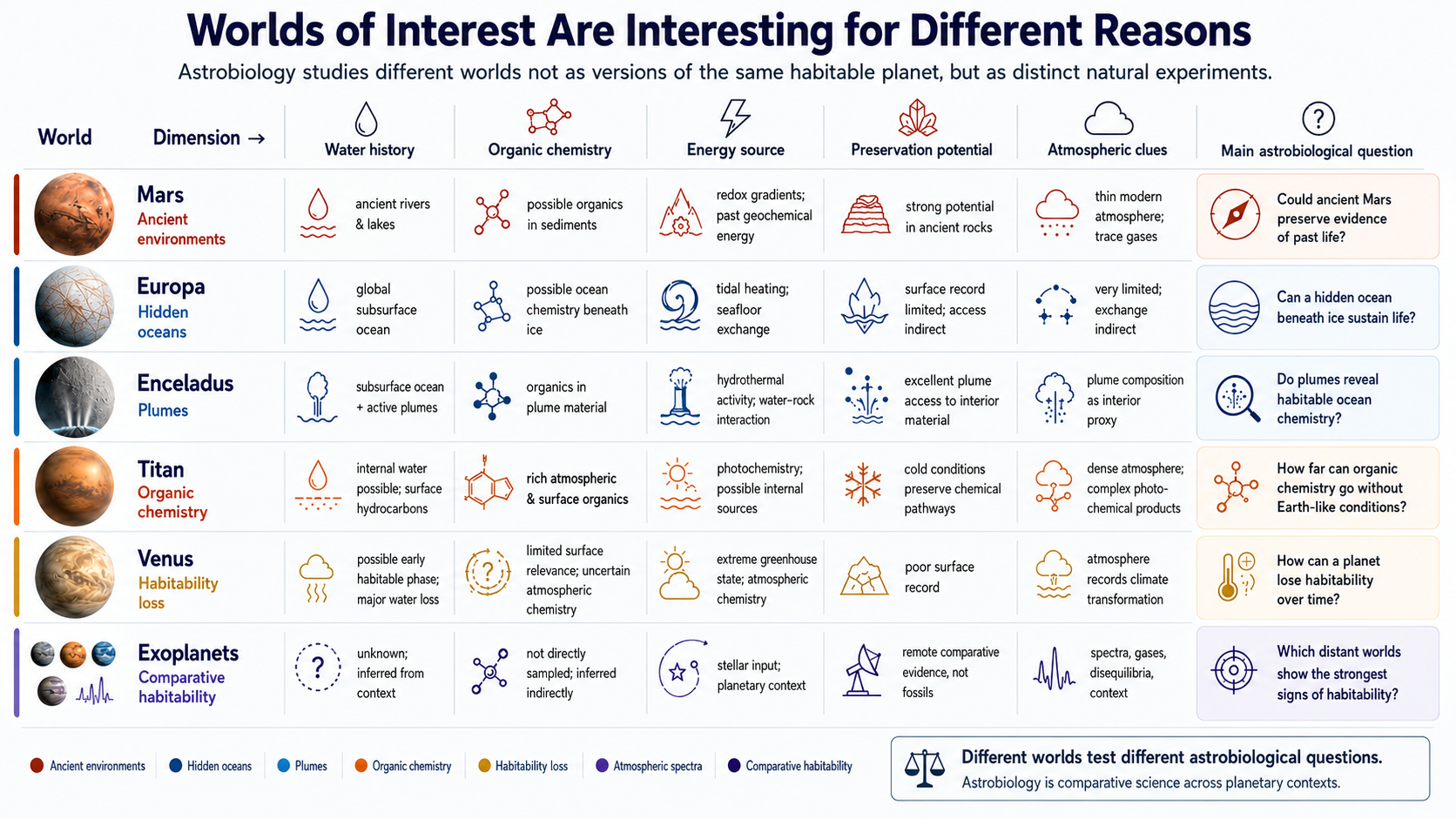
Figure 6 keeps the comparison from becoming too generic. Mars is not interesting for the same reason Titan is interesting. Europa and Enceladus are not simply frozen versions of Earth. Venus matters even when the question is how habitability can be lost. Exoplanets matter because their atmospheres may be studied only indirectly, through spectra and planetary context. The matrix makes the logic explicit: each world emphasizes a different scientific dimension, such as water history, organic chemistry, energy sources, preservation potential, atmospheric clues or the main astrobiological question.
Taken together, these worlds prevent astrobiology from relying on a single image of a habitable planet. Mars points to ancient environments and preservation. Europa and Enceladus point to hidden oceans and chemical energy. Titan points to organic chemistry under unfamiliar conditions. Venus warns about planetary divergence and habitability loss. Exoplanets turn habitability into a comparative science across many planetary systems.
The larger lesson is clear: life, if it exists beyond Earth, may not announce itself from a familiar landscape. It may be buried, extinct, microbial, chemically subtle, atmospheric, frozen into ancient minerals or hidden under ice. Astrobiology studies those possibilities without treating them as conclusions. The search becomes strongest when each world is understood on its own terms.
Biosignatures: Evidence in Context
A biosignature is a feature that may point to life. It can be a molecule, a gas, an isotopic pattern, a mineral structure, a microscopic form, a fossil-like texture, a surface signal or an atmospheric composition that appears easier to explain with biological activity than without it.
That definition sounds simple, but biosignatures are among the most difficult ideas in astrobiology. A possible sign of life is not the same as proof of life. The same molecule, structure or pattern may have different meanings in different environments. A gas that looks biologically interesting on one planet may be produced by geology on another. A mineral texture that resembles a microbial structure may result from non-living chemical processes. A carbon-bearing compound may be relevant to life without being produced by life.
Astrobiology treats evidence as contextual. A biosignature becomes stronger only when the surrounding conditions make a biological explanation more convincing than the alternatives. Scientists must ask where the signal occurs, how it formed, whether it could be preserved, what non-biological processes are possible in that environment and whether independent evidence points in the same direction.
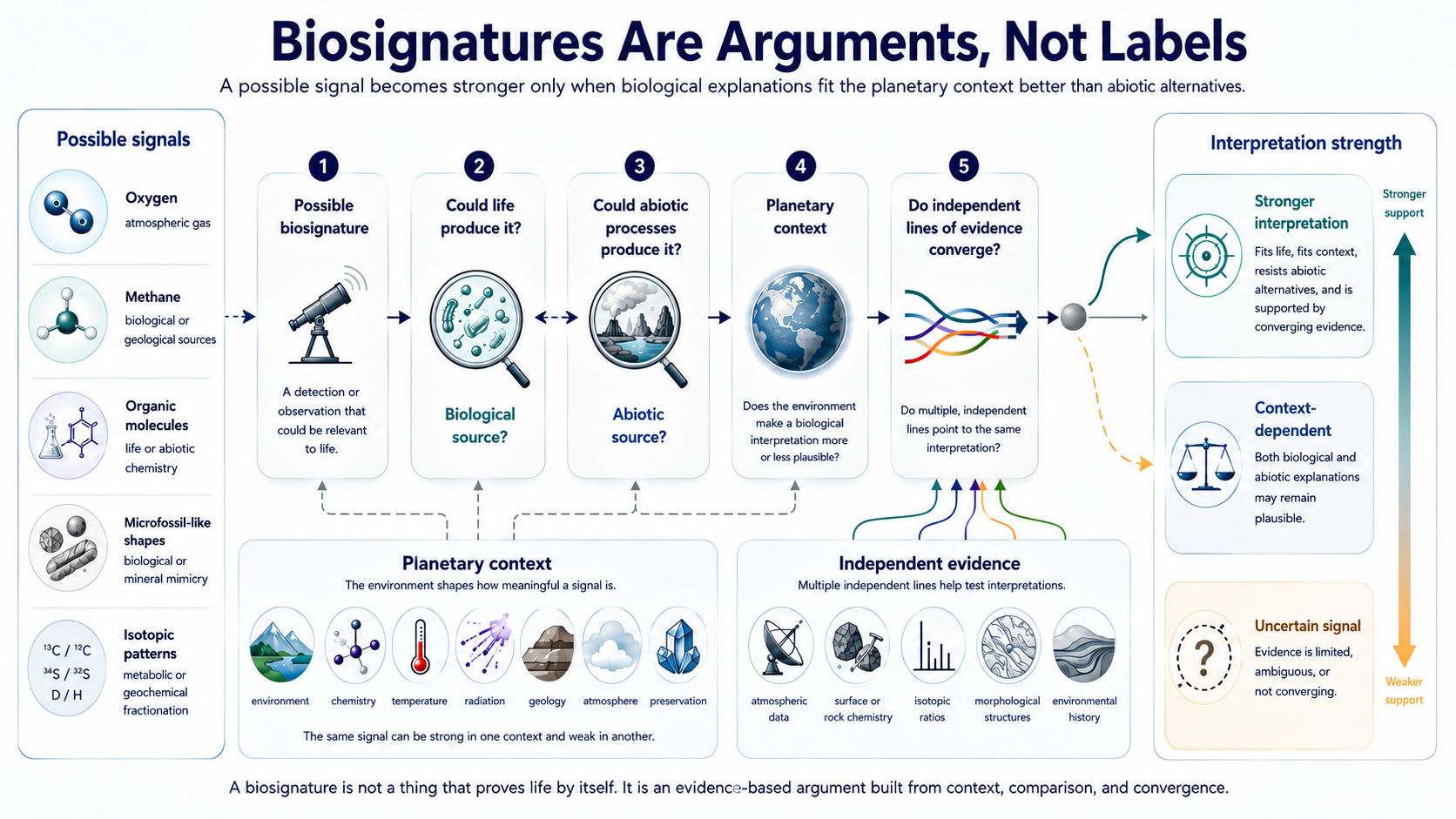
Figure 7 is the interpretive core of this section. Oxygen, methane, organic molecules, microfossil-like shapes and isotopic patterns can all be possible signals, but none of them works as a label that automatically says life. The central sequence shows the actual reasoning: first identify a possible biosignature, then ask whether life could produce it, whether abiotic processes could produce it, whether the planetary context supports a biological interpretation and whether independent lines of evidence converge. The right side of the diagram is especially important because it avoids a false binary. A signal may remain uncertain, become context-dependent or support a stronger biological interpretation. The figure does not end with “confirmed life,” because astrobiological evidence usually gains strength through comparison and convergence rather than through a single clue.
Oxygen is a useful example. On modern Earth, atmospheric oxygen is strongly linked to photosynthesis. It would be tempting to treat oxygen in another planet’s atmosphere as a sign of life. The problem is that oxygen can also accumulate through non-biological processes under certain planetary conditions. Methane raises a similar issue. On Earth, methane can be produced by microorganisms, but it can also be generated by geological reactions involving water and rock. Organic molecules follow the same logic. They matter for habitability and prebiotic chemistry, but their presence alone does not establish biology.
The strongest biosignature reasoning is comparative. The question is not only whether life could produce a signal. The question is whether non-living processes could produce the same signal in the same planetary setting. A convincing interpretation needs more than compatibility with life. It needs a pattern of evidence in which biological activity becomes the best explanation after abiotic pathways have been examined.
The James Webb Space Telescope has made this kind of reasoning more visible to the public. Webb does not take photographs of life on exoplanets. It studies light. When a planet passes in front of its star, a small portion of starlight can filter through the planet’s atmosphere. Molecules in that atmosphere absorb specific wavelengths. The resulting spectrum can reveal chemical clues, such as carbon dioxide, methane, water vapor, carbon monoxide or sulfur compounds.
Those measurements are powerful because they let scientists study distant worlds without touching them. They are also difficult because a spectrum is not a direct biological verdict. It is a chemical pattern that must be interpreted through atmospheric physics, planetary climate, stellar radiation, geology and possible chemistry.
Webb’s observations of WASP-39 b showed clear evidence for carbon dioxide in the atmosphere of an exoplanet. WASP-39 b is a hot gas giant, not a habitable Earth-like world. Its importance lies elsewhere: it demonstrated that Webb can identify atmospheric molecules in planets beyond the Solar System with remarkable precision. That ability is central to the future search for biosignatures, because atmospheric gases may be among the few accessible clues for distant planets.
K2-18 b is more directly connected to habitability discussions. Webb detected methane and carbon dioxide in its atmosphere, and those observations have been discussed in relation to the possibility of a hydrogen-rich atmosphere and a water-covered surface. K2-18 b should still be treated with caution. It is not a confirmed ocean world, and it is not a confirmed living world. Reports of possible dimethyl sulfide, a molecule associated with life on Earth, require further confirmation and should not be presented as evidence that life has been found. The safer conclusion is more important and more rigorous: Webb has begun to make the atmospheric chemistry of potentially habitable exoplanets testable.
Limiting results also matter. Webb observations of planets in the TRAPPIST-1 system have narrowed the range of atmospheric possibilities. Current results have not shown thick atmospheres on TRAPPIST-1 b and TRAPPIST-1 c, and thick hydrogen atmospheres have been ruled out for TRAPPIST-1 d and TRAPPIST-1 e while further analysis continues. Such results may sound less exciting than a promising molecule, but they are scientifically valuable. They help separate worlds that merely look promising from worlds that may actually retain environments relevant to habitability.
The same logic applies within the Solar System. Webb identified carbon dioxide on Europa’s icy surface, concentrated in a region where the surface has been geologically disrupted. The carbon likely originated from the moon’s subsurface ocean rather than from external delivery. That finding does not show that Europa is inhabited. It strengthens the case that Europa’s ocean contains carbon chemistry relevant to habitability.
Enceladus offers another example of evidence in context. Earlier spacecraft data had already shown that its plume contains water vapor, carbon dioxide, carbon monoxide, methane and organic materials. Webb observations have helped reveal the scale of water vapor released from Enceladus and how that material feeds the surrounding Saturn system. A plume is not a biosignature by itself, but it can provide access to material from an otherwise hidden ocean. For astrobiology, that access is scientifically valuable because habitability-related chemistry can be sampled without drilling through the ice.
These examples show why modern astrobiology is moving from simple signs to systems of interpretation. Carbon dioxide on Europa, methane and carbon dioxide on K2-18 b, carbon dioxide in WASP-39 b, water vapor from Enceladus and atmospheric constraints on TRAPPIST-1 planets are not pieces of one easy puzzle. Each belongs to a different planetary context. Each requires a different kind of explanation.
A biosignature is strongest when several independent lines of evidence converge. On a planet, a single gas may be ambiguous. A combination of gases far from chemical equilibrium may be more interesting. Organic molecules alone may be ambiguous. Organic molecules found with suitable water chemistry, energy sources and environmental stability may become more meaningful. A microscopic structure alone may be uncertain. A structure embedded in the right sedimentary, mineral and isotopic context may carry more weight.
Early Earth teaches the same lesson. Identifying ancient microbial life on our own planet can be difficult, even with rocks in hand. Geological processes can alter, erase or imitate biological patterns. Heat, pressure, oxidation, fluids and deformation can change the evidence. If interpreting life’s earliest traces on Earth is challenging, interpreting possible signs of life on Mars, Europa, Enceladus or an exoplanet must be even more careful.
This careful approach does not make astrobiology less exciting. It makes the search stronger. The field does not advance by treating every interesting molecule as a discovery of life. It advances by asking better questions: What produced this signal? What else could produce it? Is the environment compatible with life? Is there usable energy? Could the signal be preserved? Are several lines of evidence pointing in the same direction?
Biosignatures are therefore not labels attached to isolated molecules. They are arguments built from context. A possible biosignature becomes scientifically persuasive only when chemistry, geology, atmosphere, environment and biology begin to support the same interpretation. In astrobiology, evidence for life is not a single clue. It is a pattern that survives serious attempts to explain it without life.
Why Discovery Would Matter
The discovery of life beyond Earth would be one of the most significant scientific events in human history. Its importance would not depend on finding complex organisms, intelligence or technology. Even microbial life would change the way science understands biology, planets and the place of Earth in the universe.
A second biosphere would show that life is not restricted to a single planetary story. Until now, every organism we know belongs to the same biological history. Bacteria, plants, fungi, animals and humans all share deep ancestry on Earth. They use related molecular systems, including DNA, RNA, proteins, membranes and metabolic pathways. Life beyond Earth would give science something it has never had: an independent example.
That second example would transform the study of life. If extraterrestrial organisms shared some basic features with terrestrial life, scientists would ask whether those features reflect universal principles of biology. If they used very different chemistry, the discovery would be even more striking. It would show that life can be organized in more than one way. Either outcome would matter. Similarity would reveal patterns. Difference would reveal possibilities.
The meaning of discovery would also depend on the kind of evidence found. Fossil traces of ancient microbial life on Mars would tell a different story from active chemistry in the ocean of an icy moon. A possible atmospheric biosignature on an exoplanet would require a different level of interpretation from a sample containing cells or cell-like structures. A technological signal from an intelligent civilization would raise questions beyond biology, including communication, culture, ethics, policy and long-term responsibility.
For most astrobiology, the first discovery is more likely to be subtle than dramatic. It may be a chemical pattern in a plume from an icy moon. It may be an isotopic signal in a Martian rock. It may be a combination of atmospheric gases on a distant exoplanet. It may be a fossil-like structure that requires years of debate before scientists agree on its origin. Discovery may not arrive as a single moment. It may unfold through evidence, confirmation, criticism, reanalysis and stronger tests.
That slow process would not make the discovery less important. Science often works by reducing uncertainty step by step. A serious claim of life beyond Earth would need independent confirmation, careful contamination control and a strong case against non-biological explanations. The more extraordinary the interpretation, the more disciplined the evidence must be.
Astrobiology also carries practical responsibility. Spacecraft can carry terrestrial microbes, molecules or biological residues. If those materials reach another world, they may confuse future investigations or disturb environments that should be studied with care. Planetary protection exists because exploration is not only a technical challenge. It is also a scientific and ethical obligation. To search for life responsibly, scientists must avoid creating false evidence or damaging places that may preserve biological or prebiotic information.
The same care applies in the other direction. Missions that return samples from Mars, asteroids, comets or icy worlds require strict procedures. The concern is not fear-driven storytelling. It is scientific prudence. Samples from other worlds can contain unfamiliar chemistry, valuable evidence and, in some scenarios, material that must be handled under controlled conditions. Careful sample return protects Earth, protects the evidence and protects the credibility of the science.
A discovery would also change how Earth is understood. Astrobiology already places the biosphere in a wider frame. Life on Earth is not merely a collection of organisms living on a surface. It is a planetary phenomenon that has altered atmosphere, oceans, rocks, soils and climate over deep time. Seeing Earth beside another inhabited world would make that fact even clearer. Our biosphere would no longer be the only known expression of life in the universe. It would become one example in a broader biological reality.
Even the absence of discovery matters. If future missions and telescopes examine many promising environments and find no life, that result would also teach us something. It could mean that the origin of life is rare, that habitable conditions are harder to sustain than expected, that biosignatures are difficult to detect, or that life often remains hidden in forms science has not yet learned to recognize. Non-detection is not emptiness. It is information that reshapes the questions.
The question “Are we alone?” is powerful, but astrobiology is larger than that question. It asks how life begins, how life persists, how life changes planets and how evidence should be interpreted when the object of study is remote, ancient or unfamiliar. It asks what makes Earth understandable as a living planet and what would count as a reliable sign of another living world.
That is why astrobiology matters even before any confirmed discovery. It teaches science to think across scales. Molecules, cells, ecosystems, planets and stars become part of one connected investigation. The field does not make life vague by placing it in a cosmic context. It makes the study of life more demanding.
A confirmed second biosphere would not reduce the value of Earth. It would deepen it. Earth would remain the only home of known human life, the only biosphere we can study from within and the only planet whose living systems support our history, cultures and future. Astrobiology expands the horizon, but it also brings attention back to this planet with greater force.
To understand life as a planetary and cosmic phenomenon is to see both its reach and its dependence. Life may be possible elsewhere, but it is never detached from conditions. It needs matter, energy, environments, continuity and time. The discovery of life beyond Earth would show that biology is not only a chapter in Earth’s history. It may be part of the larger story of the universe.
Frequently asked questions
What does astrobiology study?
Astrobiology studies the origin, evolution, distribution and future of life in the universe. It connects biology with chemistry, geology, planetary science and astronomy to ask how life can begin, persist, transform planets and leave detectable evidence.
Is astrobiology only about searching for life beyond Earth?
No. The search for life beyond Earth is part of astrobiology, but the field is broader. It also studies the origin of life, Earth as an inhabited planet, habitability, biosignatures, extremophiles, planetary evolution and the future of living systems.
What is the difference between habitable and inhabited?
A habitable environment has conditions that could support life. An inhabited environment actually contains life. A planet may have water, energy and organic chemistry and still contain no organisms.
Why are organic molecules not proof of life?
Organic molecules are carbon-based compounds, and many can form without biology. Their presence may be important for prebiotic chemistry, but life requires organized systems with energy flow, boundaries, information, heredity, variation and evolution.
Why are extremophiles important for astrobiology?
Extremophiles show that life can function in environments far outside ordinary human comfort, such as high temperature, high salinity, acidity, deep subsurface rocks or intense pressure. They expand the range of habitats scientists consider, but they do not prove that similar environments elsewhere are inhabited.
Why are Mars, Europa, Enceladus, Titan, Venus and exoplanets studied for different reasons?
Each world tests a different astrobiological question. Mars is important for ancient environments and preservation, Europa and Enceladus for hidden oceans, Titan for complex organic chemistry, Venus for habitability loss, and exoplanets for comparative habitability and atmospheric clues.
What is a biosignature?
A biosignature is a feature that may indicate life, such as a molecule, gas, isotopic pattern, mineral structure, fossil-like form or atmospheric disequilibrium. A possible biosignature becomes stronger only when biological explanations fit the planetary context better than abiotic alternatives.
Has the James Webb Space Telescope found life on another planet?
No. The James Webb Space Telescope has detected and constrained atmospheric chemistry on several worlds, including exoplanets and icy bodies, but it has not confirmed life beyond Earth. Its observations help make future biosignature studies more precise.
Explore more in GlobalBioverse
Visit the GlobalBioverse hub to explore more English-language Biology content.
Go to GlobalBioverseSupport this project
If this article helped you understand Biology more clearly, you can support the project through Buy Me a Coffee. Every contribution helps sustain independent educational content built on clarity, depth, and respect for knowledge.
Support GlobalBioverse Aprendendo Biologia