Quick summary: Bioaccumulation and biomagnification describe two related but distinct ways in which persistent pollutants affect living organisms and ecosystems. Bioaccumulation refers to the progressive buildup of a substance within the tissues of a single organism over time, whereas biomagnification refers to the increase in pollutant concentration from one trophic level to the next within a food chain or food web. In this article, you will see how these processes differ, why top predators are often more affected, and why persistent pollutants remain an important concern in ecology and environmental health.
Contents
Certain pollutants released into the environment can persist for long periods instead of being rapidly broken down. Once in the environment, they may spread through air, water, sediments, and food webs, reaching areas far beyond the place where they were originally released. As a result, these substances may enter living organisms and, in some cases, increase both within individual bodies and across trophic levels.
To understand this topic clearly, it is essential to distinguish between two related but different processes. One concerns what happens within a single organism over time. The other concerns what happens across feeding relationships in ecosystems. Once this distinction is made, the concepts become much easier to understand.
What bioaccumulation is
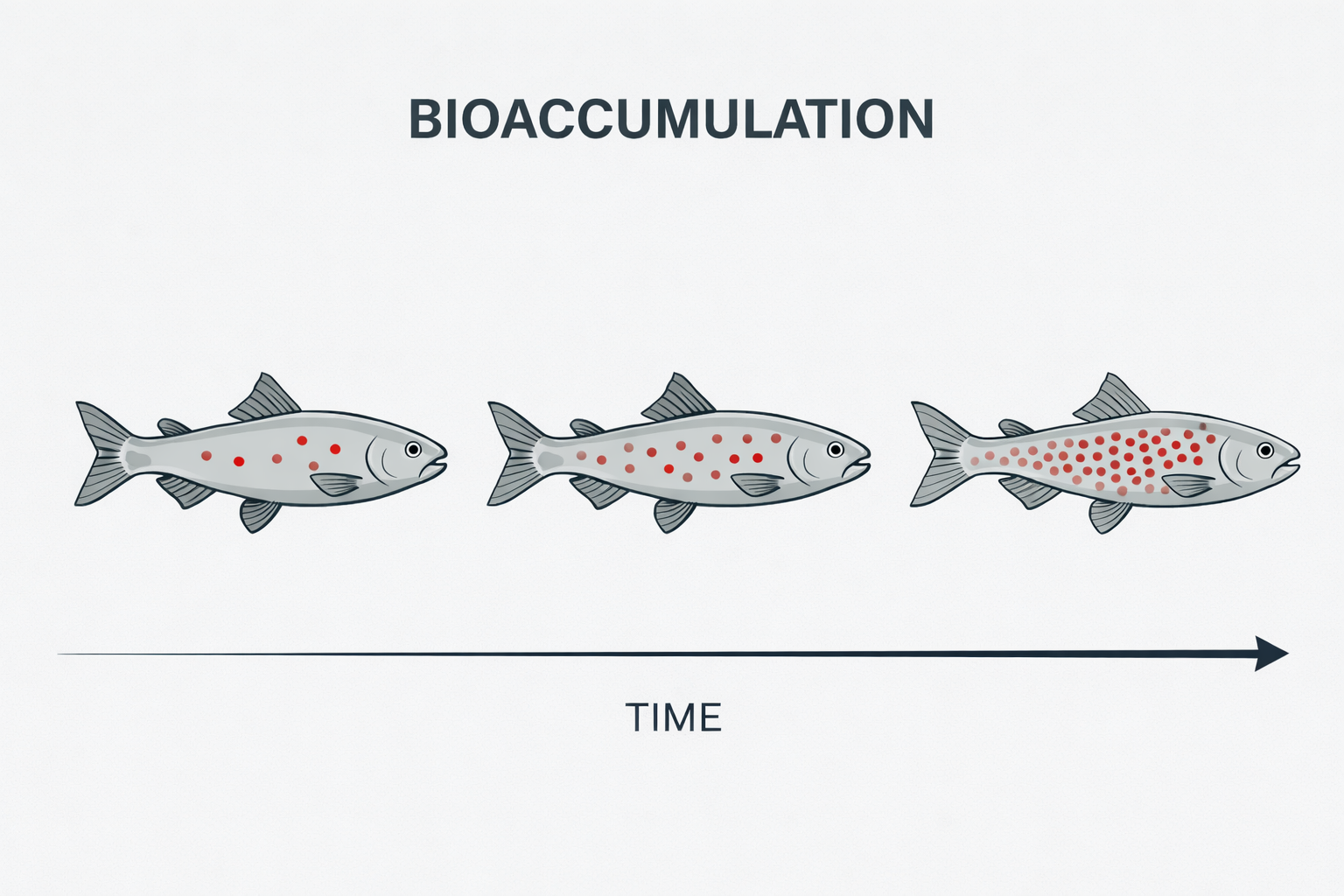
Bioaccumulation occurs when a substance enters an organism and is retained faster than it is metabolized, excreted, or otherwise eliminated. Under normal circumstances, many compounds absorbed through food, water, or direct contact with the environment are processed and removed from the body. Some pollutants, however, resist degradation or elimination and remain stored in tissues for long periods.
When this happens, the concentration of the pollutant in the organism increases over time. That is the essence of bioaccumulation: the same individual gradually carries a larger internal burden of the substance as exposure continues.
Diagram of bioaccumulation showing a fish with increasing amounts of pollutant in its tissues over time.
How bioaccumulation happens
A pollutant may enter the body through food, water, or direct exposure to the surrounding environment. If the substance is not efficiently metabolized or eliminated, it may remain stored in tissues and continue to accumulate with ongoing exposure.
Many lipophilic pollutants tend to accumulate in adipose tissue because they dissolve readily in fats. Persistent organic pollutants often behave in this way. Other contaminants, including some metals, may accumulate in different tissues depending on their chemical properties. The biological consequences of bioaccumulation depend on the type of pollutant, its concentration, how long it remains in the body, and which tissues are most affected.
This is one reason why persistence matters so much. A pollutant that remains in the body for long periods has more time to accumulate, interfere with biological processes, and potentially be transferred through ecological interactions.
Which pollutants commonly bioaccumulate
Several groups of pollutants may bioaccumulate. Common examples include heavy metals such as mercury, lead, and cadmium, as well as persistent organic pollutants (POPs) such as DDT, hexachlorobenzene, polychlorinated biphenyls, and dioxins.
When mercury is discussed in the context of biomagnification, the especially important form is often methylmercury, an organic form that moves efficiently through aquatic food webs and is much more strongly associated with trophic transfer than inorganic mercury. That distinction matters because not all chemical forms of a contaminant behave in the same way once they enter ecosystems.
How bioaccumulation differs from biomagnification
The distinction is fundamental.
Bioaccumulation is the progressive buildup of a pollutant within the tissues of a single organism over time.
Biomagnification is the increase in pollutant concentration from one trophic level to the next within a food chain or food web.
In other words, bioaccumulation concerns what happens inside one organism, whereas biomagnification concerns what happens across ecological feeding relationships.
A pollutant may bioaccumulate in prey organisms first and then become more strongly concentrated in predators that consume many contaminated prey items. In that sense, bioaccumulation within organisms helps make biomagnification across trophic levels possible.
What biomagnification is
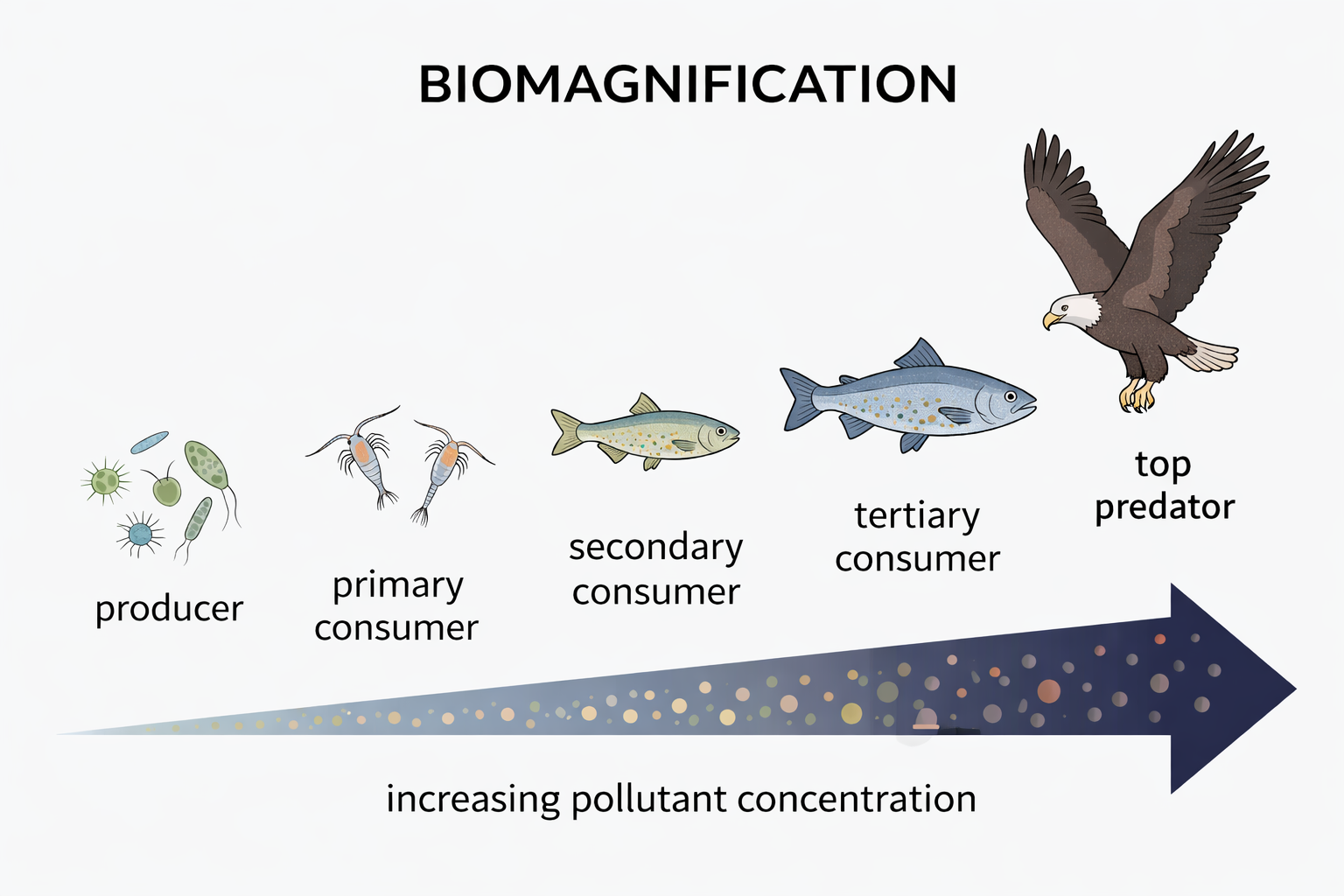
Biomagnification occurs when a pollutant becomes progressively more concentrated at higher trophic levels. This happens because organisms in ecosystems are linked by food chains and food webs. If a predator repeatedly consumes contaminated prey, the pollutant may also accumulate in the predator. As this transfer continues upward through trophic levels, concentrations may become increasingly high in organisms occupying higher positions in the food chain.
That is biomagnification: a persistent pollutant becomes more concentrated as it moves upward through trophic levels.
Diagram of biomagnification showing increasing pollutant concentration along a food chain from producer to top predator.
Not every pollutant biomagnifies. This process is especially associated with substances that are environmentally persistent and resistant to metabolic breakdown. If a compound is rapidly degraded, excreted, or transformed into less persistent forms, it is less likely to become strongly concentrated across trophic levels.
Why top predators are more affected
In a biomagnification scenario, organisms at the base of the food chain usually show the lowest concentrations of the pollutant. In aquatic ecosystems, for example, plankton and small invertebrates may contain relatively low concentrations, whereas larger predators feeding on contaminated prey may accumulate much greater amounts.
By the time the pollutant reaches top predators, concentrations may be far higher than those found at lower trophic levels. This is why predatory fish, birds of prey, marine mammals, and other top consumers are often especially vulnerable to the effects of persistent contaminants.
Bar graph showing mercury concentrations increasing across trophic levels, with the highest concentrations in top predators.
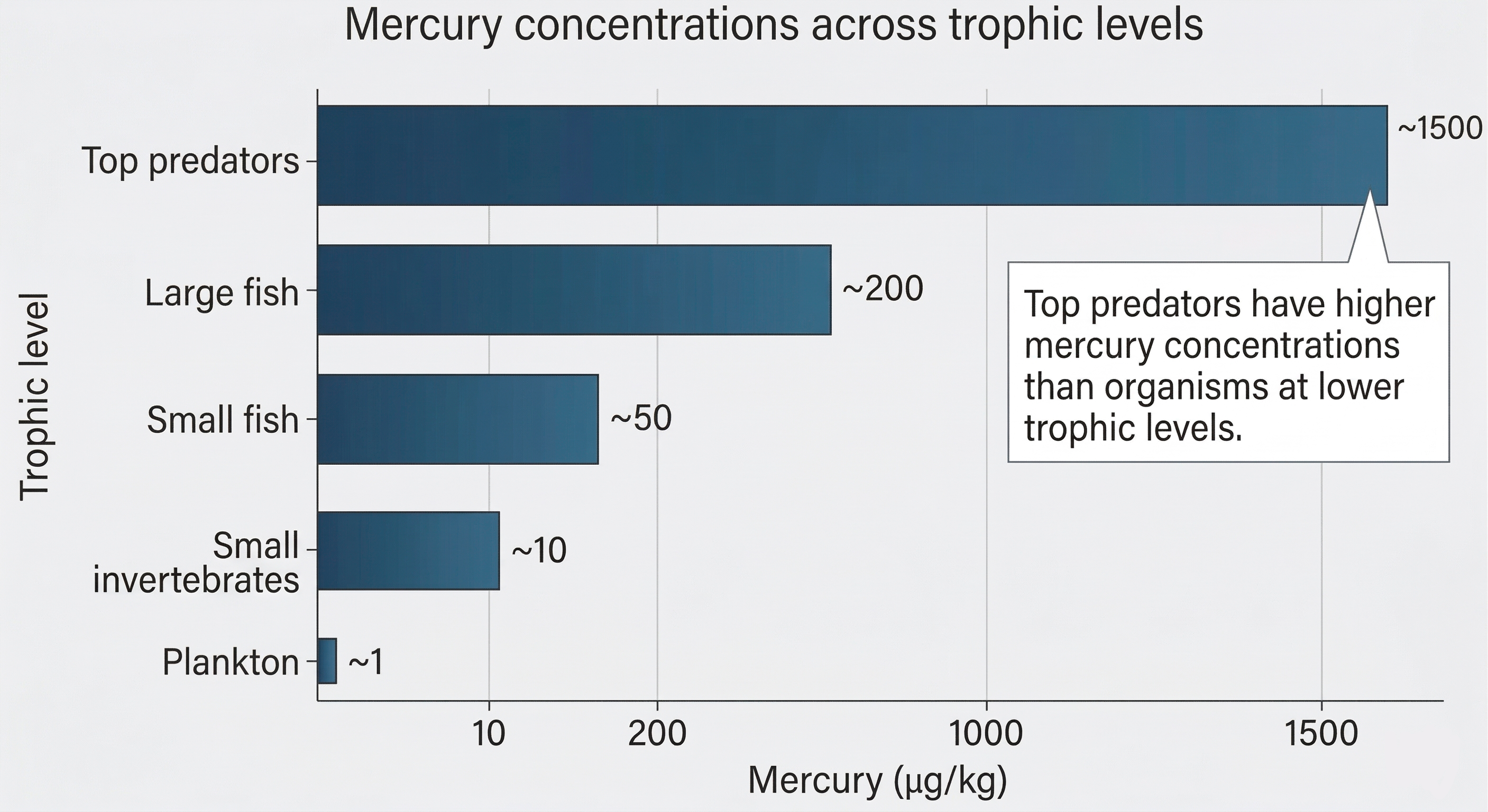
The ecological consequence is important: contamination does not remain evenly distributed across a community. It becomes disproportionately concentrated in organisms that occupy higher trophic positions, which can intensify toxic effects at the top of the food web.
A classic example: DDT
A classic example associated with biomagnification is DDT, a persistent organic pollutant historically used as an insecticide in agriculture and vector control. Its chemical stability made it useful for pest control, but that same persistence also meant that it remained in the environment for long periods instead of being rapidly degraded into less harmful compounds.
Because DDT is persistent and can move through food webs, it became one of the best-known examples of how a chemical may bioaccumulate and biomagnify. Over time, evidence of its ecological effects contributed to major restrictions and bans in many countries.
One of the most widely discussed biological consequences associated with DDT exposure was eggshell thinning in birds, a problem linked to interference with calcium metabolism and reproductive success. That example became especially influential because it showed that persistent contaminants could affect not only survival, but also reproduction, population stability, and ecosystem structure.
The importance of DDT in environmental science lies not only in its history, but also in what it revealed: substances that persist in the environment can have consequences far beyond their original target, especially when they enter food webs and become concentrated in organisms at higher trophic levels.
A more contemporary example: PFAS
A more contemporary group of contaminants often discussed in environmental toxicology is PFAS, short for per- and polyfluoroalkyl substances. These compounds are sometimes called “forever chemicals” because many of them are highly persistent in the environment and resistant to degradation.
PFAS do not replace DDT as a classic historical example, but they do illustrate how concerns about persistence, bioaccumulation, and ecological exposure remain highly relevant today. Their presence in water, wildlife, and human-associated environments has drawn attention precisely because long-lasting contaminants can continue to circulate through natural and human systems long after their release.
Why these processes matter in ecology and environmental health
Bioaccumulation and biomagnification are not merely theoretical ecological concepts. They are directly relevant to environmental health, wildlife conservation, toxicology, and public health.
These processes matter because pollutants may remain in organisms long after initial exposure, intensify over time, and become especially concentrated in higher trophic levels. They also matter because humans are part of food webs. When persistent pollutants accumulate in organisms used as food, ecological contamination may become a broader environmental and health concern.
They also remind us that the impact of a pollutant cannot be understood only by measuring how much of it was originally released. Its persistence, chemical form, movement through ecosystems, retention in tissues, and transfer across feeding relationships all influence how serious its biological effects may become.
Key takeaway
The difference between bioaccumulation and biomagnification is essential.
Bioaccumulation is the progressive buildup of a pollutant within the tissues of a single organism over time. Biomagnification is the increase in pollutant concentration from one trophic level to the next within a food chain or food web.
Together, these processes show why environmental pollutants cannot be understood only by looking at where they were released. Their persistence, movement through ecosystems, retention in tissues, and transfer through feeding relationships all matter.
Reducing these risks depends on multiple strategies: developing safer chemicals, favoring compounds that degrade more rapidly, minimizing toxic residues, strengthening environmental monitoring, and supporting regulation and prevention efforts that limit the spread of persistent pollutants in nature.
Frequently asked questions
What is the difference between bioaccumulation and biomagnification?
Bioaccumulation is the progressive buildup of a pollutant within the tissues of a single organism over time. Biomagnification is the increase in pollutant concentration from one trophic level to the next within a food chain or food web.
Does bioaccumulation happen before biomagnification?
In many cases, yes. Biomagnification depends on pollutants being retained in organisms that are then consumed by other organisms. In that sense, bioaccumulation within prey helps make biomagnification possible across trophic levels.
Do all pollutants bioaccumulate?
No. Bioaccumulation is more likely when a substance persists in the body and is not rapidly metabolized or excreted. Some pollutants are eliminated relatively efficiently, while others remain stored in tissues for long periods.
Do all pollutants biomagnify?
No. Biomagnification is most strongly associated with pollutants that are persistent and resistant to degradation or elimination. Not every substance that enters an organism will become more concentrated at higher trophic levels.
Why are top predators more affected by biomagnification?
Top predators feed on organisms that have already accumulated pollutants from lower trophic levels. As a result, contaminants may become increasingly concentrated as they move upward through the food chain, leading to the highest concentrations in organisms at the top.
Why is methylmercury so important in this context?
Methylmercury is especially important because it moves efficiently through aquatic food webs and is strongly associated with trophic transfer. It is therefore much more relevant to biomagnification than inorganic mercury in many ecological contexts.
Are bioaccumulation and biomagnification common only in aquatic ecosystems?
No. They can occur in both aquatic and terrestrial ecosystems. However, aquatic food webs are often used in examples because pollutant transfer across trophic levels is especially well documented there.
Is DDT an example of bioaccumulation, biomagnification, or both?
DDT can illustrate both processes. It may accumulate within the tissues of individual organisms over time, and it may also become more concentrated across trophic levels as contaminated organisms are consumed by predators.
Why are PFAS often mentioned in modern discussions of contamination?
PFAS are often mentioned because they are highly persistent and have become important contemporary examples of long-lasting environmental contaminants. Their persistence helps explain why they are receiving so much attention in toxicology and environmental health.
Do humans also face risks from these processes?
Yes. Humans are part of food webs, and exposure may occur through contaminated food, water, or environmental contact. This is one reason why persistent pollutants are important not only in ecology, but also in environmental health and public health.
How can the risks of bioaccumulation and biomagnification be reduced?
Risk reduction depends on preventing the release of persistent pollutants, developing safer and less persistent chemicals, improving environmental monitoring, strengthening regulation, and reducing exposure throughout ecosystems and food chains.
Explore more in GlobalBioverse
Visit the GlobalBioverse hub to explore more English-language Biology content.
Go to GlobalBioverseSupport this project
If this article helped you understand Biology more clearly, you can support the project through Buy Me a Coffee. Every contribution helps sustain independent educational content built on clarity, depth, and respect for knowledge.
Support GlobalBioverse Aprendendo Biologia