Quick summary: The difference between convergent and divergent evolution is one of the most important distinctions in evolutionary biology. Homologous structures reflect shared ancestry, while analogous structures reflect functional similarity that evolved independently. In other words, organisms may look similar for very different historical reasons, and they may look different even when they share the same evolutionary origin. Evolution is not read from appearance alone. It is read from history.
Contents
- Convergent vs. divergent evolution: the core difference
- Why similarity can be misleading in evolution
- What is divergent evolution?
- Homologous structures: shared ancestry beneath different forms
- What is convergent evolution?
- Analogous structures: similar solutions, separate histories
- Why these concepts matter in phylogeny
- How biologists tell them apart in practice
- Frequently asked questions
Did you know that a human arm is evolutionarily more closely related to a whale flipper than a shark fin is to a dolphin fin, even though the shark and the dolphin may look more alike at first glance?
That single contrast reveals a central lesson of evolutionary biology: resemblance can be informative, but it can also be deceptive. Some similarities reflect common ancestry. Others arise because different organisms, facing similar selective pressures, evolve similar adaptive solutions. And some of the most striking differences in nature emerge from structures that were inherited from the same ancestral framework.
This is why so many readers search for the difference between convergent and divergent evolution, or between homologous and analogous structures. These concepts are closely related, but they are not interchangeable. Understanding them is essential if we want to move beyond visual similarity and actually interpret evolutionary history.
In evolutionary biology, a structure is never just a shape. It is a historical product: a form shaped by inheritance, modification, constraint, and selection across time. That is why biologists do not ask only what a trait looks like or what it does. They ask where it came from, how it developed, and what kind of evolutionary pathway produced it.
This article explains convergent vs. divergent evolution, clarifies the distinction between homologous and analogous structures, and shows why these concepts matter in phylogeny. The goal is not simply to define a few terms. The goal is to understand how biologists read the history of life through form, function, and ancestry.
Convergent vs. divergent evolution: the core difference
At the broadest level, the difference between convergent and divergent evolution lies in the historical direction of change.
Divergent evolution begins with shared ancestry and leads to increasing difference over time.
Convergent evolution begins with separate lineages and leads to independently evolved similarity.
This is why homologous structures are typically associated with divergence: they come from a shared ancestral origin but may be modified for different functions. And this is why analogous structures are typically associated with convergence: they perform similar roles but arose through separate evolutionary routes.
That basic contrast gives the reader a reliable map for the rest of the article. But the real value of these concepts appears when we look more closely at how biological similarity actually works.
Why similarity can be misleading in evolution
At first glance, similarity seems like obvious evidence of relationship. If two organisms look alike, the intuitive conclusion is that they must be closely related. But evolution does not always reward intuition.
Some similarities reflect inheritance from a common ancestor. Others emerge because different lineages, facing similar selective pressures, evolve similar adaptive solutions. These are not equivalent explanations. A resemblance caused by shared ancestry tells one story; a resemblance caused by independent adaptation tells another.
That distinction matters because natural selection repeatedly works within the limits imposed by physics, biomechanics, ecology, and development. Organisms must move, feed, reproduce, regulate internal conditions, and survive in particular environments. Similar problems can favor similar solutions, even when the organisms involved are not close relatives.
For that reason, evolutionary biologists do not interpret traits from surface appearance alone. They look at morphology, internal anatomy, developmental origin, position within the body, fossil context, and phylogenetic distribution. A wing is not interpreted only as “something that flies.” A limb is not interpreted only as “something used to move.” Each structure must be understood as part of a larger historical and anatomical pattern.
This is one of the first major lessons of evolutionary thinking: biological similarity is meaningful, but it is not self-explanatory. It must be interpreted.
What is divergent evolution?
Divergent evolution is the process by which related lineages become increasingly different over time after descending from a common ancestor.
The starting point is shared ancestry. The result is diversification. As descendant populations occupy different environments, exploit different resources, or experience distinct selective pressures, inherited traits may be modified in different directions.
Over time, this process can reshape morphology, alter function, shift proportions, and generate distinct ecological specializations. A structure that began as part of a shared ancestral body plan may eventually become so transformed that its common origin is no longer obvious to a casual observer.
Divergent evolution is often easiest to visualize when related organisms adapt to different ways of life. Once lineages move into different ecological settings, selection may favor different forms of locomotion, feeding, sensory emphasis, or body organization. These differences accumulate, and what began as variation within a common historical framework becomes a branching pattern of biological diversity.
In some cases, divergent evolution becomes especially pronounced during adaptive radiation, when related lineages diversify relatively rapidly as they exploit different ecological opportunities. The principle remains the same: shared ancestry provides the starting structure, but different evolutionary paths generate different outcomes.
This is why divergent evolution is so important. It explains how organisms can remain deeply related even after becoming strikingly different in appearance and function.
Homologous structures: shared ancestry beneath different forms
Homologous structures are structures that share an evolutionary origin because they were inherited from a common ancestor.
That is the core definition of homology. It does not require the structures to look alike in the present. It does not require them to perform the same function. It does not require them to remain only slightly modified. Homology is about shared origin, not superficial sameness.
The classic example is the forelimb of tetrapods. The human arm, the bat wing, the whale flipper, and the horse forelimb differ greatly in shape, proportion, and use. One is adapted for grasping and manipulation. Another is specialized for powered flight. Another functions in aquatic locomotion. Another supports fast running on land. Yet all of them derive from the same ancestral forelimb framework.
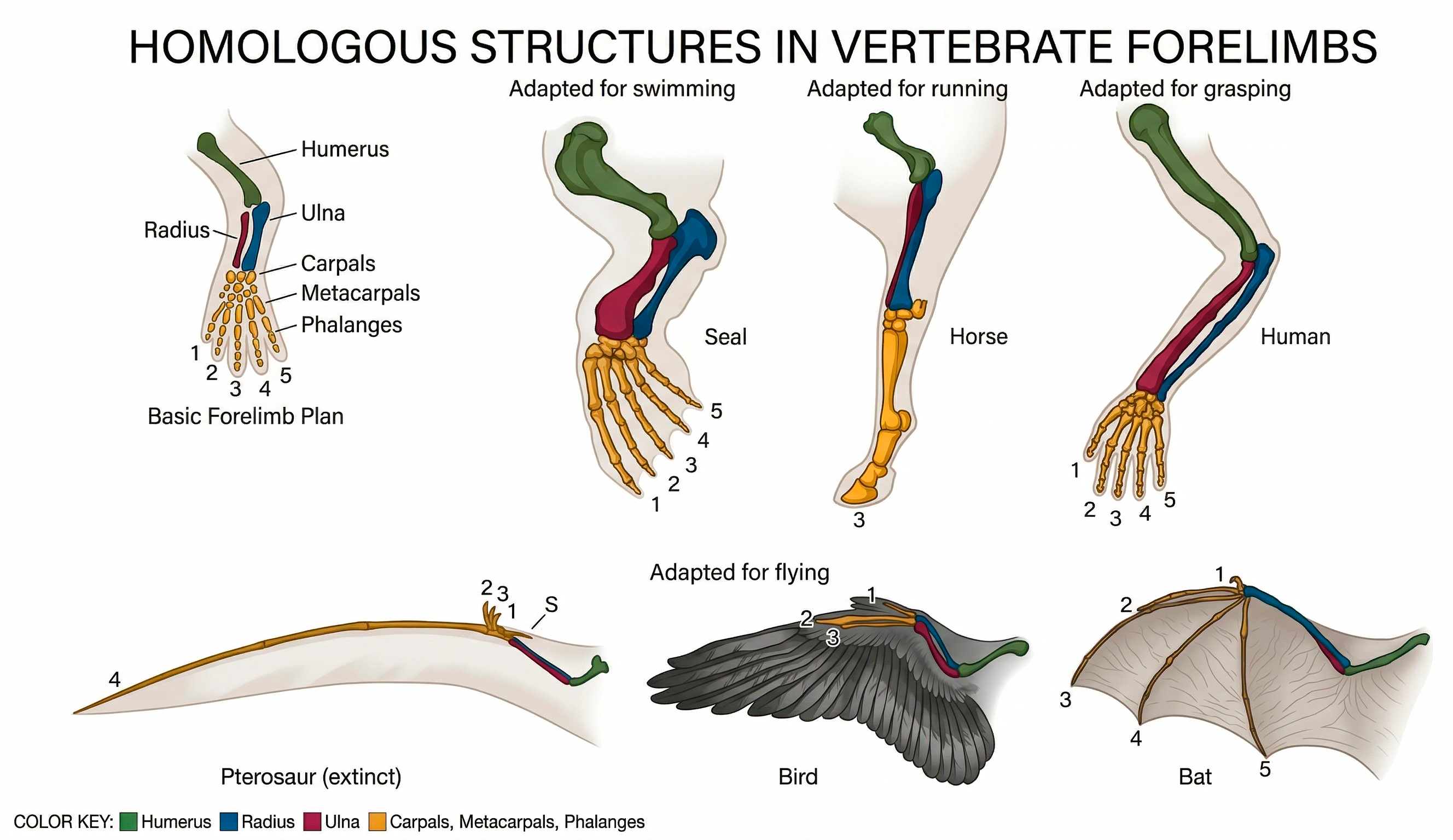
Figure 1 makes this point especially clear by showing how the same underlying skeletal plan can be reorganized into very different functional outcomes. The important pattern is not that these limbs still look alike in any superficial sense, but that the humerus, radius, ulna, wrist elements, and digits remain historically continuous even after extensive modification. Evolution has altered proportions, reduced or elongated parts, and changed mechanical use, but it has not erased common origin.
This is one of the clearest divergent evolution examples in all of biology. The structures are homologous because they reflect shared ancestry, but they became different through evolutionary divergence. Same origin, different outcomes.
That point is essential for understanding homologous and analogous structures correctly. A reader who assumes that homology means “looks the same” will miss the real biological meaning of the concept. Homology refers to continuity through descent. Evolution can stretch, reduce, fuse, reorient, and repurpose a structure while preserving its historical identity.
Homology does not depend on current function
A homologous structure can be used for grasping, swimming, flying, digging, or running. The current function may differ radically among descendant lineages, but that does not erase common origin.
This happens because evolution does not design structures from nothing each time a new challenge appears. It modifies what is already present. Natural selection works on inherited material. That is why the same ancestral framework can be transformed into very different biological tools. In Figure 1, this becomes almost impossible to miss: a limb adapted for swimming, one adapted for running, one adapted for grasping, and one adapted for flight can all preserve the same deeper anatomical identity. The visible differences are real, but they are differences built from the same inherited plan.
Why homology matters in phylogeny
The importance of homology in phylogeny is hard to overstate. Phylogenetic analysis depends on traits that preserve signals of common descent. When a character is correctly identified as homologous, it can help biologists reconstruct evolutionary relationships and distinguish genuine relatedness from misleading resemblance.
A homologous trait is not automatically simple to interpret, but it is historically informative. That is why homology is one of the foundations of comparative biology.
A brief note on deep homology
Modern evolutionary developmental biology has added another layer to this discussion through the idea of deep homology.
Deep homology refers to cases in which very different anatomical structures are built using ancient, conserved developmental and genetic regulatory systems. This does not mean that all similar traits are anatomically homologous in the classical sense. Instead, it shows that evolutionary continuity can sometimes be traced at a deeper developmental level even when adult structures differ substantially.
This idea enriches the discussion because it reminds us that evolutionary history is written not only in visible anatomy, but also in the developmental logic that helps produce form.
What is convergent evolution?
Convergent evolution is the process by which unrelated or distantly related lineages independently evolve similar traits under similar selective pressures.
The key word here is independently. The important point is not simply that the traits are similar, but that the similarity evolved separately rather than being inherited as the same trait from a recent common ancestor.
Convergent evolution shows that natural selection can repeatedly favor similar adaptive outcomes when organisms face comparable ecological challenges. Similar problems do not guarantee identical solutions, but they often produce solutions that are similar enough to be striking.
One classic example is the streamlined shape of sharks and dolphins. Sharks are cartilaginous fishes. Dolphins are mammals. Their resemblance does not indicate close evolutionary relationship. Instead, it reflects adaptation to moving efficiently through water. Hydrodynamic demands favor certain body shapes, and evolution can arrive at comparable forms more than once.
This is one of the reasons convergent evolution examples are so valuable in teaching. They show that evolution is not simply a story of shared ancestry branching outward. It is also a story of repeated adaptive logic: different lineages can arrive at similar solutions because some solutions work especially well under similar conditions.
Convergence can involve morphology, physiology, behavior, and ecological strategy. It is one of the clearest demonstrations that similar form does not always mean close kinship.
Analogous structures: similar solutions, separate histories
Analogous structures are structures that perform similar functions but do not share the same evolutionary origin in that specific form.
This is the core of analogy. The structures are similar because they solve similar problems, not because they were inherited from the same ancestral structure in the same way.
The wings of bats and insects are a classic example. Both are used for flight, so they are similar in functional terms. But their structural origins are different. Insect wings are outgrowths of the exoskeleton. Bat wings are modified vertebrate forelimbs in which skin stretches between elongated digits. Their similarity reflects adaptation for flight, not inheritance from a common ancestral wing structure.
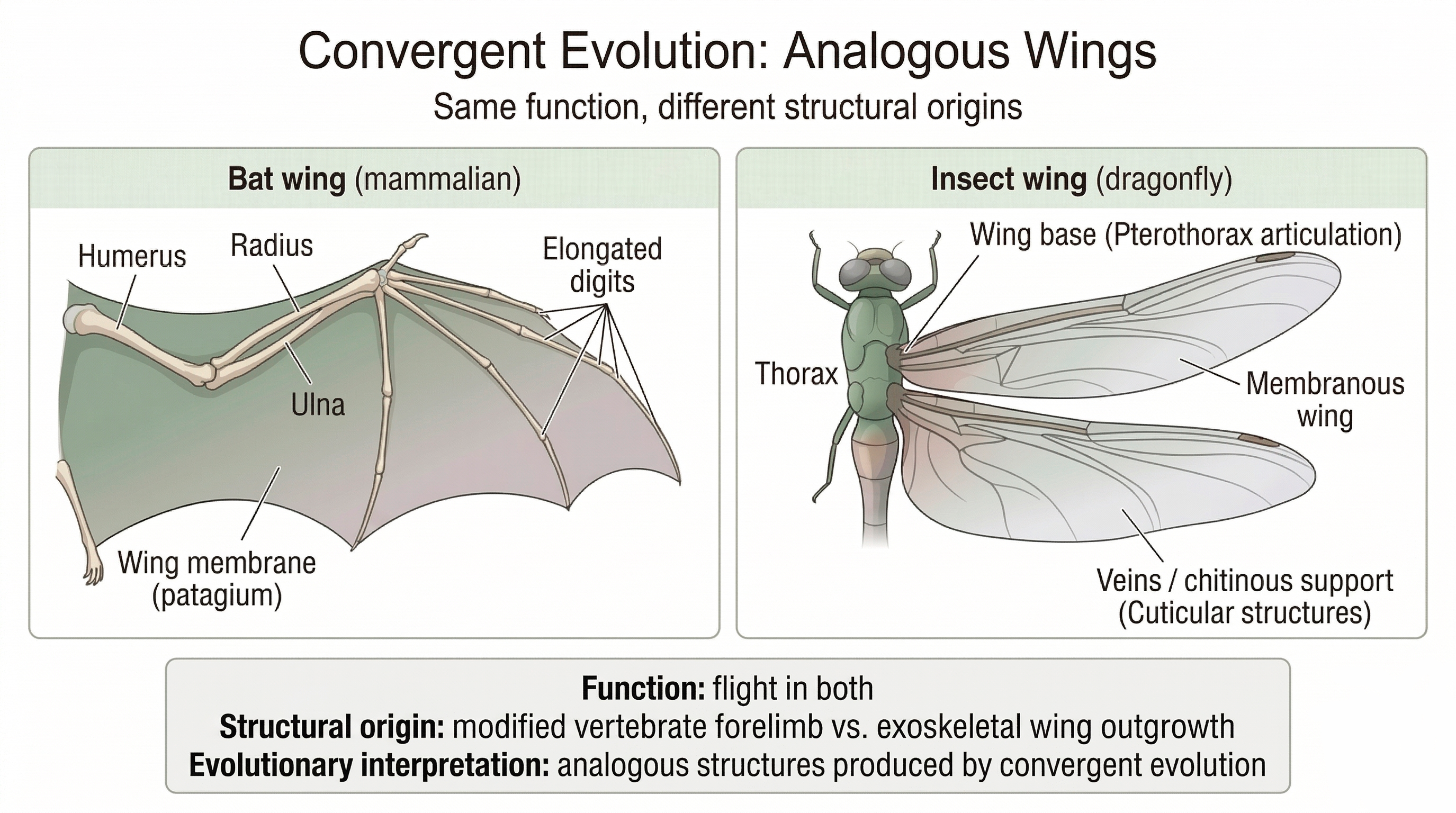
Figure 2 is especially useful here because it prevents a common misunderstanding: the shared function is real, but the biological route to that function is not the same. A bat wing is built from the vertebrate forelimb, with bones that can be compared to those of other tetrapods. An insect wing, by contrast, is not a modified forelimb at all. It is an exoskeletal outgrowth supported by cuticular structures. The flight problem is similar; the structural solution is historically different.
That is why the distinction between homology vs. analogy matters so much. Two traits may look alike and even perform similar roles, yet their histories may be entirely different. If we confuse analogy with homology, we risk confusing adaptation with ancestry.
Analogy is not a lesser category of similarity. It is one of the clearest windows into the repeated adaptive logic of evolution. It shows that natural selection can produce similar biological answers in separate evolutionary contexts.
When homology and analogy depend on the level of comparison
This is where the topic becomes genuinely memorable.
The same pair of structures can be analogous at one level of comparison and homologous at another. Bat wings and bird wings are the best-known example. As wings used for powered flight, they are analogous because flight evolved independently in birds and bats. But as vertebrate forelimbs, they are homologous because both derive from the ancestral tetrapod forelimb. Figure 1 helps with the second part of that statement by showing the common forelimb framework that vertebrate lineages continue to modify. Figure 2 helps with the first part by showing that shared aerodynamic function does not require the same structural origin. Taken together, the two figures make the hierarchy of comparison much easier to grasp: one level concerns the deeper anatomical pattern, while another concerns the specialized role that evolution has built from it.
This is not a contradiction. It is a consequence of the hierarchical nature of biological traits.
In other words, when readers ask whether two structures are homologous or analogous, the most scientifically honest response is often another question: compared in what sense? Are we comparing overall function? Underlying anatomy? Developmental origin? Position within the body plan?
This is one of the most important refinements a reader can learn from the distinction between homologous and analogous structures. Biology is rarely served well by rigid either-or thinking. Precision matters. Level of comparison matters. Historical interpretation matters.
Once this is understood, the discussion moves beyond anatomy alone. The distinction between homology and analogy becomes essential for phylogenetic reasoning, because evolutionary history must separate inherited similarity from independently evolved resemblance. Evolution is not read from appearance alone. It is read from history.
Why these concepts matter in phylogeny
These concepts are not just useful definitions. They are central to phylogenetic reasoning.
Phylogeny seeks to reconstruct the evolutionary relationships among organisms. To do that well, biologists need characters that reflect real patterns of descent. Homologous characters are informative because they can track common ancestry. By contrast, convergent characters may introduce noise if they are mistaken for evidence of shared descent.
This is where homoplasy becomes essential.
Homoplasy refers to similarity that is not inherited from the most recent common ancestor in the same form. Convergent evolution is one major source of homoplasy. When separate lineages independently evolve similar traits, they may create the illusion of close relationship even when no such relationship exists at that level.
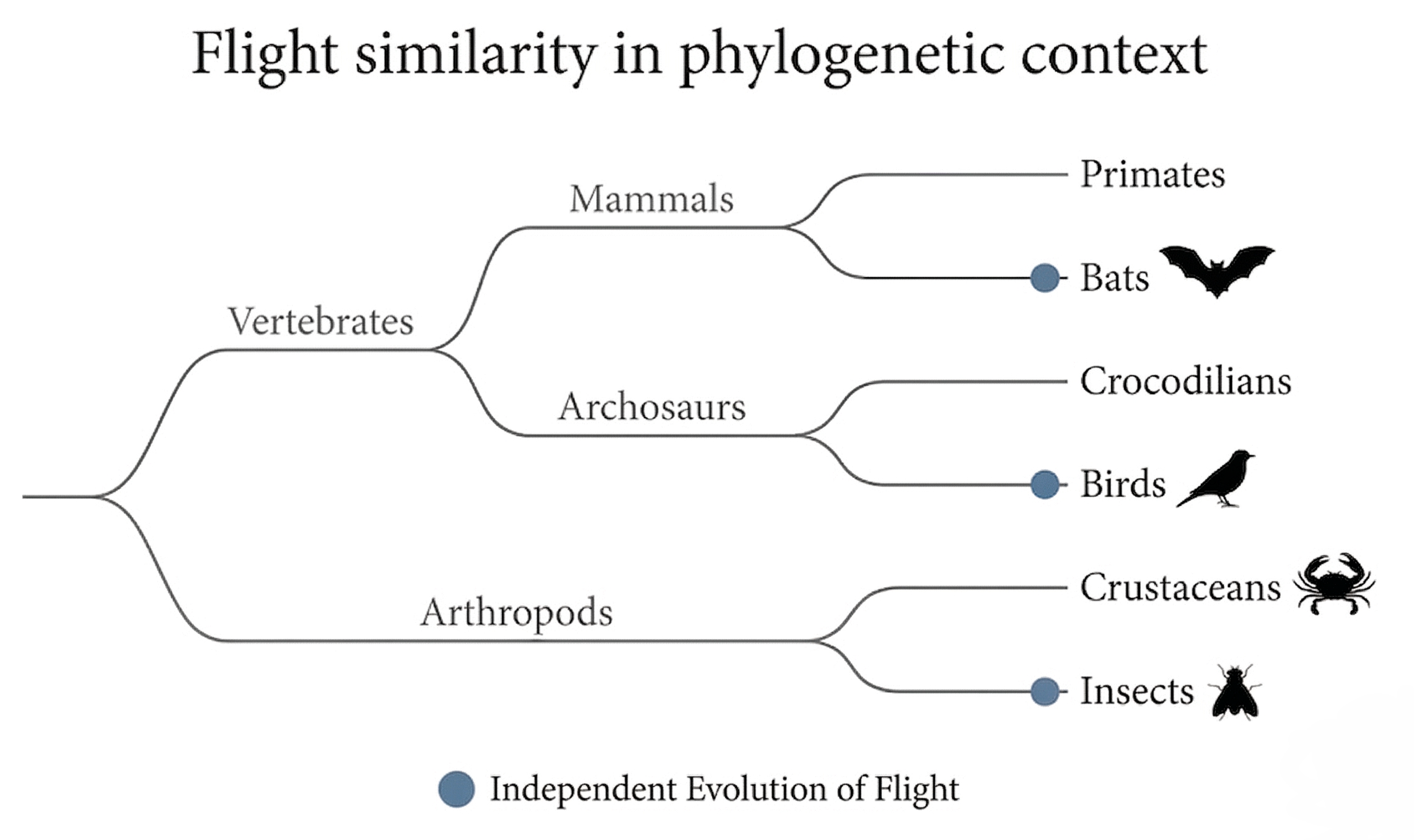
Figure 3 captures this problem with unusual economy. Birds, bats, and insects all fly, but flight does not place them together as a close natural group. The figure matters not because it simply labels distant branches, but because it forces the reader to reinterpret an intuitive mistake: functional resemblance can be phylogenetically misleading. Bats are mammals, birds belong to the archosaur lineage, and insects are arthropods. Once that branching pattern is clear, the shared presence of flight stops looking like evidence of close common ancestry and starts looking like independent convergence.
That is why phylogenetic analysis does not rely on a single striking feature. A robust interpretation compares multiple characters and asks whether they form a consistent historical pattern. Increasingly, this also involves molecular evidence, which can help clarify cases in which morphology is ambiguous or strongly shaped by convergence.
Understanding homology in phylogeny therefore means understanding more than simple resemblance. It means recognizing that some similarities are historically informative and others are historically misleading. Two organisms may look similar, but the real question is why they look similar. Did they inherit the trait from a common ancestor, or did evolution arrive at a similar solution more than once? Figure 3 offers the phylogenetic version of that question: not “who looks alike?” but “what does that similarity actually mean in the history of descent?”
That question sits at the heart of phylogenetic inference.
How biologists tell them apart in practice
Biologists distinguish homology from analogy by combining multiple lines of evidence rather than trusting surface resemblance alone.
The main approaches include:
Comparative anatomy, which examines internal structure, positional relationships, and overall organization.
Developmental evidence, which looks at how a structure forms during embryonic and post-embryonic development.
Fossil evidence, which may reveal transitional forms and historical continuity.
Phylogenetic distribution, which evaluates how a trait is distributed across related and unrelated groups.
Genetics and developmental pathways, which can sometimes reveal deeper continuity or independent assembly of similar traits.
No single criterion is always enough by itself. Evolutionary interpretation is strongest when different kinds of evidence converge on the same historical explanation. In practice, Figures 1 through 3 mirror these different kinds of reasoning rather well. Figure 1 emphasizes comparative anatomy and structural continuity. Figure 2 emphasizes the distinction between similar function and different origin. Figure 3 emphasizes phylogenetic distribution and the danger of reading similarity without historical context. Together, they reinforce a central methodological point: biologists do not classify traits by appearance alone, but by integrating anatomy, development, evolutionary history, and branching relationships.
That is why the distinction between homology vs. analogy is not a matter of memorizing labels. It is a matter of reconstructing trait history with as much accuracy as possible. The deeper question is never just whether two things look alike. The deeper question is whether they are alike for the same historical reason.
Conclusion
The difference between convergent and divergent evolution is ultimately a difference in evolutionary history.
Divergent evolution begins with shared ancestry and leads to increasing difference. Convergent evolution begins with separate lineages and leads to independently evolved similarity. Homologous structures reflect shared origin. Analogous structures reflect similar adaptive roles without the same structural ancestry in that specific form.
These distinctions matter because they change how we read the living world. A whale flipper and a human arm may look different and still reveal common descent. A shark and a dolphin may look similar and still reveal separate evolutionary routes shaped by similar selective pressures.
Once we stop treating resemblance as self-explanatory, evolutionary biology becomes far more powerful. It no longer asks only what organisms look like. It asks why they came to look that way, what kind of history shaped them, and what that history reveals about the branching and repeated patterns of life on Earth.
Evolution is not read from appearance alone. It is read from history.
Continue reading in GlobalBioverse
If you want to keep building the broader evolutionary and ecological context behind this topic, these articles connect especially well with the ideas discussed here:
Frequently asked questions
What is the difference between convergent and divergent evolution?
Divergent evolution starts from a shared ancestor and produces increasing difference among descendant lineages. Convergent evolution starts from separate lineages and produces similar traits that evolved independently under similar selective pressures.
What are homologous and analogous structures?
Homologous structures share a common evolutionary origin, even if they now look different or perform different functions. Analogous structures perform similar functions but do not share the same structural origin in that specific form.
Are homologous structures always similar in function?
No. Homologous structures are defined by shared ancestry, not by shared function. The same ancestral structure may be modified for grasping, flying, swimming, or running in different lineages.
Are analogous structures always completely unrelated?
Not in every possible sense. Two structures may be analogous at the level of function but still include homologous elements at a deeper anatomical level. Bat and bird wings illustrate this especially well.
Why is convergence important in phylogeny?
Because convergence can create misleading similarity. If independently evolved traits are mistaken for homologous ones, they can distort the reconstruction of evolutionary relationships.
What is homoplasy?
Homoplasy is similarity that did not arise from inheritance from the most recent common ancestor in the same form. Convergent evolution is one of its most important causes.
What is deep homology?
Deep homology refers to cases in which very different structures are shaped by ancient, conserved developmental and genetic mechanisms. It points to continuity at a deeper biological level than visible anatomy alone.
Can natural selection produce similar traits in unrelated organisms?
Yes. That is one of the clearest outcomes of convergent evolution. Similar ecological demands can favor similar adaptive traits in lineages with very different histories.
Explore more in GlobalBioverse
Visit the GlobalBioverse hub to explore more English-language Biology content.
Go to GlobalBioverseSupport this project
If this article helped you understand the topic more clearly, consider supporting this project. Your contribution helps sustain independent, rigorous, and accessible Biology education for students, educators, and curious readers.
Support this project Aprendendo Biologia