Quick summary: Natural selection is the evolutionary process by which heritable traits become more or less common depending on how they affect survival and reproductive success. To understand it clearly, it is essential to distinguish mutation, variation, differential reproduction, adaptation, and acclimation. This article examines how selection acts on phenotypes, why heritable variation matters, and how directional, disruptive, and stabilizing selection reshape trait distributions over time.
Contents
What natural selection is
Natural selection is one of the central ideas in Biology because it explains how populations change across generations without invoking purpose, intention, or need. Organisms do not develop useful traits because they want them or because the environment somehow gives them what they lack. Instead, populations already contain variation, and some of that variation affects how likely individuals are to survive and reproduce.
That distinction matters because natural selection is often misunderstood. Mutation introduces new genetic variants. Variation is the raw material already present in a population. Natural selection sorts that variation according to how it performs in a particular environment. Adaptation is the longer-term evolutionary outcome that emerges when certain heritable traits are consistently favored.
Another clarification is equally important: individuals do not evolve in the population-genetic sense; populations do. An individual organism may survive, die, reproduce, or fail to reproduce, but evolution occurs when the frequencies of heritable traits change from one generation to the next. Natural selection, then, is not simply a story about “the strongest surviving.” It is a process of unequal reproductive success among individuals with different phenotypes.
A simple beetle example makes this easier to visualize. Imagine a population with two heritable color variants: a wild-type yellow phenotype and a mutant green phenotype. If predators detect yellow beetles more easily, those individuals are consumed more often, whereas green beetles are more likely to survive. Over generations, because green beetles survive predation more frequently and leave more offspring on average, the frequency of the green phenotype increases in the population.
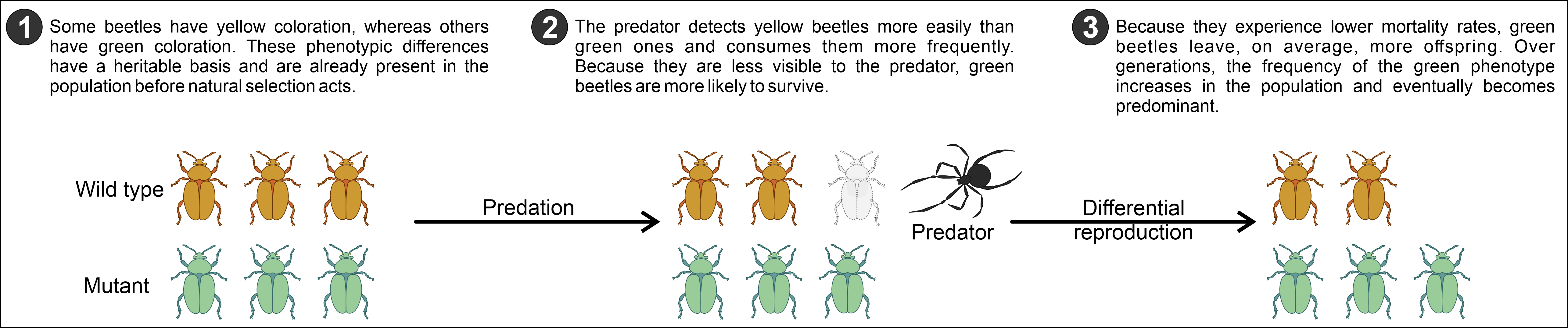
In this beetle population, the yellow wild-type and green mutant phenotypes are already present before selection occurs. Predation does not create the green phenotype; it changes survival and reproduction among phenotypes that already exist. Because green beetles are less visible to the predator, they are attacked less often, survive in greater numbers, and contribute more offspring to the next generation. Over time, this unequal survival and reproduction increases the frequency of the green phenotype in the population.
Why variation matters
Natural selection requires variation within populations. If all individuals were identical with respect to a trait, there would be nothing for selection to favor or disfavor. This variation may involve morphology, physiology, behavior, development, or life-history traits. Body size, pigment pattern, thermal tolerance, beak shape, toxin resistance, developmental rate, and mating displays are all examples of traits that can vary within populations.
Still, not every visible difference has evolutionary significance. Some differences arise mainly from environmental influences rather than inherited genetic variation. For natural selection to generate evolutionary change, the phenotypic differences under selection must be at least partly heritable. In other words, offspring must tend to resemble their parents in the relevant trait.
Consider a population of ants that differs in abdomen size. Some individuals have smaller abdomens, others have intermediate ones, and others have larger ones. This visible spread in phenotype is exactly the kind of variation on which selection may act. By itself, however, variation does not tell us which phenotype will be favored. That depends on ecological conditions. If larger abdomens improve storage capacity during periods of food limitation, larger individuals may leave more descendants. If intermediate size performs best under stable conditions, the outcome changes.
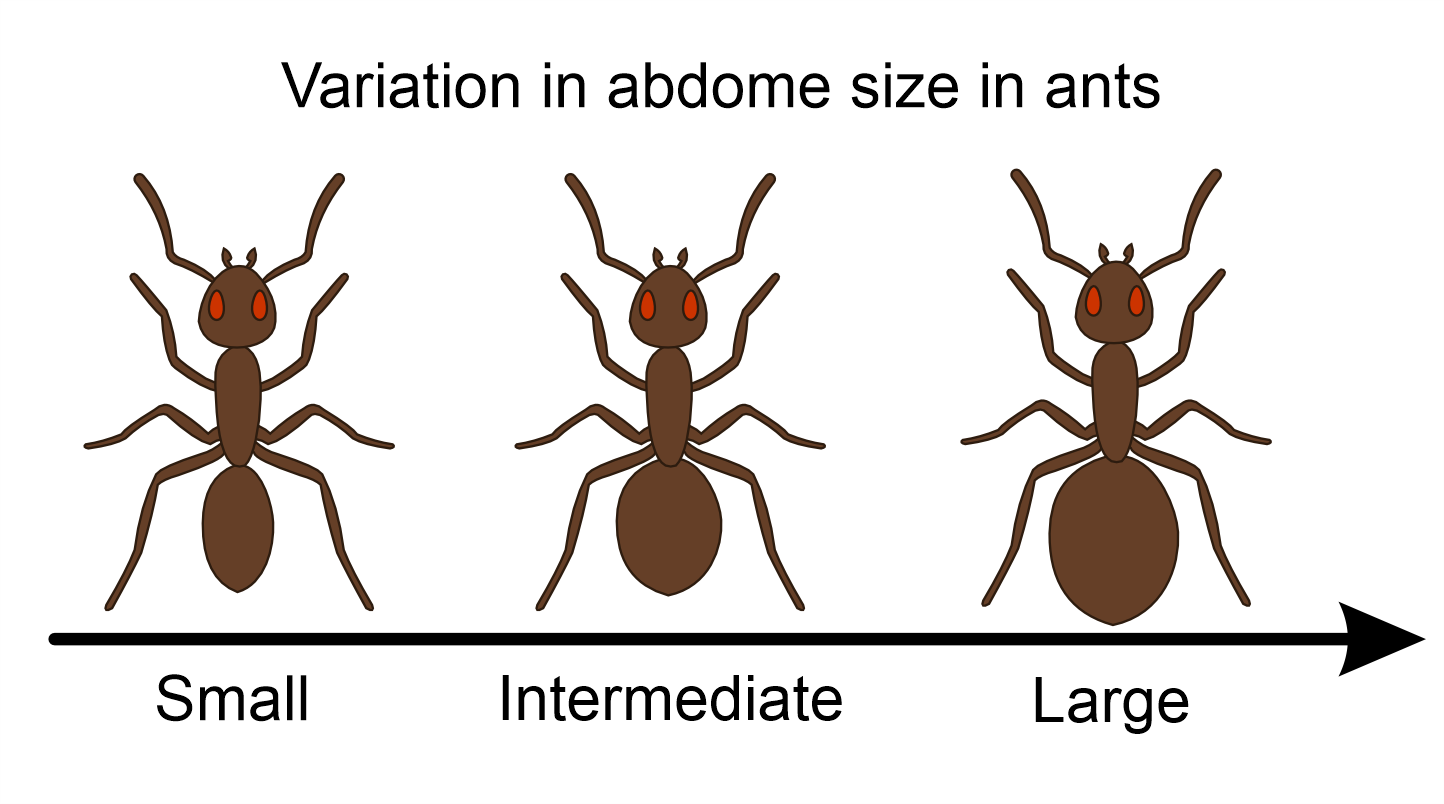
The ant figure shows that individuals within the same population may differ continuously in a trait such as abdomen size. This kind of phenotypic spread is the condition that makes selection possible. At this stage, the figure does not indicate which phenotype is favored; it shows that the population is not phenotypically uniform. Selection can only alter trait frequencies if such variation already exists.
Variation, then, is not a secondary detail. It is the starting point of the whole process. No variation, no sorting by selection. No heritable variation, no cumulative evolutionary response.
Differential reproduction and adaptation
A key expression in evolutionary Biology is differential reproduction. It means that individuals with different phenotypes leave different numbers of descendants. This is the foundation on which natural selection operates.
That idea is broader than simple survival. Surviving long enough to reproduce matters, of course, but reproductive success also depends on finding mates, producing viable offspring, competing effectively, and functioning well in the ecological context of the species. A phenotype may improve survival without increasing reproductive output, and sometimes the reverse may also occur. Natural selection ultimately depends on how traits affect representation in the next generation.
Returning to the beetle example, if predators remove the more visible wild-type yellow beetles more often than the mutant green beetles, green beetles will, on average, survive more frequently and leave more offspring. Over time, the green phenotype becomes more common. That shift in frequency is the evolutionary consequence of differential reproduction.
When a heritable trait increases in frequency because it improves performance in a particular environment, that trait may be described as an adaptation. An adaptation is not just any trait. It is a heritable characteristic that enhances fitness under specific environmental conditions. This is why adaptation is always relative. A trait is not universally advantageous; it is advantageous in a given ecological setting.
A related distinction often causes confusion, so it is worth stating directly. Adaptation is an evolutionary outcome that emerges across generations when heritable traits are favored by selection. Acclimation is an adjustment made by an individual during its own lifetime, usually in response to environmental change. One is population-level and evolutionary; the other is individual-level and physiological or developmental.
Natural selection acts on phenotypes
Natural selection filters phenotypes—the observable traits that actually interact with the environment. A predator does not detect genes directly; it responds to color, movement, shape, smell, or behavior. Temperature does not “test alleles” in the abstract; it affects physiological performance as expressed through the phenotype. Mates do not choose genotypes as invisible molecular entities; they respond to visible, audible, chemical, or behavioral signals.
At the same time, evolutionary change depends on the genetic basis of those phenotypes. If a phenotype is favored but has no heritable component, the population will not show a lasting evolutionary response in that trait. The most precise formulation is this: natural selection acts on phenotypic differences, but evolutionary change requires heritable variation.
This is one reason why selection is so often represented with trait distributions. A population is not a collection of identical organisms. It is a distribution of phenotypes. Some individuals are smaller, larger, darker, lighter, faster, slower, more tolerant, or less tolerant than others. Selection changes the shape of that distribution over generations.
Three classic patterns are commonly described: directional selection, disruptive selection, and stabilizing selection. These are not separate mechanisms in the sense of completely distinct biological laws. They are different statistical patterns showing how selection can reshape phenotypic variation within a population.
Directional selection
Directional selection occurs when one extreme of the phenotypic distribution is favored over the others. As a result, the population mean shifts over time toward the favored extreme.
Using the ant example, suppose that individuals with larger abdomens store more nutrients and therefore reproduce more successfully in an environment where food availability is irregular. Across generations, larger-abdomen phenotypes become more common, and the average abdomen size of the population increases.
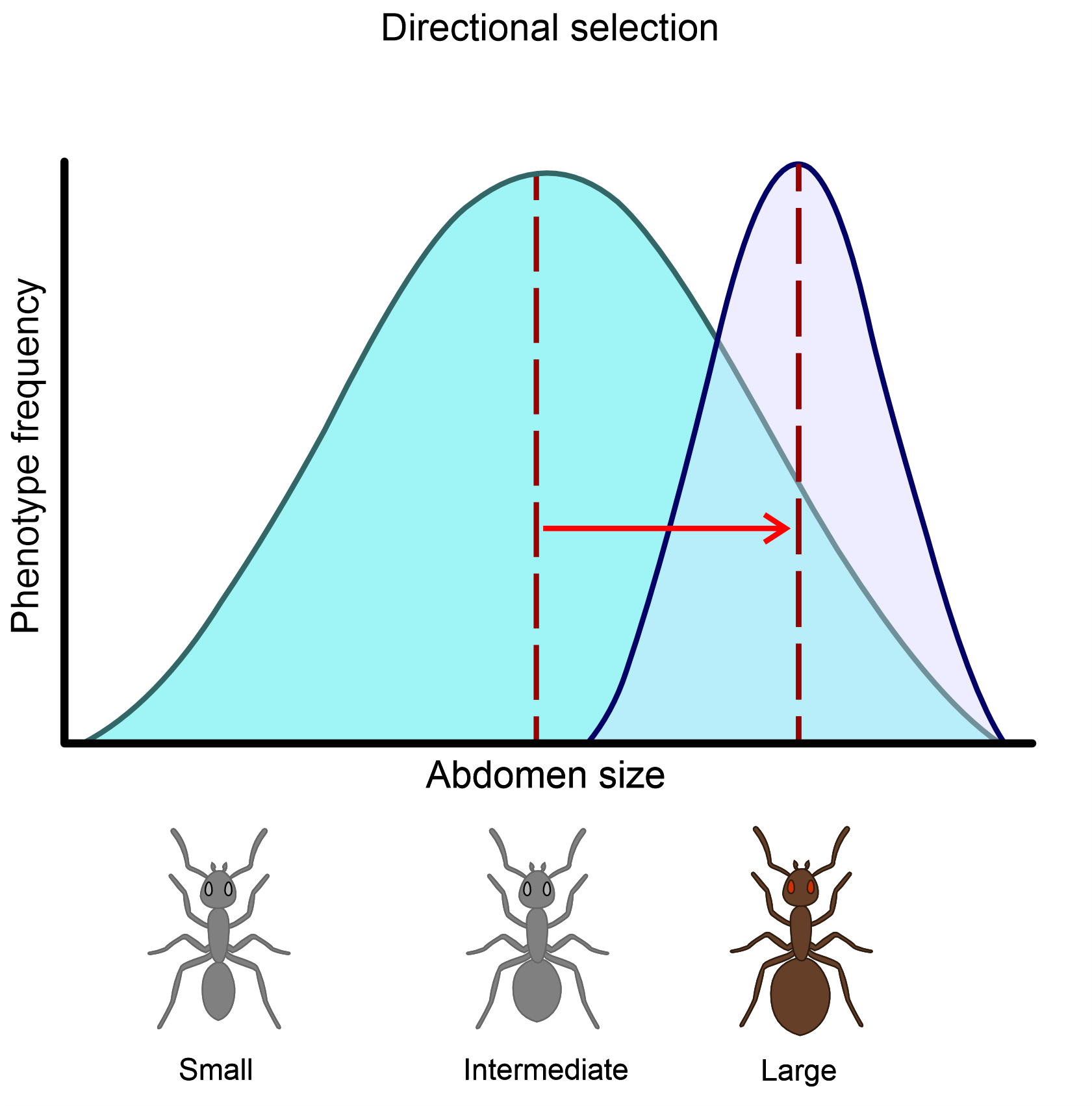
In this pattern, the distribution moves toward one side because the favored phenotype is not the intermediate condition but one extreme. The figure shows that selection does not merely remove some individuals at random. It alters the statistical structure of the population by increasing the frequency of one end of the trait range. This is why directional selection is often associated with environmental change: when conditions shift, a previously uncommon phenotype may become especially advantageous.
Directional selection can also reduce the frequency of alternative phenotypes, but its most recognizable feature is the displacement of the mean trait value. The population does not simply become more uniform; it moves in a particular phenotypic direction.
Disruptive selection
Disruptive selection occurs when intermediate phenotypes are disfavored and both extremes are favored. Instead of one central peak remaining dominant, the population tends to show two peaks, reflecting increased frequency at opposite ends of the distribution.
Again using abdomen size as the example, imagine that ants with very small abdomens perform well in one microenvironment and ants with very large abdomens perform well in another, while intermediate abdomens perform poorly in both. In that case, selection pushes against the middle rather than toward it.
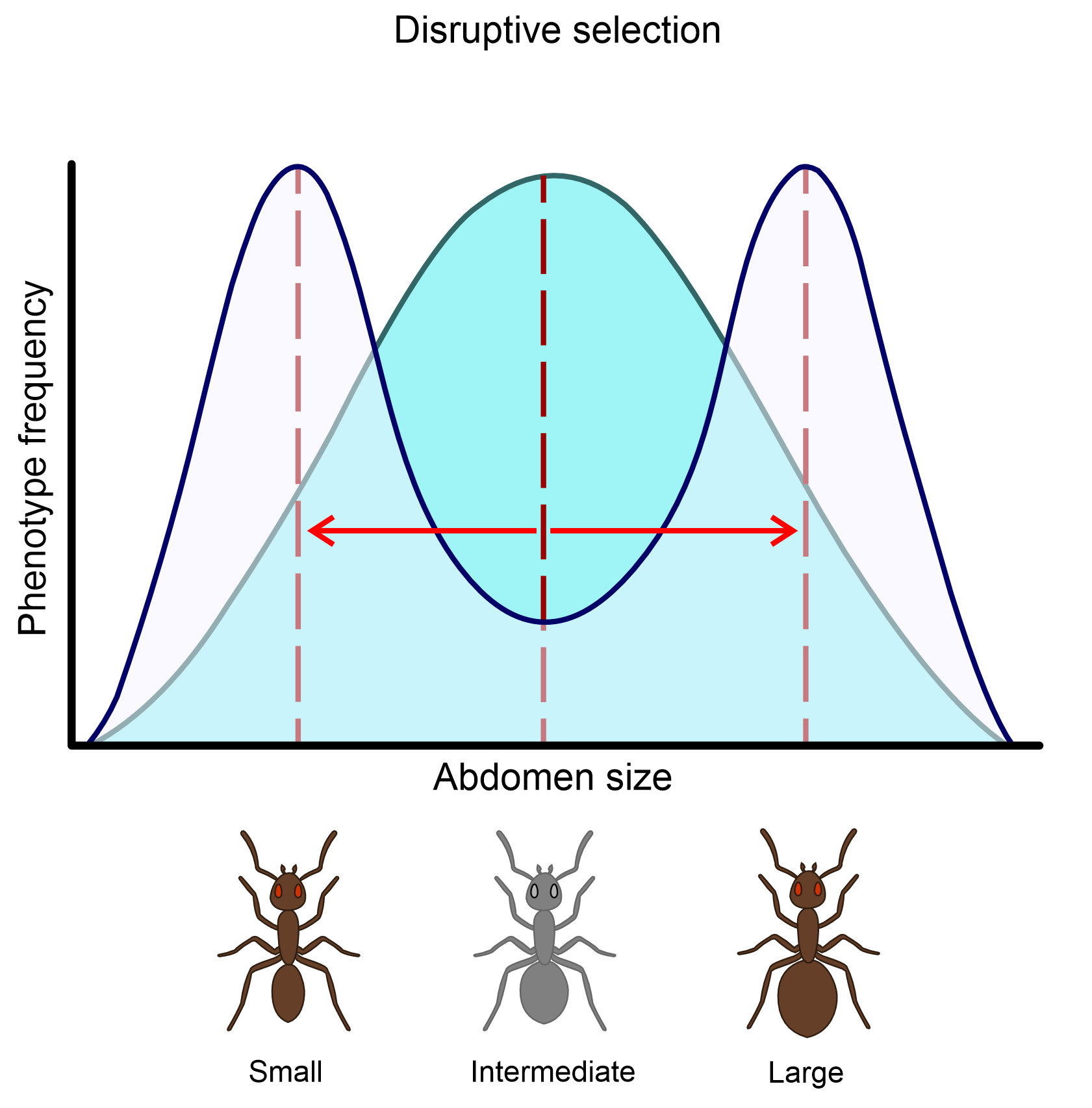
The figure shows that the central portion of the distribution becomes less common while opposite ends increase in frequency. Rather than concentrating variation around a single mean, disruptive selection separates the population into distinct phenotypic clusters. This pattern matters because it increases divergence within the population. Under some conditions, especially if ecological differences are paired with assortative mating or spatial separation, disruptive selection may contribute to evolutionary divergence and, over longer timescales, possibly speciation.
Still, disruptive selection alone should not be treated as an automatic path to new species. It creates a pattern of favored extremes, but additional evolutionary and ecological factors are needed for full reproductive isolation to arise.
Stabilizing selection
Stabilizing selection occurs when intermediate phenotypes are favored and extreme phenotypes are disfavored. In this pattern, the population mean tends to remain relatively similar, while phenotypic variation around that mean decreases.
Using the same trait once more, imagine that very small abdomens limit energy storage, while very large abdomens impose an energetic or mechanical cost. If intermediate size offers the best balance between these trade-offs, individuals near the center of the distribution leave more descendants than those at either extreme.
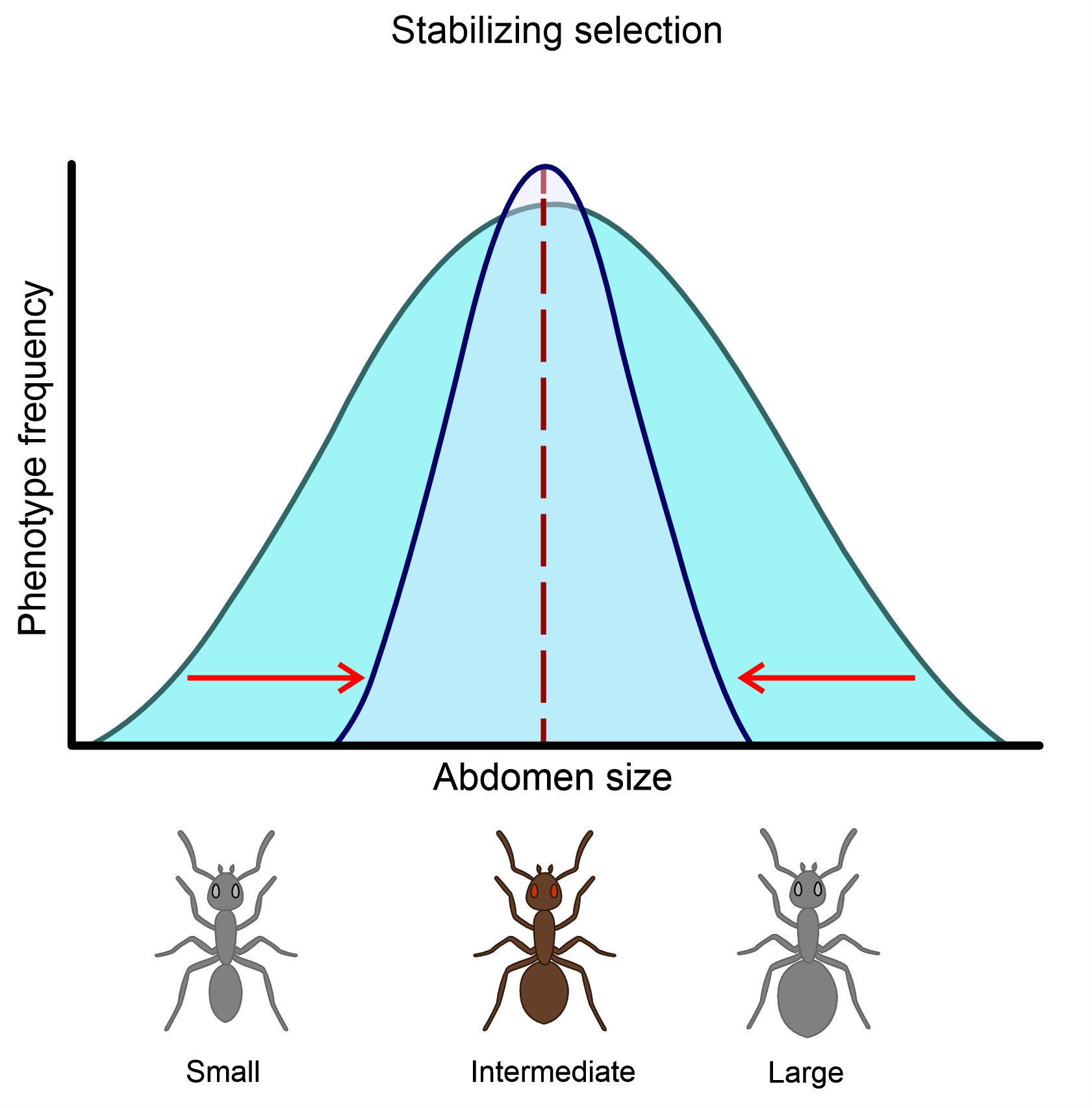
Here, the distribution becomes narrower around the center because extreme phenotypes are removed more often. The figure shows that evolution does not always involve a shift toward one side of the trait range. Sometimes the main effect of selection is to preserve an already successful intermediate phenotype while reducing variance around it. This pattern is common when environmental conditions consistently favor a well-balanced trait value rather than one extreme.
Stabilizing selection is especially useful for showing that evolution does not always produce dramatic directional change. Sometimes the evolutionary response is not a shift in the mean but a reduction in variance around a phenotype that already performs well in that environment.
From variation to evolutionary change
Natural selection links three core ideas: variation, differential reproduction, and adaptation. Populations contain heritable differences. Those differences affect performance in particular environments. Individuals with some phenotypes leave more descendants than others. Over generations, the frequencies of the associated traits change.
This logic explains why natural selection is both simple and powerful. It does not require foresight, intention, or any built-in drive toward perfection. It only requires variation, inheritance, and unequal reproductive success. From those ingredients, populations can change in remarkably complex ways.
It also explains why the three classic patterns of selection matter. Directional selection shifts the distribution toward one extreme. Disruptive selection favors both extremes and weakens the middle. Stabilizing selection preserves the intermediate condition and reduces extremes. Together, these patterns show that evolution is not a single uniform trajectory. It is a response to the specific structure of ecological pressures acting on heritable phenotypic variation.
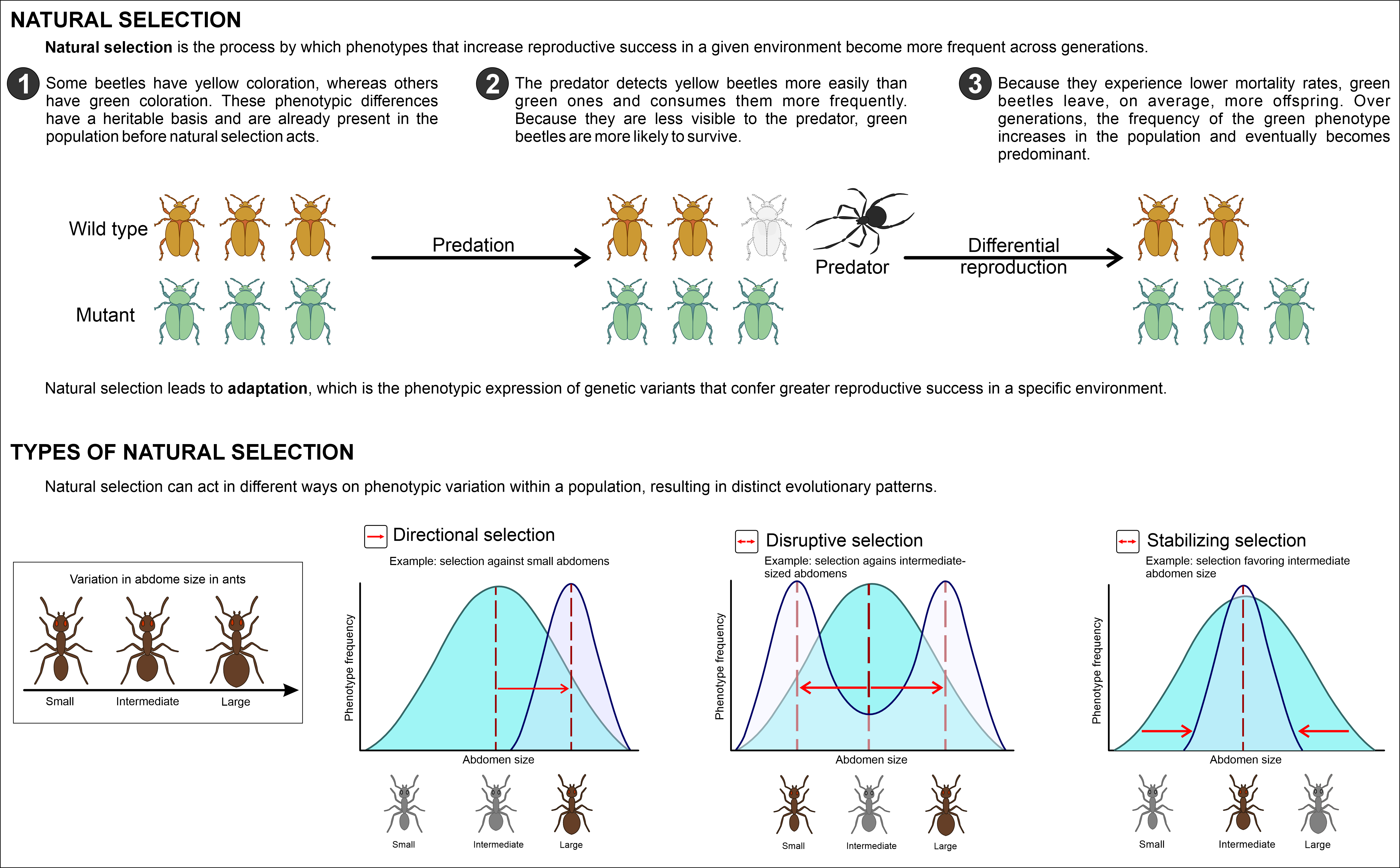
In the summary figure, the upper sequence shows selection operating through differential survival and reproduction, while the lower panels show how that same logic can generate different population-level outcomes depending on which phenotypes are favored. The figure brings together two scales of explanation: the mechanism acting on individuals and the statistical response observed in populations.
In that sense, natural selection is best understood not as a slogan about “survival of the fittest,” but as a population-level process that reshapes biological variation across generations.
Frequently asked questions
Is natural selection the same as evolution?
No. Natural selection is one of the main mechanisms of evolution, but evolution is the broader process of change in the genetic and phenotypic composition of populations over generations. Other mechanisms, such as mutation, genetic drift, and gene flow, also contribute to evolutionary change.
Does natural selection create new traits?
Not directly. New variants arise through mutation and other sources of genetic change. Natural selection does not invent useful traits because organisms need them; it changes the frequency of variants that already exist.
Does natural selection act on genes or on phenotypes?
It acts directly on phenotypes, because phenotypes are what interact with the environment. However, lasting evolutionary change depends on whether those phenotypic differences have a heritable basis.
Is survival enough for natural selection to occur?
No. Survival matters only insofar as it affects reproductive success. A trait matters evolutionarily when it changes how much an individual contributes to the next generation.
What is the difference between variation and adaptation?
Variation refers to differences among individuals within a population. Adaptation refers to a heritable trait that increases fitness in a particular environment and becomes more common through natural selection.
What is the difference between adaptation and acclimation?
Adaptation is an evolutionary outcome across generations. Acclimation is an adjustment made by an individual during its lifetime in response to environmental conditions.
What is directional selection?
It is a pattern in which one extreme phenotype is favored, causing the population mean to shift over time toward that extreme.
What is disruptive selection?
It is a pattern in which intermediate phenotypes are disfavored and both extremes are favored, often increasing phenotypic divergence within the population.
What is stabilizing selection?
It is a pattern in which intermediate phenotypes are favored and extreme phenotypes are removed more often, reducing variation around the mean.
Can natural selection occur without heritable variation?
Selection can influence which individuals survive or reproduce in a given generation, but without heritable variation it will not produce lasting evolutionary change in the trait under consideration.
Explore more in GlobalBioverse
If you are building a stronger foundation in evolution, it is worth continuing with closely related topics such as mutation, adaptation, fitness, speciation, and the difference between microevolution and macroevolution. These concepts become much easier to understand once natural selection is clearly separated from the common misconceptions that surround it.
Go to GlobalBioverseSupport this project
If this article helped you understand the topic more clearly, consider supporting this project. Your contribution helps sustain independent, rigorous, and accessible Biology education for students, educators, and curious readers.
Support GlobalBioverse Aprendendo Biologia