Quick summary: Shelford’s law of tolerance explains a basic ecological principle: species can persist only within certain environmental limits. Temperature, water availability, salinity, pH, oxygen, and other abiotic factors influence survival, growth, and reproduction, but real species distributions are not determined by a single factor alone. To understand where species live, ecology must connect tolerance ranges, biological performance, life-stage differences, and the distinction between fundamental and realized niche.
Contents
- What Shelford’s law of tolerance is
- Why abiotic factors matter in ecology
- Minimum, maximum, optimum, and zones of stress
- Survival, growth, and reproduction do not have the same tolerance range
- Broad and narrow tolerance: generalists and specialists
- Why one factor alone rarely explains real species distributions
- Tolerance range, niche, and the difference between fundamental and realized niche
- Conclusion
- Frequently asked questions
A barnacle can cling to wave-battered rock, a desert plant can persist through prolonged drought, and a freshwater fish may die in seawater. Why are living organisms so unevenly distributed across the planet?
One of the classic answers in ecology begins with tolerance. Species do not respond equally to environmental conditions. Each species has limits within which it can survive, function, grow, and reproduce. Outside those limits, its performance declines sharply, and persistence may become impossible.
This is the starting point of Shelford’s law of tolerance, a foundational ecological idea stating that both too little and too much of an environmental factor can be limiting. A species is not restricted only by scarcity. Excess can also push physiology beyond workable boundaries. Distribution, then, is not simply about whether a factor exists, but about whether it falls within a biologically tolerable range.
That classical model remains extremely useful, but it is only the beginning. Real species distributions are shaped not only by abiotic conditions, but also by dispersal, evolutionary history, and interactions with other organisms. So the most accurate ecological view is this: tolerance explains an essential part of the story, but not the whole of it.
What Shelford’s law of tolerance is
Shelford’s law of tolerance states that the success of an organism depends on whether environmental conditions remain within a range it can tolerate. For any given factor, such as temperature, salinity, or oxygen concentration, there is usually a lower limit, an upper limit, and an intermediate range in which biological performance is better.
This matters because ecology is not only about presence or absence. It is also about performance. A species may be common where conditions are close to its optimum, rare where conditions are stressful but still tolerable, and absent where conditions exceed its physiological limits.
That is why the tolerance concept is so powerful. It links environmental conditions to abundance, rather than treating habitat as a simple yes-or-no category. The question is not merely whether an organism can exist somewhere, but how well it can function there.
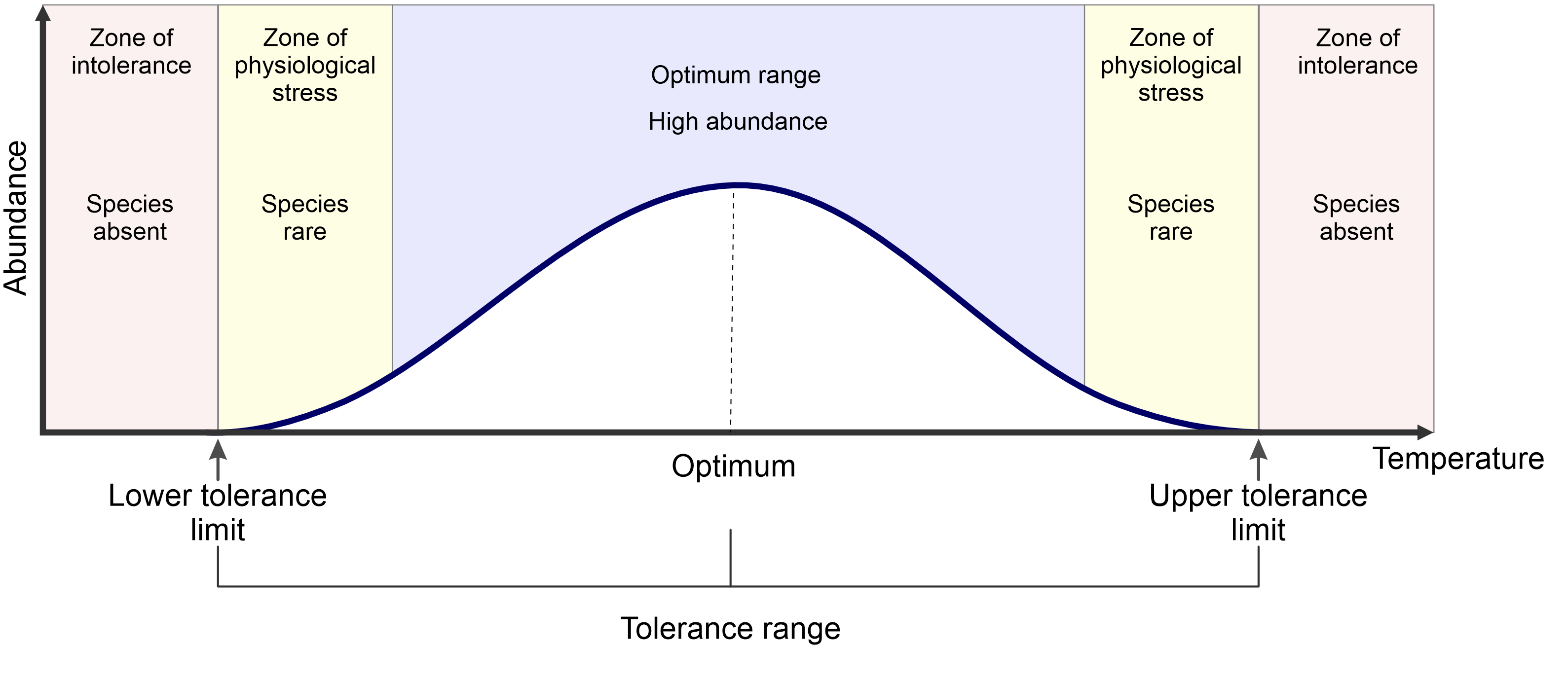
Figure 1 shows the internal structure of a tolerance range. The central region is the optimum range, where abundance is highest because conditions support strong biological performance. On either side lie the zones of physiological stress, where the species may still occur but becomes rarer. Beyond those regions are the zones of intolerance, where the species is absent because the environmental factor falls outside workable limits. The diagram is simplified, but its message is fundamental: species distributions are shaped by limits, not by preference alone.
Why abiotic factors matter in ecology
Abiotic factors are the non-living components of the environment that influence organisms and ecosystems. They include temperature, water availability, salinity, pH, oxygen concentration, and light. These variables affect metabolism, hydration, osmotic balance, enzyme activity, membrane stability, gas exchange, and development. Because physiology depends on them, ecology depends on them too.
Temperature is one of the clearest examples. It influences reaction rates, activity levels, development, and the stability of proteins and membranes. Water availability affects hydration, nutrient transport, and the maintenance of normal cellular function. Salinity shapes osmotic regulation. pH influences chemical balance and the behavior of many biological molecules. Oxygen availability affects aerobic metabolism, and light directly influences photosynthesis in producers while also altering habitat conditions for many other organisms.
No species experiences the environment as a single isolated variable. Organisms live in a world of combined physical and chemical conditions, and their ecology reflects that complexity.
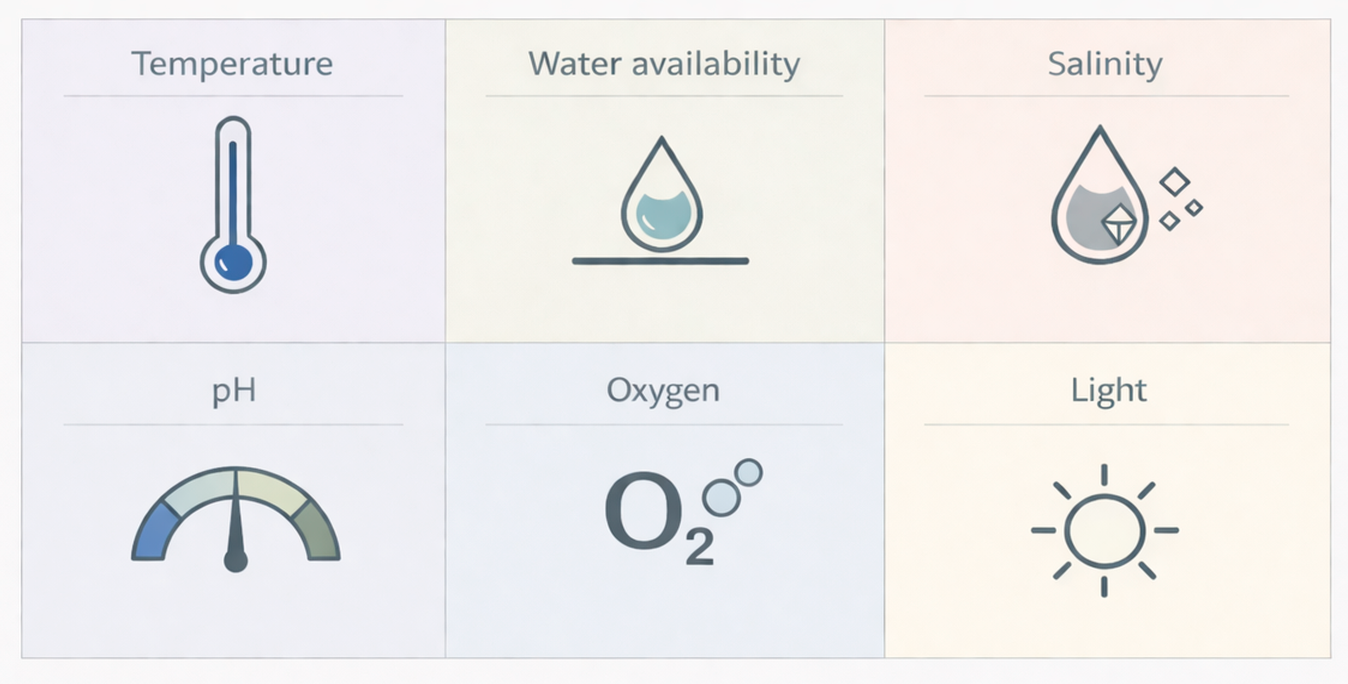
Figure 2 brings together several of the environmental variables that ecology repeatedly returns to. The important point is not that all species respond to all of them in the same way, but that every species exists within a multidimensional abiotic environment. A fish in oxygen-poor water, a halophyte in saline soil, and an intertidal invertebrate exposed to heat and desiccation are all facing abiotic constraints, but not the same ones, and not with the same degree of sensitivity.
Minimum, maximum, optimum, and zones of stress
A tolerance range is not a uniform band. It has internal structure. The lower and upper tolerance limits mark the boundaries beyond which persistence is impossible. Between them lies an intermediate region where performance is better. Between the optimum and the lethal limits are the zones of physiological stress, where organisms may survive, but only under strain.
This distinction matters because survival and high performance are not the same thing. A species may remain alive in stressful conditions and still grow more slowly, reproduce less successfully, become more susceptible to disease, or lose in competition with other species. That is why abundance often peaks not simply where the species can survive, but where its physiology works with the least strain and the greatest efficiency.
In practice, ecological limitation often appears before obvious mortality. Reduced fertility, slower growth, altered behavior, or developmental instability may emerge first. So when ecologists say that a factor is limiting, they do not mean only that it kills. They also mean that it can reduce biological performance enough to shape abundance and distribution.
Survival, growth, and reproduction do not have the same tolerance range
One of the most important refinements of the classical model is that different biological processes often have different tolerance breadths. A species may survive across a relatively broad range of conditions, but show a narrower range for growth and an even narrower one for successful reproduction.

Figure 3 illustrates this clearly. Survival may extend across a broad interval, meaning the organism can remain alive under many conditions. Growth usually requires a more favorable range, because building tissues and maintaining active metabolism demand additional physiological efficiency. Reproduction is often narrower still, since producing gametes, supporting embryos, coordinating reproductive behavior, and completing development typically depend on tighter physiological control.
A useful way to understand this is through energy allocation. Under stressful conditions, organisms tend to prioritize immediate maintenance and survival over growth, and especially over reproduction. Reproduction is not biologically trivial; it is often one of the most demanding functions an organism performs. So an environment may be good enough to keep individuals alive, but still poor enough to prevent a stable, self-sustaining population from forming.
This also helps explain why life stage matters. Eggs, larvae, juveniles, and adults often differ in tolerance. A habitat that can be occupied by adults may still be unsuitable for embryonic development or juvenile survival. In that case, the species may appear present, but the environment does not truly support full population persistence across generations.
Broad and narrow tolerance: generalists and specialists
Species differ not only in where their optimum lies, but also in how wide their tolerance range is. Some species tolerate a broad range of environmental conditions and can therefore occupy varied habitats. Others perform well only under a relatively narrow set of conditions.
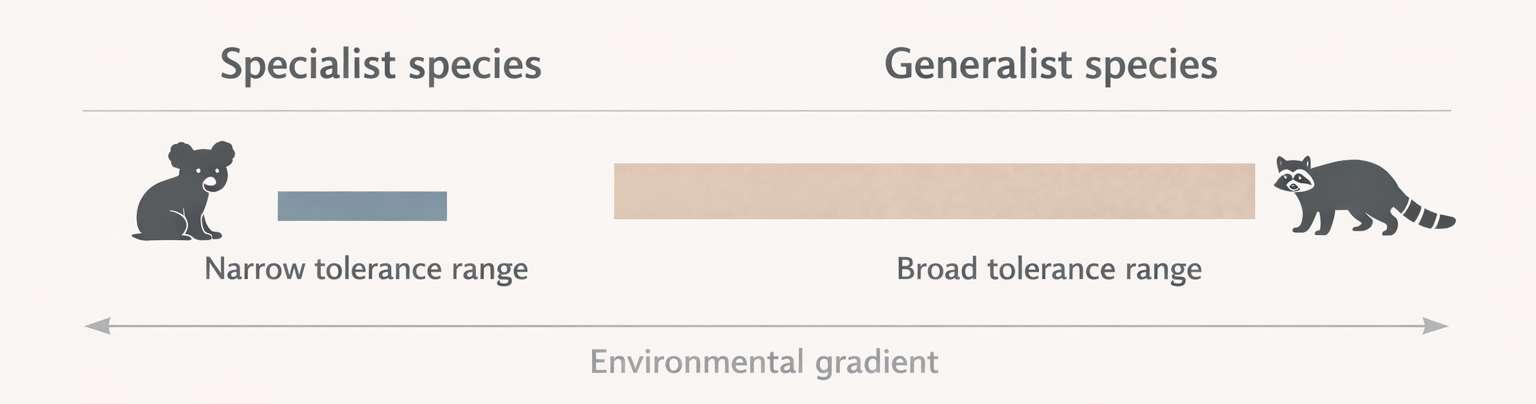
Figure 4 contrasts these broad ecological patterns. A generalist species can persist across a wider portion of an environmental gradient, which often allows it to occupy a greater variety of habitats. A specialist species is restricted to a narrower segment of that gradient. That narrower tolerance may allow high efficiency under specific conditions, but it also tends to increase vulnerability when the environment changes.
This does not mean generalists are always superior. Specialists can be extremely successful in the particular environments to which they are adapted. But their ecological success is often tied to stability. When conditions shift beyond their narrower tolerable range, their distributions may contract more sharply.
Why one factor alone rarely explains real species distributions
The classical tolerance curve is valuable because it isolates one variable and makes the logic easy to grasp. But natural environments are never one-factor systems. Organisms experience temperature together with water availability, oxygen, salinity, light, pH, substrate, disturbance, and the presence of other organisms.
That is why real species distributions cannot usually be explained by a single abiotic gradient alone. Abiotic factors remain central, especially at broad scales, but biotic interactions also matter. Competition, predation, parasitism, mutualisms, and habitat modification can all change where a species actually occurs. A location may fall within a species’ physiological tolerance and still remain unoccupied because the species cannot reach it, cannot establish there, or is excluded by other organisms.
So the modern ecological interpretation is not that Shelford’s law is outdated. It is that the law provides a foundational physiological framework, while real-world ecology adds additional layers of complexity.
Tolerance range, niche, and the difference between fundamental and realized niche
This is where the idea of niche becomes especially important. In simple terms, the fundamental niche is the full set of environmental conditions under which a species could persist in the absence of limiting biotic interactions. The realized niche is the smaller portion it actually occupies in nature, once competition, predation, and other ecological pressures are taken into account.
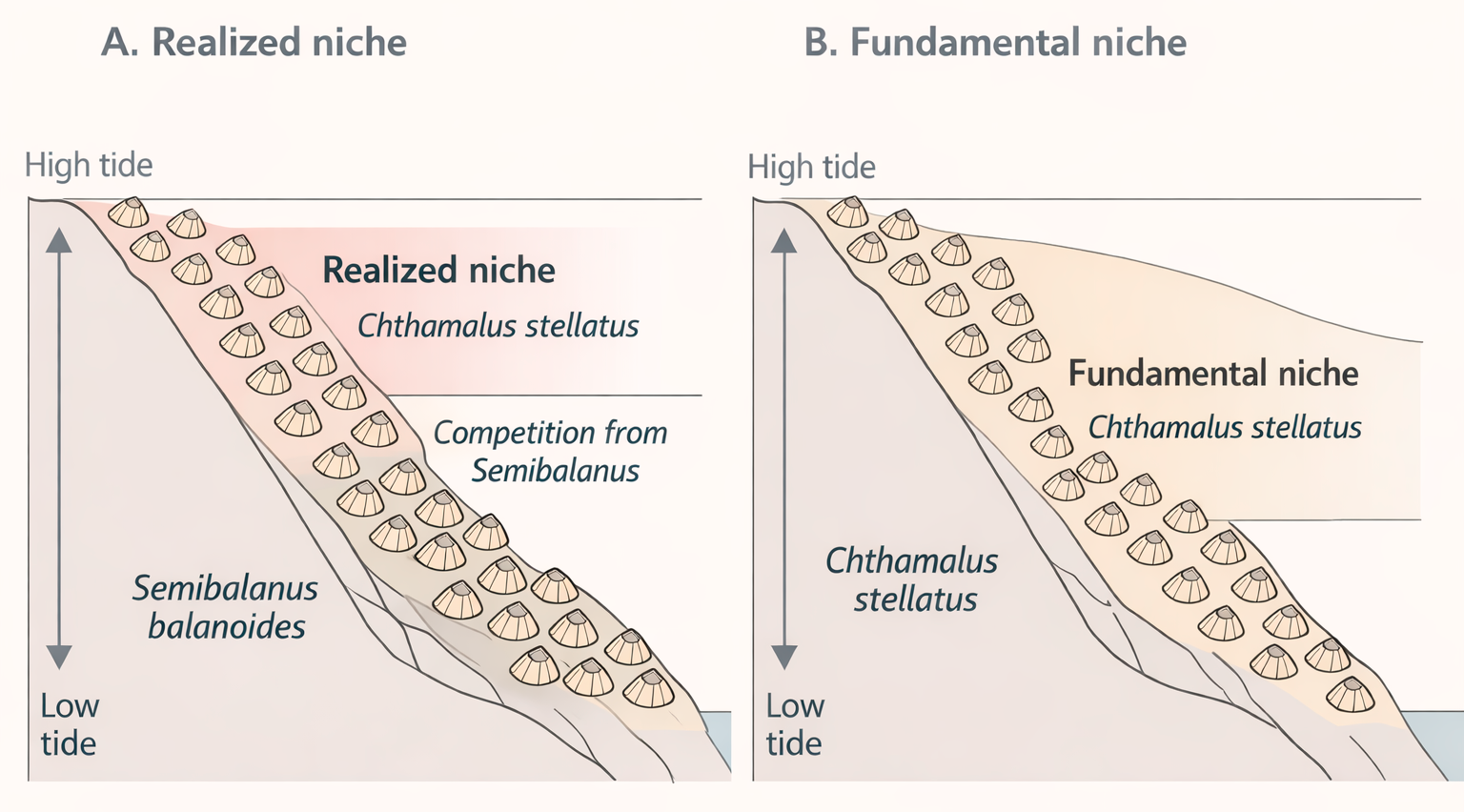
Figure 5 presents a classic intertidal example. Chthamalus stellatus can tolerate a broader vertical range on the shore than its actual field distribution first suggests. However, where Semibalanus balanoides is competitively dominant, Chthamalus is excluded from part of that potential range. As a result, its realized niche is narrower than its fundamental niche.
This example matters because it corrects one of the most common misunderstandings in introductory ecology. A tolerance range does not automatically equal actual distribution. A species may be physiologically capable of living across a wider range of conditions than the range it truly occupies in nature. Ecology, then, must connect abiotic tolerance with biotic interaction.
Conclusion
Shelford’s law of tolerance remains one of the clearest ways to begin answering a fundamental ecological question: why do species live where they do? Species persist only within certain environmental limits, and those limits help shape their abundance and distribution.
But the most accurate ecological view goes further. Survival is not the same as growth, and growth is not the same as successful reproduction. Life stages may differ in sensitivity. Broadly tolerant species often occupy wider ranges than narrowly tolerant ones. And the environments species could occupy are not always the same as the environments they actually occupy, because competition and other ecological processes can restrict them.
So the enduring value of Shelford’s law lies in what it does best: it provides a simple, powerful framework for understanding environmental limits. Modern ecology builds on that framework by showing how physiology, performance, niche, and ecological interaction come together to shape the living world.
Frequently asked questions
Is Shelford’s law the same as Liebig’s law of the minimum?
No. Liebig’s law emphasizes limitation by the scarcest essential factor relative to need. Shelford’s law emphasizes that both deficiency and excess can be limiting. The two ideas are related, but they are not identical.
Does a tolerance range mean a species performs equally well everywhere within it?
No. Conditions near the optimum usually support better performance than conditions near the limits. A species may survive across much of its tolerance range while remaining rare or physiologically stressed in large portions of it.
Can a species survive outside its optimum range?
Yes. That is exactly what the zones of physiological stress represent. The species may still occur there, but usually with lower abundance and reduced growth or reproduction.
Why are some species widespread while others are restricted?
Part of the answer lies in tolerance breadth. Broadly tolerant species often occupy a wider range of conditions, whereas narrowly tolerant species tend to be more restricted. But dispersal, evolutionary history, and interactions with other organisms also matter.
Is the realized niche always smaller than the fundamental niche?
In practice, yes. The realized niche is the portion of the fundamental niche that remains after ecological interactions and other real-world constraints are taken into account.
Do all life stages have the same tolerance?
Often no. Eggs, larvae, juveniles, and adults can differ substantially in sensitivity to environmental factors. That is why a habitat may allow adult presence without supporting long-term population persistence.
Are abiotic factors more important than biotic interactions?
Both are important. Abiotic conditions strongly influence whether a species can persist at all, while biotic interactions often help determine where that species actually occurs within that broader physiological possibility.
Explore more in GlobalBioverse
Visit the GlobalBioverse hub to explore more English-language Biology content for deeper understanding.
Go to GlobalBioverseSupport this project
If this article helped you understand the topic more clearly, consider supporting this project. Your contribution helps sustain independent, rigorous, and accessible Biology education for students, educators, and curious readers.
Support GlobalBioverse Aprendendo Biologia