Quick summary: A species may be able to survive under more conditions than the ones it actually occupies in nature. The fundamental niche is that broader set of conditions under which the species could persist in principle, whereas the realized niche is the smaller portion it actually occupies in the real world. The difference between them helps explain why physiological tolerance alone does not fully determine species distribution: competition, predation, disease, mutualistic dependence, dispersal limits, and ecological history also matter.
Contents
- What an ecological niche is
- What the fundamental niche is
- What the realized niche is
- Why the realized niche is usually smaller
- Competition, predation, and other biotic interactions
- The classic barnacle example
- Niche, habitat, and tolerance range are not the same thing
- Why this distinction matters in ecology
- Related reads
- Frequently asked questions
If a species can survive in a given environment, why is it not always found there?
That question takes us one step beyond Shelford’s law of tolerance. Tolerance helps us understand the environmental limits within which a species can survive. But ecological reality is more demanding than simple survival. A species may tolerate a certain temperature, salinity, moisture level, or oxygen concentration and still fail to establish, maintain a population, or persist in that place. To understand why, ecology must distinguish between what is possible in principle and what actually happens in nature.
This is where the contrast between fundamental niche and realized niche becomes so useful. It helps us separate four ideas that are often confused: niche, tolerance range, habitat, and distribution. Once those are clearly distinguished, a basic ecological puzzle becomes much easier to understand: species do not occupy all the environments they could physiologically tolerate.
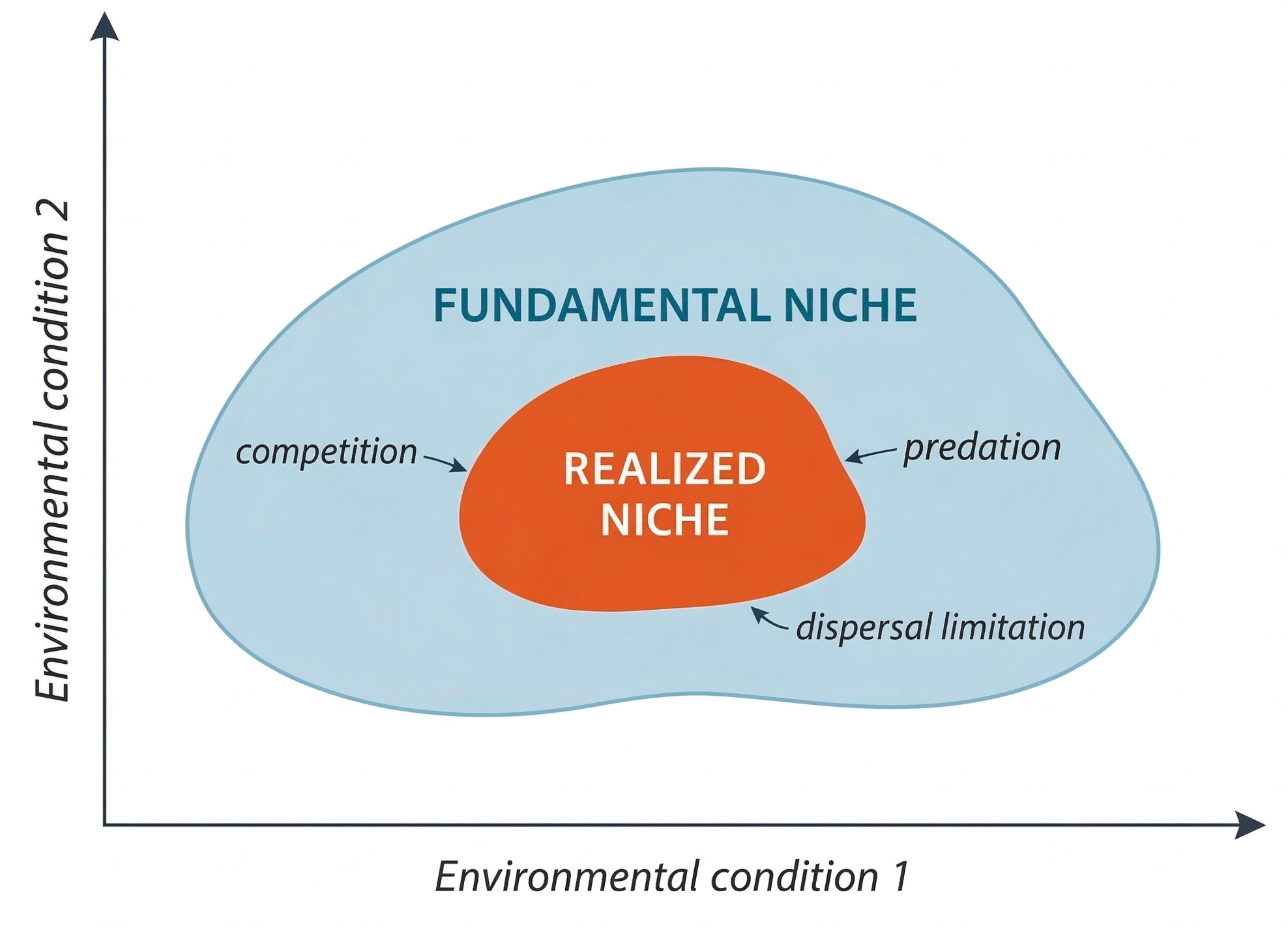
Figure 1 introduces the central relationship of the article. The fundamental niche is the broader space of ecological possibility, whereas the realized niche is the narrower space actually occupied in nature once constraints such as competition, predation, and dispersal limitation enter the picture.
What an ecological niche is
An ecological niche is not simply the place where a species lives. It is the broader set of environmental conditions, resources, constraints, and interactions that shape whether that species can survive, grow, and reproduce.
Abiotic and biotic dimensions
In that sense, the niche includes both abiotic dimensions, such as temperature, moisture, salinity, pH, oxygen availability, and light, and biotic dimensions, such as competitors, predators, parasites, prey, hosts, and mutualists. A niche is therefore not just a location on a map. It is a structured ecological context.
Why niche is not just “role”
People often say that a niche is a species’ “role,” and that idea is not entirely wrong, but it is incomplete. For the present discussion, the most useful way to think about niche is as the set of conditions and ecological requirements under which a species can maintain viable populations. That is why niche should not be reduced to “where a species lives,” and it should not be reduced to “what a species does” either. It is broader than both.
What the fundamental niche is
The fundamental niche is the full set of environmental conditions under which a species could survive, grow, and reproduce in the absence of sufficiently strong biotic restrictions, such as exclusion by competitors or intense enemy pressure. It is a statement about ecological possibility.
This niche depends heavily on the species’ physiology, performance, and requirements. In practical terms, tolerance ranges help define the environmental side of the fundamental niche. If a species can persist only within certain limits of temperature, moisture, oxygen, salinity, or other abiotic variables, those limits help define where persistence is possible. But the niche is still broader than a simple tolerance curve, because multiple factors operate together rather than one at a time.
This idea connects closely with animal thermoregulation, because physiological performance always depends on environmental conditions acting within functional limits rather than in isolation.
What the realized niche is
The realized niche is the portion of the fundamental niche that a species actually occupies in nature, once real-world constraints are taken into account. It is the niche expressed under the conditions of actual communities, actual barriers, and actual ecological history.
Why the realized niche is usually smaller
A simple way to keep the distinction clear is this: the fundamental niche is about ecological possibility, whereas the realized niche is about ecological reality. In many cases, the realized niche is narrower because other organisms and historical factors prevent the species from occupying all the conditions it could otherwise tolerate. That means the realized niche is not merely a conceptual subset. It is an observable ecological outcome.
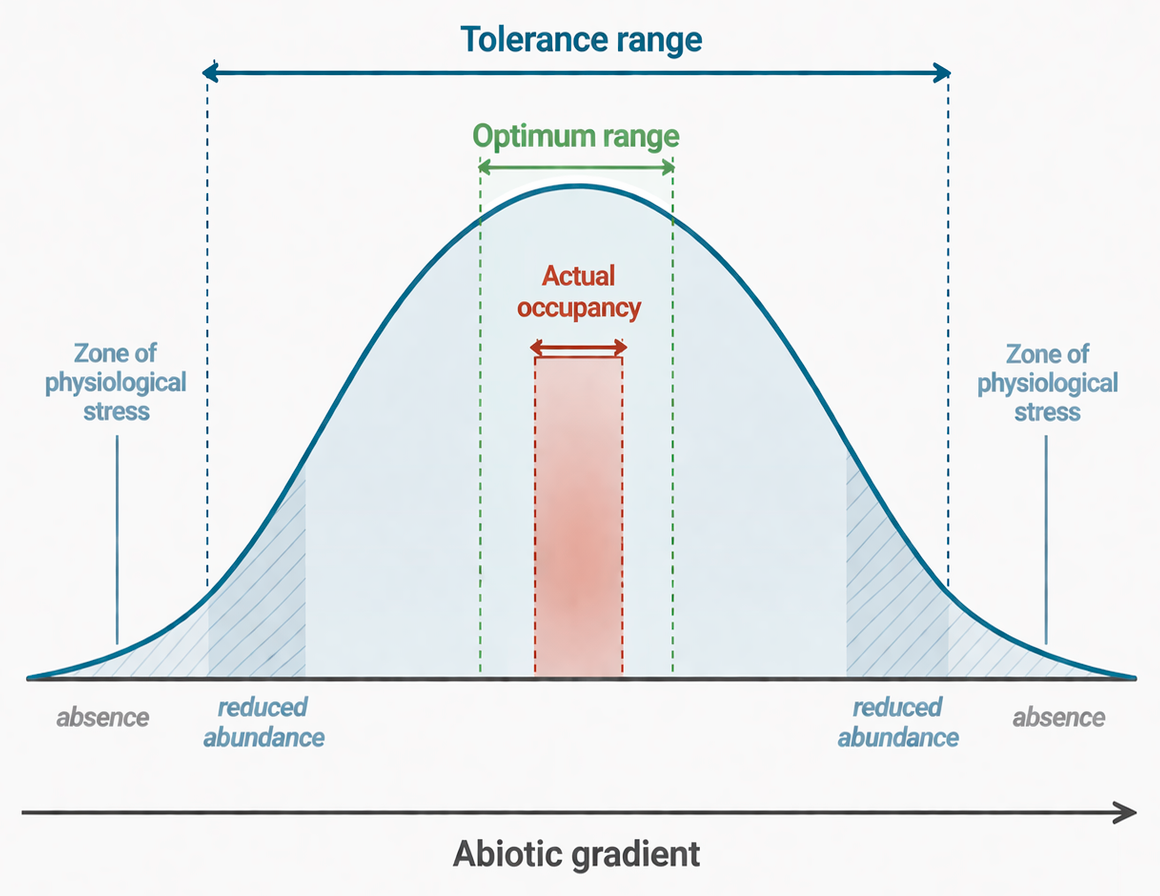
Figure 3 helps connect this article back to tolerance theory. A species may persist across a broad abiotic range and still occupy only a narrower portion of that range in nature. Tolerance is therefore not the same as occupation, and that distinction is one of the keys to understanding why realized niches are often smaller than fundamental niches.
Competition, predation, and other biotic interactions
Because survival alone is not the whole ecological story, species may fail to persist in a place even when abiotic conditions are suitable. Competition is the classic reason the realized niche becomes smaller than the fundamental niche: another species may be more efficient at acquiring space, food, light, nutrients, or some other limiting resource. Predation can also keep a species out of otherwise tolerable environments, showing that the fundamental–realized distinction is not a competition-only story. Parasites and pathogens may further shrink realized niches when disease pressure reduces survival or reproduction below sustainable levels. In other cases, persistence depends on the presence of mutualists such as pollinators, mycorrhizal fungi, nitrogen-fixing bacteria, or seed dispersers. Dispersal limitation and historical contingency also matter, because suitable conditions do not guarantee presence if colonization never happened or if community assembly followed a different path.
These ecological pressures are also part of the broader framework through which natural selection acts on populations over time, because variation in persistence and reproductive success depends on the interaction between organisms and their environments.
The classic barnacle example
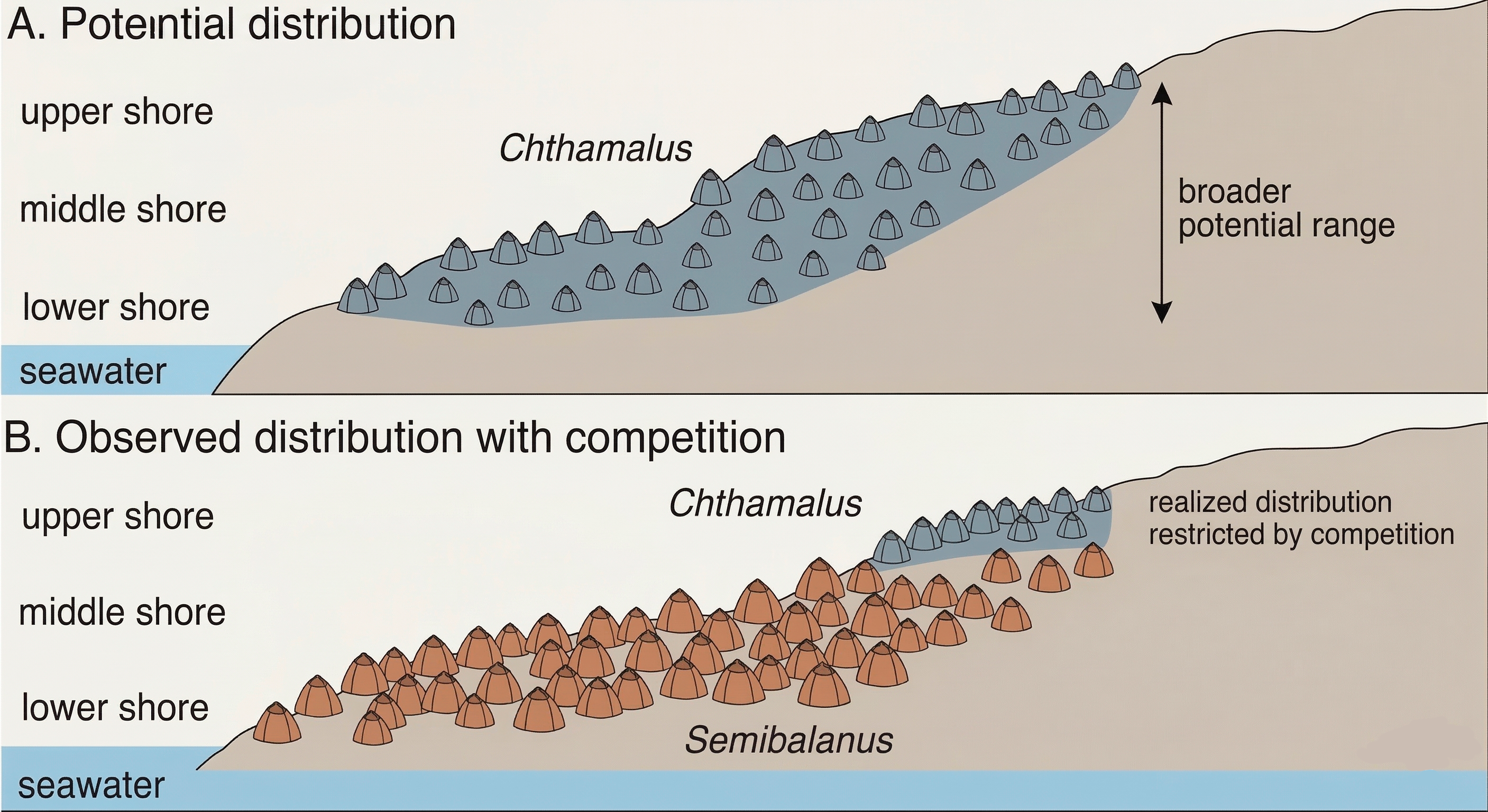
One of the most famous demonstrations of the difference between fundamental niche and realized niche comes from rocky intertidal barnacles. In the classic ecological example involving Chthamalus and Semibalanus (historically also discussed as Balanus in older literature), the upper-shore barnacle Chthamalus can tolerate a broader vertical range on the shore than its observed field distribution first suggests. But where the stronger competitor occupies the lower and middle intertidal, Chthamalus becomes restricted mainly to the upper zone.
That makes the lesson very clear. The fundamental niche of Chthamalus is broader than the strip where it is commonly seen. Its realized niche is narrower because competition compresses its actual distribution. The observed pattern on the shore is therefore not a direct map of maximum physiological tolerance. It is the outcome of tolerance plus competition.
This example matters because it corrects a very common misunderstanding: the place where a species is found is not necessarily the full range of conditions it could tolerate. Distribution is shaped not only by physiology, but also by ecological interactions.
Niche, habitat, and tolerance range are not the same thing
This distinction matters because these terms are constantly mixed up.
Niche vs habitat
A habitat is the place or type of environment where an organism lives. A niche is broader: it includes the conditions, resources, and ecological interactions associated with persistence. Habitat is about location; niche is about the ecological framework that makes persistence possible or impossible.
Niche vs tolerance range
A tolerance range refers to the span of values of a particular factor, such as temperature or salinity, that a species can endure. A niche integrates many factors at once and also incorporates interactions with other species. Tolerance helps define the abiotic side of the fundamental niche, but it is not the niche by itself.
Niche vs distribution
A species’ distribution is where it is found. Its niche is part of the explanation for why it is found there and absent elsewhere. Distribution is the pattern we observe; niche is one of the conceptual tools used to explain that pattern.
Why this distinction matters in ecology
The difference between fundamental niche and realized niche is not just a vocabulary exercise. It is central to understanding why species occur where they do, why competitive exclusion happens, why invasions succeed or fail, and why species distribution models must be interpreted carefully. If we know only what a species can tolerate physiologically, we still do not know whether it will actually occupy all suitable-looking environments. This distinction also matters for conservation. Protecting places that seem physically suitable may not be enough if key mutualists are missing, if predators or competitors change the outcome, or if dispersal barriers prevent colonization. In ecology, “could live there” and “does live there” are not the same statement.
The key lesson is simple: knowing what a species can tolerate is necessary, but not sufficient. Ecology must also ask what prevents that species from occupying all of its potential space. That is exactly where the distinction between fundamental niche and realized niche becomes indispensable.
Related reads
To extend the same line of reasoning across related topics, continue with these posts:
Shelford’s Law of Tolerance: how abiotic factors shape where species live
Understand how abiotic limits help define where species can persist and why physiological tolerance matters in ecology.
Animal thermoregulation: understanding ectothermy, endothermy, and homeothermy
See how environmental conditions interact with physiology and performance, shaping the limits within which organisms function.
Natural selection: how variation, differential reproduction, and adaptation are connected
Explore how ecological pressures can influence survival and reproduction, helping explain why populations change over time.
Frequently asked questions
Is the realized niche always smaller than the fundamental niche?
In ecological practice, the realized niche is typically equal to or smaller than the fundamental niche; it does not exceed it. The core idea is that realized occupancy reflects additional real-world constraints acting on ecological potential.
Is niche the same as habitat?
No. Habitat is the place or environment where a species lives, whereas niche is the broader set of conditions, resources, and interactions associated with its persistence.
Does the fundamental niche describe where a species actually lives?
No. It describes where the species could persist in principle if major restricting biotic interactions were absent.
Why can a species be absent from a suitable environment?
Because suitable abiotic conditions are only part of the story. Competition, predation, disease, missing mutualists, dispersal barriers, and historical contingency can all prevent occupation.
Is the realized niche determined only by competition?
No. Competition is the classic explanation, but predation, parasitism, disease, mutualistic dependence, and dispersal limitation also matter.
How is this related to Shelford’s law of tolerance?
Shelford’s law helps define the abiotic limits within which a species can survive, which contributes to the environmental side of the fundamental niche. But tolerance alone does not explain the species’ full real-world distribution.
Why does this matter for conservation?
Because conserving only physically suitable areas may fail if species interactions, ecological dependencies, or access to those areas are ignored. Effective conservation has to consider both environmental suitability and ecological context.
Explore more in GlobalBioverse
Visit the GlobalBioverse hub to explore more English-language Biology content.
Go to GlobalBioverseSupport independent science education
If this article helped you understand the topic more clearly, consider supporting this project. Your contribution helps sustain independent, rigorous, and accessible Biology education for students, educators, and curious readers.
Support this project Aprendendo Biologia