Quick summary: Habitat and ecological niche are closely connected, but they do not mean the same thing. Habitat refers to the place or type of environment where a species lives. Ecological niche is broader: it includes the environmental conditions, resources, constraints, and interactions that shape whether that species can survive, grow, and reproduce there. Keeping that distinction clear helps explain why two species may occur in the same habitat without occupying the same ecological position, and why location alone is never enough to explain distribution.
Contents
- What habitat means
- What an ecological niche means
- Niche and habitat are not interchangeable
- Why the distinction matters for species distribution
- Niche, tolerance range, and distribution are different ideas
- The same habitat can contain different niches
- Why this distinction matters in ecology
- Frequently asked questions
- Related reads
A forest, a pond, a coral reef, a mangrove, a patch of soil, a rocky shore. Ecology often begins with places. That is one reason habitat is such a familiar and intuitively accessible term. It points to the environmental setting in which organisms are found, and it gives us a first way to describe where species live. But ecological understanding cannot stop at location alone.
Two species may occur in the same forest and still differ profoundly in the conditions they tolerate, the resources they use, the organisms they interact with, and the way they persist through time. The same is true on a rocky shore, in a freshwater lake, or within a single host organism. A shared setting does not automatically mean a shared ecological position. Place matters, but it does not capture the full biological logic behind persistence, coexistence, and distribution.
That is where the distinction between habitat and ecological niche becomes important. These terms are closely related, but they are not interchangeable. Habitat refers to the place or type of environment where a species lives. Ecological niche is broader. It includes the environmental conditions, resources, constraints, and interactions that shape whether a species can survive, grow, and reproduce there. Once that distinction is lost, ecological explanations become flatter than they should be. Distribution starts to look like a simple matter of location, when in reality it reflects a much richer interplay between organisms and their environments.
This difference also helps clarify why ecology cannot be reduced to maps of occurrence. A species may be present in a habitat and still occupy only part of the ecological space that might seem available. Another species may occur in the same habitat while relying on different resources, tolerating different ranges of stress, or responding differently to competitors, predators, parasites, or mutualists. In that sense, habitat tells us something important about where organisms are, but niche helps explain why they are there, why they may fail elsewhere, and why another species in the same setting may still live under a different ecological pattern.
Understanding that contrast strengthens much more than vocabulary. It improves the way we think about species distribution, tolerance, coexistence, specialization, competition, and the relationship between physical setting and ecological persistence. The distinction becomes even clearer when habitat and niche are placed side by side in a structured way, because the visual comparison makes explicit what the terms themselves often leave blurred in ordinary usage.
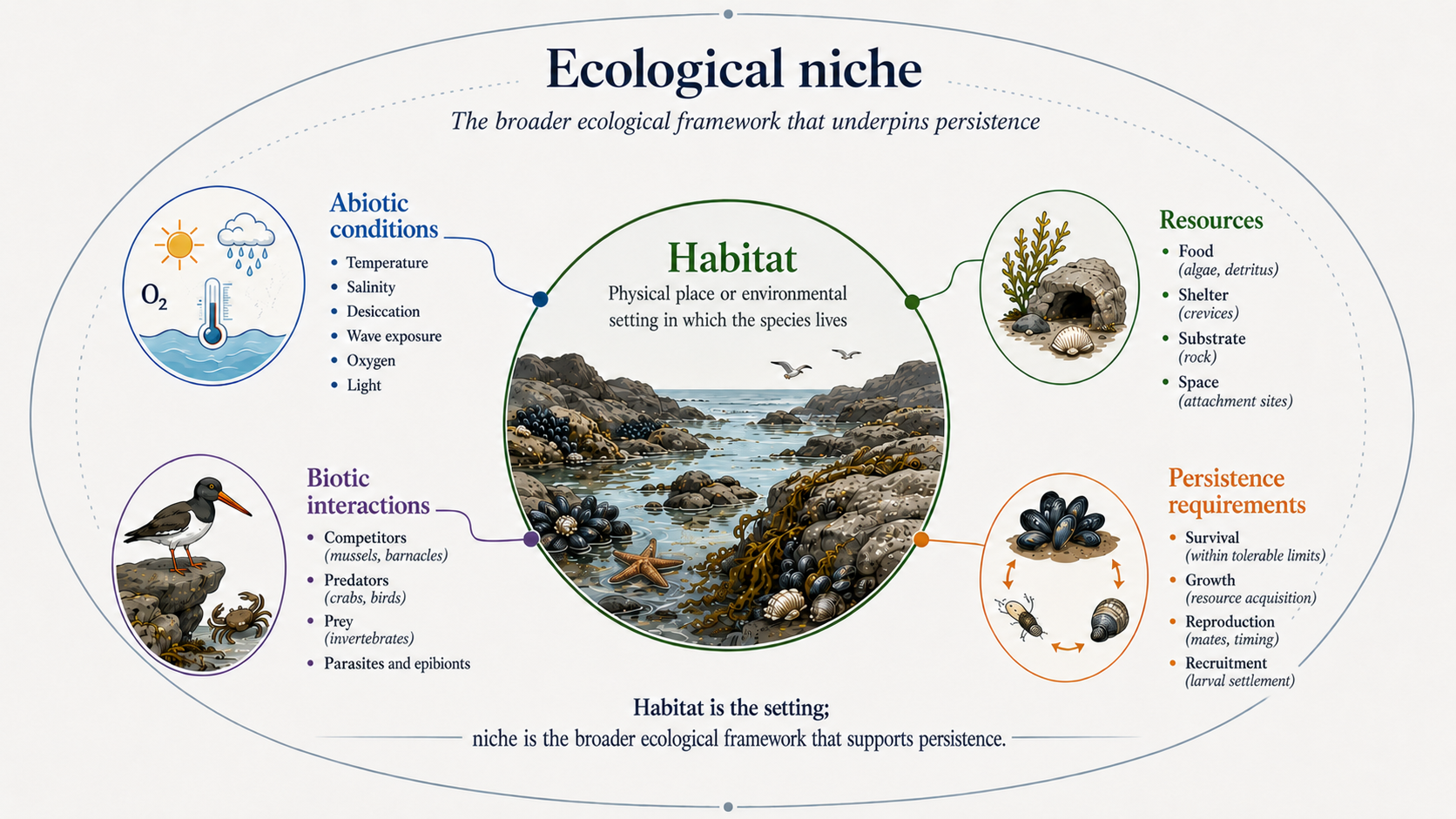
The distinction becomes easier to hold once the two concepts are placed side by side. Habitat refers to the environmental setting itself. Ecological niche is broader: it includes the abiotic conditions, resources, biotic interactions, and persistence-related requirements that shape whether a species can actually maintain a population in that setting. That contrast is the conceptual backbone of the discussion that follows.
Figure 1 helps fix that distinction early. The central rocky shore represents habitat as the physical setting in which life occurs. Around it, the broader niche framework expands beyond place alone. Abiotic conditions help define workable limits, resources determine what can be used, biotic interactions alter outcomes, and persistence requirements determine whether survival, growth, and reproduction can be maintained over time. Habitat, in other words, is part of the explanation, but it is not the whole explanation.
What habitat means
A habitat is the place or type of environment in which an organism lives. In ecology, the term refers first to the environmental setting where a species occurs: a freshwater pond, a mangrove, a coral reef, a seagrass meadow, a tropical forest, a rocky intertidal shore, a desert, a patch of sediment, or even the body of another organism when the species depends on a host. Across all of these cases, the central idea remains stable. Habitat identifies the physical or environmental setting in which life takes place.
That is part of what makes the concept so familiar. Habitat is often one of the first ecological terms people learn, and for good reason. It is relatively easy to picture. A habitat can be described in terms of substrate, salinity, moisture, water availability, temperature regime, vegetation structure, depth, light exposure, or other broad environmental features. When we say that a species lives in wetlands, estuaries, alpine meadows, coral reefs, or temperate forests, we are usually speaking in habitat terms. The focus falls on the kind of environment where the organism is found.
That descriptive value matters. Habitat gives ecology an important spatial starting point. It allows us to identify the environmental backdrop against which organisms live and to describe, in broad terms, the setting associated with a species. In many contexts, that is already useful. Habitat can help organize field observations, compare environments, and frame basic questions about environmental suitability.
Even so, habitat does not provide a complete ecological explanation. Knowing that a species lives in a forest, pond, reef, or marsh does not by itself tell us which resources it uses, which abiotic limits constrain it, how it responds to competitors or predators, or why it persists in one portion of that environment but not in another. Two species may share the same habitat and still differ profoundly in diet, timing of activity, microhabitat use, tolerance to stress, reproductive requirements, and ecological interactions. The setting may be the same, but the biological terms of persistence may be very different.
For that reason, habitat should be understood as an important but limited concept. It identifies the setting in which life takes place, but it does not by itself capture the wider ecological structure that Figure 1 places around that setting. That broader explanatory task belongs to the concept of niche.
What an ecological niche means
An ecological niche is broader than habitat. If habitat identifies the kind of environment in which a species lives, niche refers to the fuller ecological framework under which that species can persist. It includes the conditions the species can tolerate, the resources it requires, the constraints it faces, and the interactions that shape whether survival, growth, and reproduction are actually possible. That broader scope is what gives the concept its explanatory power, and also what makes it so frequently misunderstood.
Part of the niche is abiotic. Temperature, water availability, salinity, oxygen concentration, pH, light, substrate, and other physical or chemical variables influence whether a species can function in a given setting. These factors help define the environmental side of persistence. A species is not simply present or absent in relation to them. Its physiology, performance, and limits are all tied to how those variables fall within or outside biologically workable ranges.
Part of the niche is also biotic. Competitors, predators, parasites, pathogens, prey, hosts, mutualists, and symbionts all help determine whether a species can maintain viable populations. A place may appear physically suitable and still fail to support persistence because the ecological relationships within that setting alter the outcome. In that sense, niche does not describe an organism in isolation from the living world around it. It describes persistence under real ecological conditions, where success depends not only on abiotic tolerance, but also on interaction.
That is why niche should not be reduced to a place. It should also not be flattened into a simple formula such as “the role of a species in the ecosystem.” That familiar expression captures part of the idea, but only part. It points toward ecological function, yet it does not fully express the fact that a niche also involves limits, requirements, dependencies, and relationships that shape whether a species can exist in a given context at all.
The concept becomes clearer when understood in this more complete way. A niche is not merely where a species is found, and it is not merely what it does. It is the broader ecological configuration within which persistence becomes possible. Once that is clear, many other ideas in ecology begin to fall into place more naturally, including tolerance, coexistence, competition, specialization, and the difference between potential and actual distribution.
That broader structure is exactly what Figure 1 was designed to clarify. Once abiotic conditions, resources, biotic interactions, and persistence requirements are placed around the environmental setting itself, niche becomes much harder to confuse with habitat. The concept stops looking like a synonym for place and begins to recover its full ecological meaning.
Niche and habitat are not interchangeable
The difference can be stated plainly. Habitat refers to the place or type of environment where a species lives. Ecological niche refers to the broader set of conditions, resources, constraints, and interactions under which that species can persist. The two ideas are related, but they do not operate at the same explanatory level.
A habitat can be shared. A niche is more specific.
Two species may occur in the same habitat and still occupy different niches because they differ in diet, timing of activity, microhabitat use, tolerance to abiotic stress, susceptibility to predators or pathogens, reproductive requirements, or dependence on other organisms. The environmental setting may be the same, yet the ecological terms of persistence may differ substantially. Shared place does not imply shared ecological position.
That is why the two terms should not be used as synonyms. When niche is reduced to just another word for habitat, an important layer of ecological explanation disappears. Ecology becomes a description of where organisms are found, rather than an analysis of why they can persist there, why they may fail elsewhere, and why different species in the same setting do not necessarily live under the same ecological logic.
The distinction matters because habitat tells us where a species occurs, whereas niche helps explain the broader ecological structure associated with that occurrence. One identifies the setting. The other helps clarify the conditions that make persistence possible within it.
Why the distinction matters for species distribution
Species distribution is not explained by place alone. It is explained by the relationship between organisms and the ecological conditions under which they can persist. That is why the difference between habitat and niche is more than a terminological refinement. It changes the way distribution itself is interpreted.
Once habitat is separated clearly from niche, a common ecological misunderstanding begins to dissolve. A location may appear suitable in broad physical terms and still fail to support a species. The problem, in such cases, is not necessarily that the habitat is “wrong” in any simple descriptive sense. The problem is that the broader ecological requirements of persistence are not fully met. A species may be absent because abiotic conditions fall outside workable limits, because key resources are missing, because interactions with other organisms change the outcome, or because the broader ecological context does not support stable population maintenance.
This is also why distribution cannot be read as a direct map of environmental appearance. Two places may look similar and still differ in the conditions that matter biologically. Conversely, a species may be able to tolerate a wider range of conditions in principle than the narrower range it actually occupies in nature. That is where the connection to Shelford’s law of tolerance becomes especially useful. Tolerance helps define the abiotic limits within which a species can survive, but distribution depends on more than abiotic tolerance alone.
This is also why distribution should never be read as a simple visual summary of habitat. As Figure 3 makes clear, distribution belongs to a different explanatory level. It is the observed pattern. Habitat is the setting, tolerance helps define limits, and niche provides the broader ecological framework under which persistence becomes possible or fails.
The same logic also clarifies why the distinction between fundamental niche and realized niche is so informative. A species may be capable of persisting under a broader set of conditions than the narrower set it actually occupies once competition, predation, disease, mutualistic dependence, dispersal limitation, and ecological history enter the picture. Distribution, then, is not simply the visible footprint of where a species could live. It is the ecological outcome of what that species can tolerate, what it requires, and what the living world around it allows.
At that point, the value of the distinction becomes unmistakable. Habitat tells us where a species lives. Niche helps explain why it lives there, why it may fail elsewhere, and why another species in the same setting may still persist under a different ecological structure. Without that distinction, ecology risks becoming a description of places. With it, ecology becomes an explanation of persistence, coexistence, and distribution.
Niche, tolerance range, and distribution are different ideas
Another common source of confusion appears when ecological niche is treated as if it were the same thing as tolerance range or distribution. The three ideas are related, but they operate at different levels of explanation and should not be merged.
The confusion becomes easier to dissolve when the concepts are arranged at their proper explanatory scale. Habitat refers to the setting. Tolerance range refers to the limits of performance along one abiotic factor. Ecological niche refers to the broader framework that integrates multiple ecological dimensions. Distribution refers to the pattern we actually observe in nature. Once those levels are separated, the relationships among them become much easier to interpret.
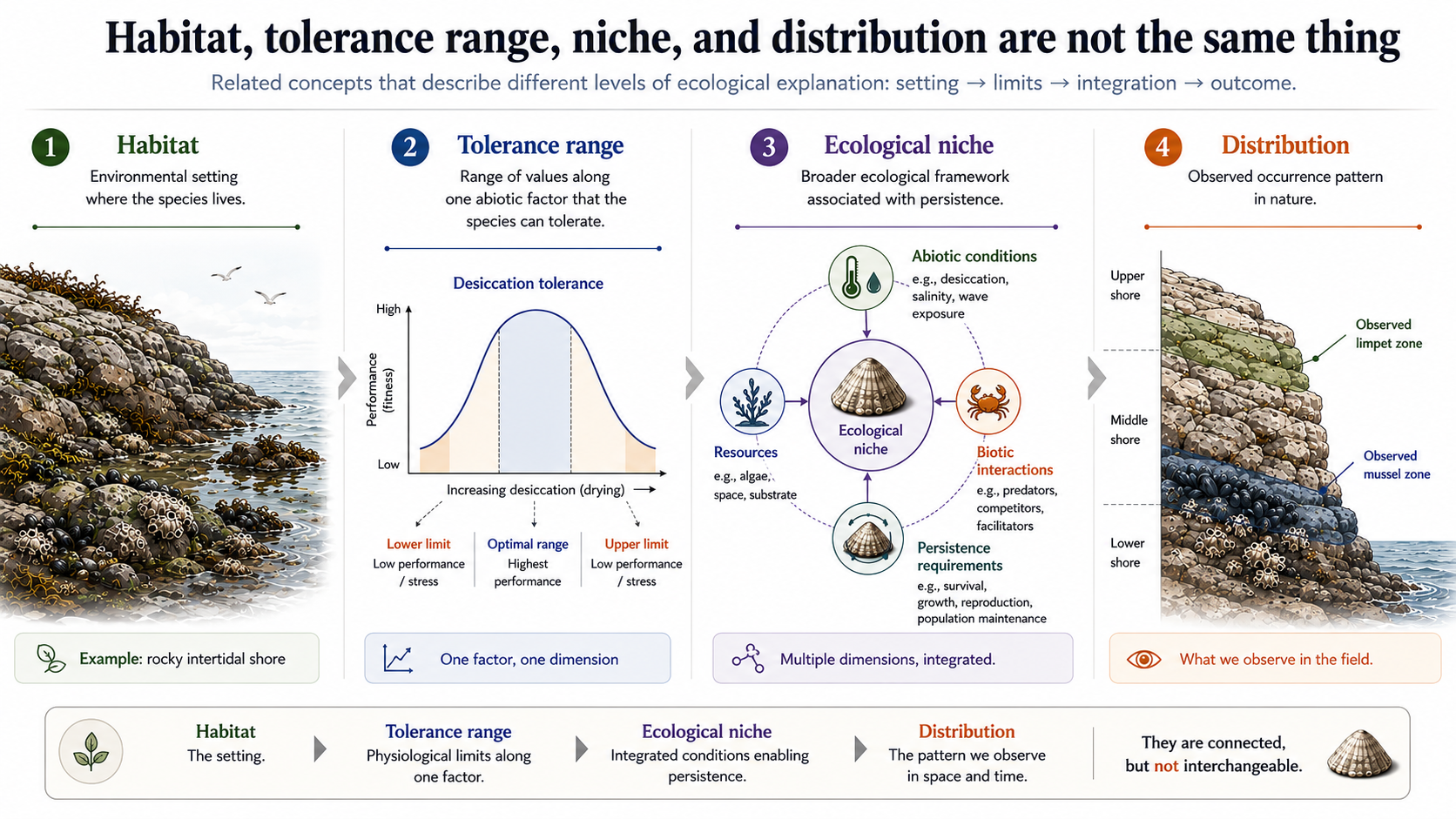
Figure 3 is useful precisely because it prevents these ideas from collapsing into one another. Habitat appears as the environmental setting. Tolerance range narrows the focus to one dimension of physiological possibility, here represented along a desiccation gradient. Ecological niche broadens the explanation again by integrating abiotic conditions, resources, biotic interactions, and persistence requirements. Distribution comes last, as the observed pattern in the field. That final pattern matters, but it is not self-explanatory. It is the outcome, not the whole framework behind the outcome.
Seen in that sequence, an important ecological point becomes harder to miss. A species may occur in a habitat without occupying all of it. It may tolerate more conditions than the narrower set in which it is actually found. And its observed distribution may reflect not only physiological limits, but also resource dependence, competition, predation, facilitation, and other ecological relationships. Distribution is what we map. Niche is part of what helps explain why the map takes that form.
A tolerance range refers to the span of values of a particular abiotic factor that a species can endure. A species may tolerate a certain range of temperature, salinity, oxygen concentration, moisture, or pH. That information is ecologically important because it helps define the environmental limits within which persistence is possible. Even so, a tolerance range usually concerns one factor at a time. It tells us something about physiological limits, but not the full ecological structure associated with persistence.
An ecological niche is broader. It does not refer to a single abiotic gradient, but to the larger set of conditions, resources, constraints, and interactions under which a species can survive, grow, and reproduce. The niche includes multiple abiotic dimensions at once and also incorporates biotic relationships such as competition, predation, parasitism, mutualism, and dependence on hosts or prey. For that reason, niche cannot be reduced to one tolerance curve along one environmental axis. It is a wider ecological framework.
Distribution is different again. Distribution is the observed pattern of where a species occurs. It is what ecologists map, record, and compare across landscapes, regions, or habitats. In that sense, distribution is not the same as niche, but one of the outcomes that niche helps explain. A map of occurrence shows where a species is found. It does not, by itself, reveal the full set of conditions and interactions that make that pattern possible.
This distinction matters because otherwise ecological reasoning becomes compressed into a single, misleading idea. The tolerance of a species to one abiotic factor, the broader niche associated with persistence, and the observed pattern of occurrence all begin to blur together. Once that happens, important questions become harder to think about clearly. Why is a species absent from an apparently suitable place? Why do two species with overlapping habitats still differ in distribution? Why can a species tolerate more conditions in principle than the narrower set it occupies in nature? Those questions require the concepts to remain distinct.
The conceptual payoff is straightforward. Tolerance range helps describe limits along a given abiotic dimension. Niche helps explain the broader ecological framework of persistence. Distribution is the observable pattern that results from that framework interacting with real environments. Keeping those ideas separate makes ecological interpretation more precise and much more informative.
The same habitat can contain different niches
A rocky shore makes the distinction especially clear. Limpets and mussels may occur on the same intertidal habitat and still not occupy the same niche. They do not use the setting in the same way, and they are not limited by the same ecological conditions.
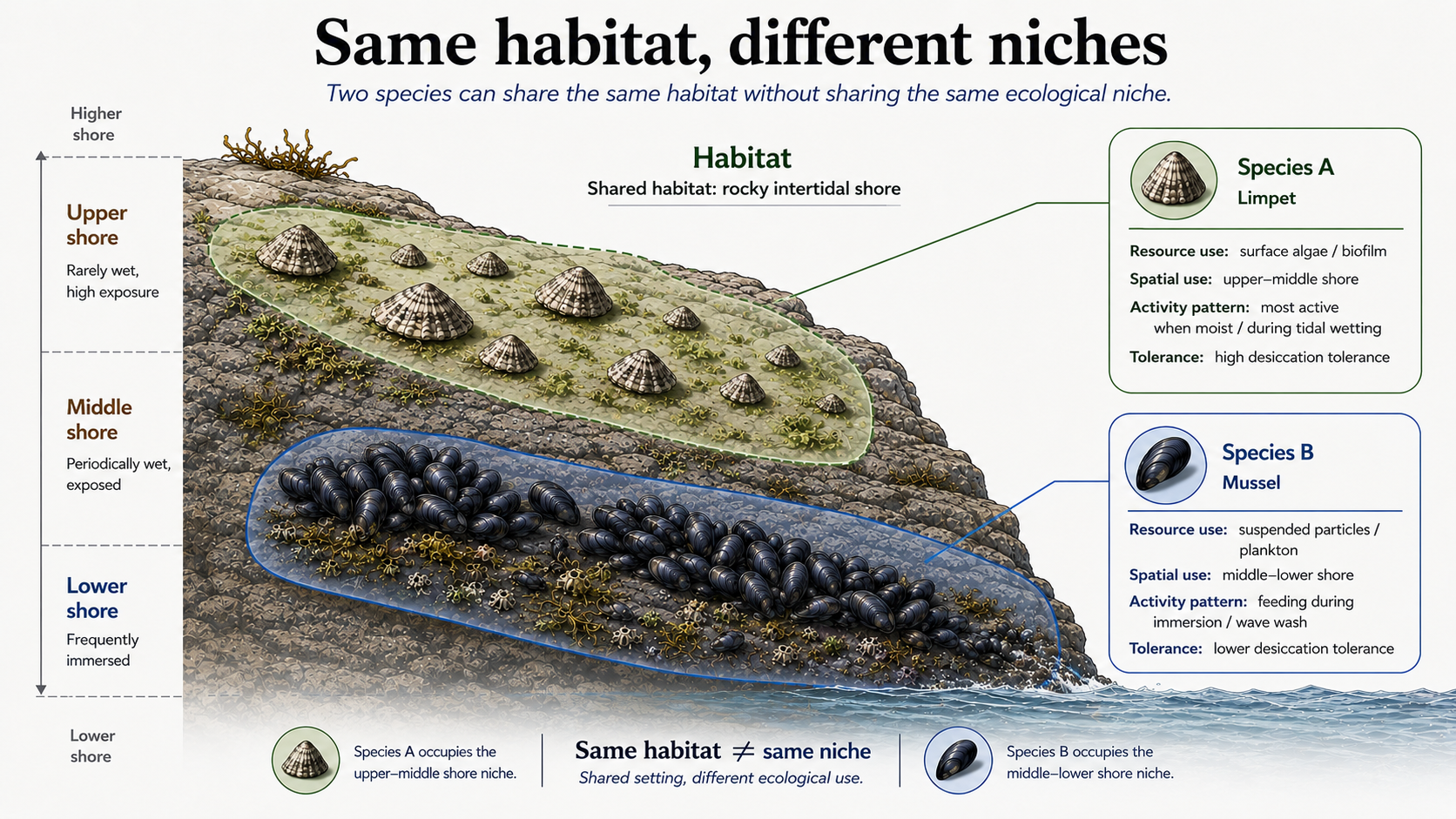
Figure 2 shows why the difference matters. The habitat is shared: both species occur on the same rocky intertidal shore. But the ecological pattern is not the same. Limpets are associated more strongly with the upper–middle shore, where grazing on surface algae and biofilm is possible under conditions of greater exposure and stronger desiccation stress. Mussels occupy the middle–lower shore, where feeding depends more on suspended particles carried by immersion and wave wash, and where desiccation pressure is lower. The setting is one. The niche structure is not.
That is the key point. Habitat identifies the environmental backdrop. Niche helps explain how each species uses that backdrop, which conditions matter most to it, and why two organisms in the same general place may still persist under different ecological terms. Once that difference is visible, shared habitat no longer looks like evidence of ecological equivalence.
The same logic appears across many ecosystems. In forests, two bird species may occur in the same habitat while differing in foraging height, food choice, timing of activity, predator exposure, or reproductive conditions. In lakes, two fish may share the same body of water while differing in depth use, prey choice, or oxygen tolerance. In plant communities, species rooted in the same soil may still differ in shade tolerance, pollination dependence, nutrient strategy, or vulnerability to herbivores. Shared habitat does not erase ecological differentiation.
That is why habitat alone is often too coarse as an explanatory tool. It identifies the setting, but it does not capture the finer ecological structure that makes coexistence, exclusion, specialization, or differential distribution intelligible. To understand why species that seem to live in the same place are not necessarily doing the same ecological work, and are not limited in the same way, the concept of niche becomes indispensable.
Why this distinction matters in ecology
The distinction between habitat and niche is not merely definitional. It changes how ecological questions are framed and how ecological explanations are judged. Once the two terms are separated clearly, many patterns that would otherwise seem simple or even puzzling begin to make better sense.
It matters for coexistence because species can share the same habitat without sharing the same niche. It matters for competition because overlap in ecological requirements can shape whether species persist together, exclude one another, or partition resources in ways that reduce direct conflict. It matters for conservation because protecting a physically suitable environment is not always enough if the broader ecological requirements of persistence are missing. A place may look appropriate in habitat terms and still fail to support a species if key resources, mutualists, or interaction conditions are absent. It matters for invasion biology because an introduced species may encounter habitats that appear suitable while entering communities that alter establishment, spread, or persistence. It also matters for species distribution models, since maps based only on broad environmental variables may miss ecological restrictions that become visible only when niche is considered more fully.
The distinction also improves how ecological explanations are read. If a species is said to be absent because it “lacks habitat,” the statement may be descriptively convenient and still remain conceptually weak. In some cases, the physical setting may indeed be unsuitable. In others, the setting may be present while the broader niche conditions are not. The difference is not verbal decoration. It affects the depth and accuracy of the explanation.
That is why the contrast between habitat and niche has such wide value in ecology. Habitat identifies the environmental setting where a species lives. Niche helps explain the broader ecological structure under which persistence becomes possible there. Once that difference is understood, many other ideas become easier to organize with precision, including tolerance, competition, coexistence, specialization, distribution, and the contrast between fundamental and realized niche.
In that sense, the distinction does more than clarify two terms. It sharpens ecological reasoning itself.
Frequently asked questions
Is ecological niche the same as habitat?
No. A habitat is the place or type of environment where a species lives. An ecological niche is broader. It includes the conditions, resources, constraints, and interactions associated with persistence. Habitat identifies the setting, whereas niche helps explain the fuller ecological framework under which a species can survive, grow, and reproduce there.
Can two species share the same habitat but have different niches?
Yes. That is a common ecological situation. Two species may occur in the same environment while using different resources, tolerating different ranges of stress, occupying different microhabitats, or interacting differently with predators, competitors, parasites, or mutualists. Shared habitat does not mean identical ecological requirements.
Is niche just the role a species plays in the ecosystem?
Not exactly. The idea of “role” points to part of the concept, but it is not sufficient on its own. A niche includes not only ecological function, but also the broader set of abiotic and biotic conditions under which a species can persist. It is therefore wider than function alone.
How is niche related to tolerance range?
A tolerance range refers to the span of values of a particular abiotic factor that a species can endure, such as temperature, salinity, or oxygen concentration. A niche is broader because it integrates many abiotic dimensions at once and also incorporates biotic interactions. A tolerance range helps define part of the niche, but it is not the niche by itself.
How is niche related to species distribution?
Distribution is the observed pattern of where a species occurs. Niche helps explain that pattern by identifying the broader ecological framework associated with persistence. In other words, distribution is what we observe in nature, whereas niche is part of the explanation for why that pattern takes the form that it does.
Why does this distinction matter in conservation?
Because protecting a place that looks physically suitable may still fail to support a species if the necessary ecological conditions are missing. Resources, mutualists, interaction structure, and the broader conditions required for persistence all matter. Conservation depends on more than habitat appearance alone.
How does this connect to fundamental niche and realized niche?
The connection becomes much clearer once niche is separated from habitat. The fundamental niche refers to the broader set of conditions under which a species could persist in principle, whereas the realized niche is the smaller portion it actually occupies in nature. That contrast is much easier to understand when niche is treated as a broader ecological framework rather than as a synonym for place.
Related reads
- Shelford’s Law of Tolerance: how abiotic factors shape where species live
- Fundamental niche vs realized niche: why species do not occupy all the environments they could tolerate
- Animal thermoregulation: understanding ectothermy, endothermy, and homeothermy
- Natural selection: how variation, differential reproduction, and adaptation are connected
Explore more in GlobalBioverse
Visit the GlobalBioverse hub to explore more English-language Biology content.
Go to GlobalBioverseSupport this project
If this article helped you understand Biology more clearly, you can support the project through Buy Me a Coffee. Every contribution helps sustain independent educational content built on clarity, depth, and respect for knowledge.
Support GlobalBioverse Aprendendo Biologia